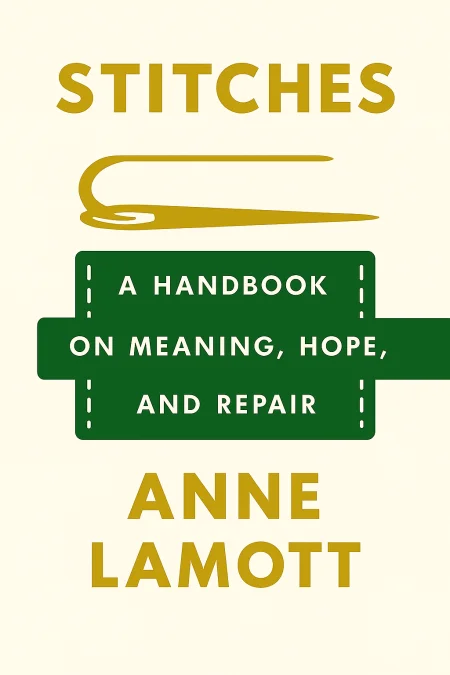
Stitches
A Handbook on Meaning, Hope and Repair
Book Edition Details
Summary
In the tapestry of life's chaos, Anne Lamott's "Stitches" offers a thread of profound insight. When the world feels like it's unraveling, Lamott gently guides us toward solace and understanding through her signature blend of humor and wisdom. This poignant follow-up to "Help, Thanks, Wow" dives into the heart of human resilience, exploring how we mend our spirits after personal and collective upheaval. Lamott invites readers to embrace their brokenness, weaving strength and connection from the fabric of their experiences. As we stitch together the pieces of our shattered selves, we discover a patchwork of meaning and community, vibrant with warmth and humanity. "Stitches" is a tender reminder that healing is an art, best crafted with patience and love.
Introduction
In the landscape of contemporary American literature, few voices resonate with as much raw honesty and spiritual authenticity as Anne Lamott's. A writer who has spent decades excavating meaning from the messiness of human existence, Lamott emerged from the counterculture of Northern California to become one of America's most beloved spiritual memoirists. Her journey reads like a modern pilgrimage through addiction, single motherhood, faith, and the relentless pursuit of truth in an often chaotic world. What sets Lamott apart is her extraordinary ability to find profound meaning in ordinary moments, to discover grace in imperfection, and to weave coherent narratives from life's seemingly random threads. Through her unflinching examination of personal struggles and spiritual awakening, readers encounter a master storyteller who transforms vulnerability into wisdom. Her work reveals how an overly sensitive child can evolve into a beacon of hope for others navigating their own dark nights of the soul, how sobriety can become a pathway to deeper creativity and connection, and how faith—messy, questioning, and beautifully imperfect—can serve as both anchor and compass in turbulent times.
From Sensitive Child to Awakened Writer
Anne Lamott's childhood was marked by an almost painful awareness of the world's suffering that others seemed to navigate with ease. Growing up in the 1950s and 1960s, she found herself perpetually diagnosed as "the overly sensitive child," a label that felt more like condemnation than understanding. While her peers could watch Disney movies without distress, young Anne would be devastated by the inevitable maternal sacrifice that seemed to punctuate every animated tale. She couldn't visit dog pounds because of the animals left behind, couldn't ignore the unhappiness radiating from adults who insisted everything was fine. This hypersensitivity extended to her family's carefully maintained facade of civility. In a household where no one ever raised their voices during a troubled twenty-seven-year marriage, emotions were expressed through "clipped phrases of erudite contempt." Her parents and their friends created what she later described as an "Advent calendar" existence, where opening any door might reveal people passed out or inappropriate behavior, all explained away with the casual dismissal that they had "all just been drinking." For a child already attuned to subtleties and undercurrents, this environment of denial and minimization was both confusing and crazy-making. The salvation came through books and the women's movement that burst forth when she was fifteen. Literature provided the "divine plop" of settling deeply into worlds greater than her troubled mind, while feminism gave her permission to name what she had always seen but been told wasn't real. These twin discoveries—that truth existed in stories and that her perceptions were valid—would become the foundation of her eventual calling as a writer. The very sensitivity that had made childhood so difficult would prove to be her greatest asset, allowing her to see and articulate experiences that others might overlook or minimize. Her path to writing wasn't linear or easy. Like many children raised around alcoholism, she had learned to "help everyone in the world" while neglecting her own needs, armed with what she imagined was "a clipboard by the age of six" to keep track of her caseload of people to fix. Breaking free from this pattern required learning entirely new skills: trusting her perceptions, expressing anger and grief, and eventually, taking her turn as "a radical act."
Finding Sobriety and Community
July 1986 marked the watershed moment when Lamott put down the drink that had been both companion and captor for the first thirty-two years of her life. This decision to get sober, along with having a child a few years later, represented what she called "the two most extreme decisions of my life." The people who guided her through early sobriety were far from the polished professionals one might expect—they were fellow travelers who "had not been housebroken for long" and weren't always practicing good dental hygiene, but they possessed something infinitely more valuable than credentials: hard-won wisdom about how to live. These unlikely mentors taught her revolutionary concepts that flew in the face of everything she'd learned growing up in an achievement-oriented family. They introduced her to the radical notion that she wouldn't always get her way, that this was actually good for her even though it would feel terrible, and that maturity meant learning to live with unresolved problems. Most shocking of all, they taught her that it was not only acceptable but necessary to ask for help, lots of help, from the network of people who seemed to have been mysteriously assigned to her path. The community that surrounded her in sobriety operated like a system of "emergency tents," providing practical support and spiritual sustenance without judgment. One friend became her spiritual mentor, answering every tough parenting and theological question with patience and wisdom. Another friend, Neshama, possessed the invaluable skill of sewing, repeatedly letting out Lamott's pants and repairing the inevitable damage that comes with living fully in the world. These relationships taught her that being of service to others—becoming "an ally to the lonely and suffering, a big-girl helper to underdogs"—was her best shot at happiness. Perhaps most importantly, her sober community taught her to pay attention without becoming enslaved to her "tiny princess mind." They helped her discover that Oregon juncos, those ordinary gray birds weighing only an ounce, could fill her with hope simply through the act of mindful observation. This attention to small wonders, combined with the support of people who understood the daily work of staying sober, created the foundation for a life of meaning that didn't depend on external achievements or the approval of others.
Teaching Faith Through Imperfect Grace
Lamott's spiritual journey defies easy categorization, emerging not from childhood indoctrination but from a desperate adult need for something larger than her own chaotic mind. Her faith is decidedly unpolished, more likely to express itself through Sunday school projects made with coffee filters than through theological dissertations. When she describes God, she's careful to distinguish her understanding from "an old man in the sky who loves the occasional goat sacrifice," instead embracing Jane Kenyon's vision of divinity as present in prisoners' meals, patient gardening, and working hinges. Her approach to teaching faith, particularly to the developmentally disabled teenagers in her Sunday school class, embodies this earthbound spirituality. When faced with the horror of the Sandy Hook shooting, she didn't offer platitudes about God's plan but instead acknowledged the nightmare while gently holding space for both reality and hope. Her students, given the choice between discussing tragedy and making art, choose art one hundred percent of the time—a preference that speaks to humanity's instinct toward creation even in the face of destruction. The coffee filter angels they crafted together became a perfect metaphor for her theology: homemade, slightly imperfect, but undeniably beautiful and meaningful. When one student, Mason, a brain cancer survivor, proclaimed himself a miracle while raising his arms like a muscleman, Lamott witnessed the kind of resurrection she believes in—not dramatic interventions but the simple, astonishing fact of continued existence and joy despite everything. Her understanding of faith embraces what she calls "patch patch patch"—the daily work of threading needles, making knots, and finding one place in torn cloth where a stitch will hold. This practical spirituality acknowledges that "the secret of life" isn't found in grand gestures or perfect understanding but in the persistent, loving work of repair and restoration. Like the sparrow lying in the street with legs pointed skyward, trying to hold up the falling sky, her faith insists that "one does what one can," even when the gesture seems absurdly small in the face of enormous need.
Weaving Meaning from Life's Broken Pieces
The central metaphor of Lamott's approach to meaning-making reveals itself in her understanding of quilting and stitching. When life hands us what seems like incompatible pieces—"brown Hawaiian print, say, along with orange Rob Roy tartan and three squares of vomitous sea-foam upholstery"—the temptation is to despair at the grotesque mismatch. But Lamott has discovered that the secret lies not in finding perfect pieces but in using the same color thread to unify disparate elements, creating unexpected beauty from apparent chaos. This philosophy was tested profoundly through her friendship with Pammy, who died of cancer at thirty-seven, leaving behind an eighteen-month-old daughter. For years after Pammy's death, Lamott clung to her friend's white linen blouse from Talbots, wearing it like a talisman, unable to throw away this last tangible connection. The shirt, with its elegant simplicity and pearl buttons, had become what she called their "slutty surplice," a holy garment that made her feel both beautiful and brave. The eventual releasing of this shirt in the muddy waters of the Mekong River in Laos represented a profound understanding about grief and memory. Rather than "getting over" loss, Lamott learned that we carry our beloveds forward through integration rather than preservation. The fabric of memory doesn't need to be physically held to remain meaningful; like mica glinting in rock, the essential truth of love persists even after the material reminders have dissolved. Her friend Neshama's transformation of two damaged curtain tops into one functional, beautiful window covering exemplifies this philosophy in action. What emerged was "fabulous and crazy," a "wild lake of designs" that looked "like a tumbling trick instead of a delicate Madonna in repose." The lumps and seams weren't flaws to be hidden but evidence of the loving work of restoration, proof that "beauty is a miracle of things going together imperfectly." This understanding extends to communities as well, whether it's the town that chose to keep the four teenagers who accidentally started a devastating fire "inside the pale" of protection and belonging, or the network of friends who supported a woman through her husband's dementia and death.
Summary
Anne Lamott's life and work demonstrate that meaning emerges not from perfection or achievement but from the courageous willingness to remain present to both beauty and brokenness, stitching them together with threads of love, community, and stubborn hope. Her journey from overly sensitive child to celebrated author and spiritual teacher proves that our greatest vulnerabilities often become our most powerful gifts when transformed through honest self-examination and genuine connection with others. From her struggles with addiction and single motherhood to her unvarnished exploration of faith and grief, Lamott shows us that the search for meaning is itself the meaning, found in paying attention to small wonders, accepting imperfection as a form of grace, and understanding that we are all ultimately engaged in the sacred work of walking each other home. Her life offers two essential practices for anyone seeking deeper purpose: the radical act of taking your turn instead of always giving it away, and the patient work of making one stitch at a time, trusting that enough small acts of love and attention can hold together even the most damaged and disparate pieces of existence into something unexpectedly beautiful and whole.
Related Books
Download PDF & EPUB
To save this Black List summary for later, download the free PDF and EPUB. You can print it out, or read offline at your convenience.
By Anne Lamott
