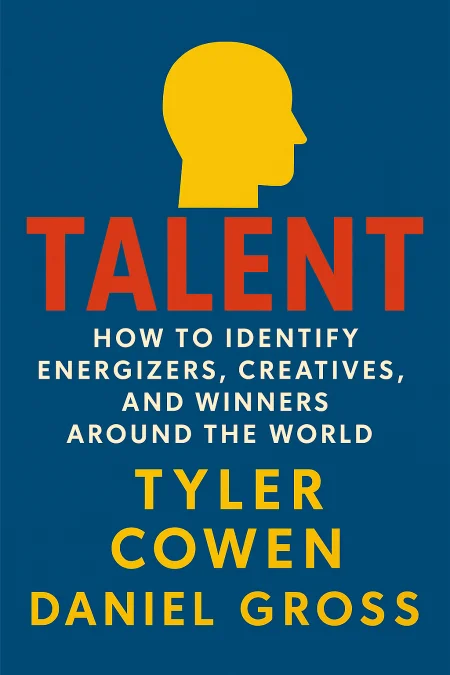
Talent
How to Identify Energizers, Creatives, and Winners Around the World
Book Edition Details
Summary
Unveiling the intricate dance between instinct and analysis, "Talent" by Tyler Cowen and Daniel Gross is a riveting exploration into the elusive art of talent discovery. Brimming with insights from two of the most inquisitive minds in economics and entrepreneurship, this book reframes our understanding of genius. How do we pinpoint the spark that can ignite an entire organization? Cowen and Gross unravel this enigma, offering a masterclass in spotting the often-overlooked brilliance in unconventional places. From virtual interviews to gender biases and the untapped potential of diverse abilities, they blend scientific rigor with intuitive wisdom, charting a course for both talent hunters and the undiscovered themselves. Here, every page is a testament to the transformative power of recognizing and nurturing the extraordinary.
Introduction
In an era where capital is abundant but exceptional talent remains scarce, the ability to identify and nurture human potential has become the ultimate competitive advantage. Traditional hiring methods, bureaucratic processes, and credential-based selection systems often fail to capture the essence of transformative talent. This creates a profound opportunity for those who can develop superior talent identification skills. The authors present a comprehensive framework that treats talent spotting as both an art and a science, requiring deep understanding of intelligence patterns, personality dynamics, and human potential. Their approach moves beyond conventional wisdom to explore how truly exceptional individuals think, behave, and create value. The central questions this framework addresses include: How do we recognize creative spark in its earliest forms? What personality traits predict long-term success versus immediate competence? How can we overcome systematic biases that cause us to overlook diverse talent pools? The framework provides structured methods for conducting revelatory interviews, understanding the relationship between intelligence and creativity, and building networks that attract exceptional individuals.
The Art and Science of Talent Spotting
Talent identification operates at the intersection of systematic methodology and intuitive judgment, requiring both analytical rigor and pattern recognition skills that develop through extensive practice. Like art appreciation or wine tasting, talent spotting improves with deliberate exposure to excellence and careful study of what distinguishes exceptional performers from merely competent ones. The scientific dimension involves understanding research on cognitive abilities, personality traits, and performance predictors, while recognizing the limitations and context-dependencies of such research. Intelligence tests, personality assessments, and behavioral indicators provide useful starting points, but they cannot capture the multiplicative effects that occur when various talents combine in unique ways. The art dimension requires developing sophisticated pattern recognition abilities, learning to spot potential that others miss, and understanding how different types of excellence manifest across contexts. Consider how legendary talent scout John Hammond discovered Bob Dylan, Bruce Springsteen, and Aretha Franklin by recognizing something indefinable that transcended technical skill or conventional appeal. Hammond combined deep musical knowledge with an intuitive sense of authenticity and star quality that couldn't be reduced to formulas. Similarly, venture capitalist Peter Thiel's success in backing Mark Zuckerberg and Elon Musk stems from his ability to apply philosophical and moral frameworks to assess whether founders possess the conviction and vision necessary for world-changing ventures. These examples illustrate how the most successful talent spotters develop unique synthesized approaches that combine systematic analysis with highly developed intuitive capabilities.
Intelligence, Personality, and Performance Predictors
Intelligence matters most for inventors, leaders managing complex systems, and individuals operating at the very top of achievement distributions, but its predictive power varies dramatically across contexts and career stages. Research reveals that while intelligence strongly correlates with becoming an inventor, it explains only small percentages of variation in most other professional outcomes, with personality and situational factors often proving more decisive. The relationship between intelligence and success follows a complex pattern where extremely high performance requires multiple factors working in combination rather than intelligence alone. This multiplicative model explains why brilliant individuals sometimes fail while those with more modest test scores achieve extraordinary results through superior work habits, emotional intelligence, or strategic thinking. Intelligence also matters more when talent pools are relatively unexplored, such as with young people or individuals from underrepresented backgrounds, since fewer competing factors have been optimized. Personality traits like conscientiousness, openness, and emotional stability provide more reliable predictors of day-to-day performance, but their importance varies significantly by role and organizational level. A cashier benefits most from conscientiousness and agreeableness, while a startup founder might need high openness combined with strategic disagreeableness to challenge conventional wisdom. The key insight is that successful talent identification requires matching personality profiles to specific contextual demands rather than applying universal standards. Understanding when intelligence trumps personality and vice versa enables more nuanced talent decisions that account for both individual capabilities and situational requirements.
Overcoming Bias in Talent Evaluation
Systematic biases in talent evaluation create both obstacles and opportunities, as those who learn to recognize and counteract these biases gain access to overlooked talent pools while competitors remain constrained by conventional thinking. Gender bias manifests through confidence gaps, communication style differences, and varying expectations for assertiveness, causing many talented women to be undervalued despite equal or superior capabilities. Racial and cultural biases operate through unfamiliarity with different communication styles, risk-averse behaviors in cross-cultural situations, and assumptions about cultural fit that mask underlying potential. International candidates and individuals from different socioeconomic backgrounds often present themselves more formally or cautiously during interviews, making their true capabilities harder to assess. These presentation differences reflect strategic adaptation to unfamiliar evaluation contexts rather than limitations in ability or motivation. The most effective approach to bias reduction involves developing cultural competency through diverse experiences, creating evaluation processes that account for different communication styles, and actively seeking talent in overlooked communities. Rather than trying to eliminate all biases, successful talent spotters learn to recognize when their judgments might be influenced by surface-level factors and develop compensating mechanisms. This might include adjusting interview styles for different cultural backgrounds, looking more carefully for confidence in women candidates, or using multiple evaluators with different perspectives to gain more complete pictures of candidate potential.
Building Networks and Raising Aspirations
Exceptional talent identification ultimately depends more on access to strong candidate pools than on superior evaluation techniques, making network development and talent attraction the highest-leverage activities for long-term success. The most successful talent spotters invest heavily in building communities, platforms, and reputation systems that naturally attract ambitious individuals seeking growth opportunities. Effective networks operate through multiple channels including educational institutions, professional associations, online platforms, and referral systems from previous successful placements. Each channel tends to attract different types of talent, so diversified network strategies help identify individuals with varied backgrounds and capabilities. The goal is creating filtering mechanisms that preselect for intelligence, motivation, and cultural alignment while remaining open to unconventional profiles that might be missed by traditional recruitment methods. Beyond identification, exceptional talent spotters understand their role in raising aspirations and helping individuals realize greater potential than they initially envisioned for themselves. This involves introducing people to higher levels of achievement, connecting them with inspiring role models, and providing concrete pathways for reaching more ambitious goals. The compound effects of aspiration-raising can transform individual trajectories over decades, creating networks of high achievers who continue to refer exceptional talent. By combining systematic network building with genuine investment in individual development, talent spotters create virtuous cycles that continuously improve the quality and diversity of available candidates.
Summary
The highest-performing organizations and individuals distinguish themselves not by having better resources, but by developing superior capabilities to identify, attract, and develop human talent that others overlook or undervalue. True talent identification requires synthesizing analytical frameworks with intuitive pattern recognition, understanding both the power and limitations of intelligence and personality assessments, and developing systematic approaches to counteract biases that constrain conventional thinking. The ultimate insight is that talent spotting success depends as much on building networks and raising aspirations as on evaluation techniques, creating compound advantages that strengthen over time and contribute to broader human flourishing.
Related Books
Download PDF & EPUB
To save this Black List summary for later, download the free PDF and EPUB. You can print it out, or read offline at your convenience.
By Tyler Cowen
