
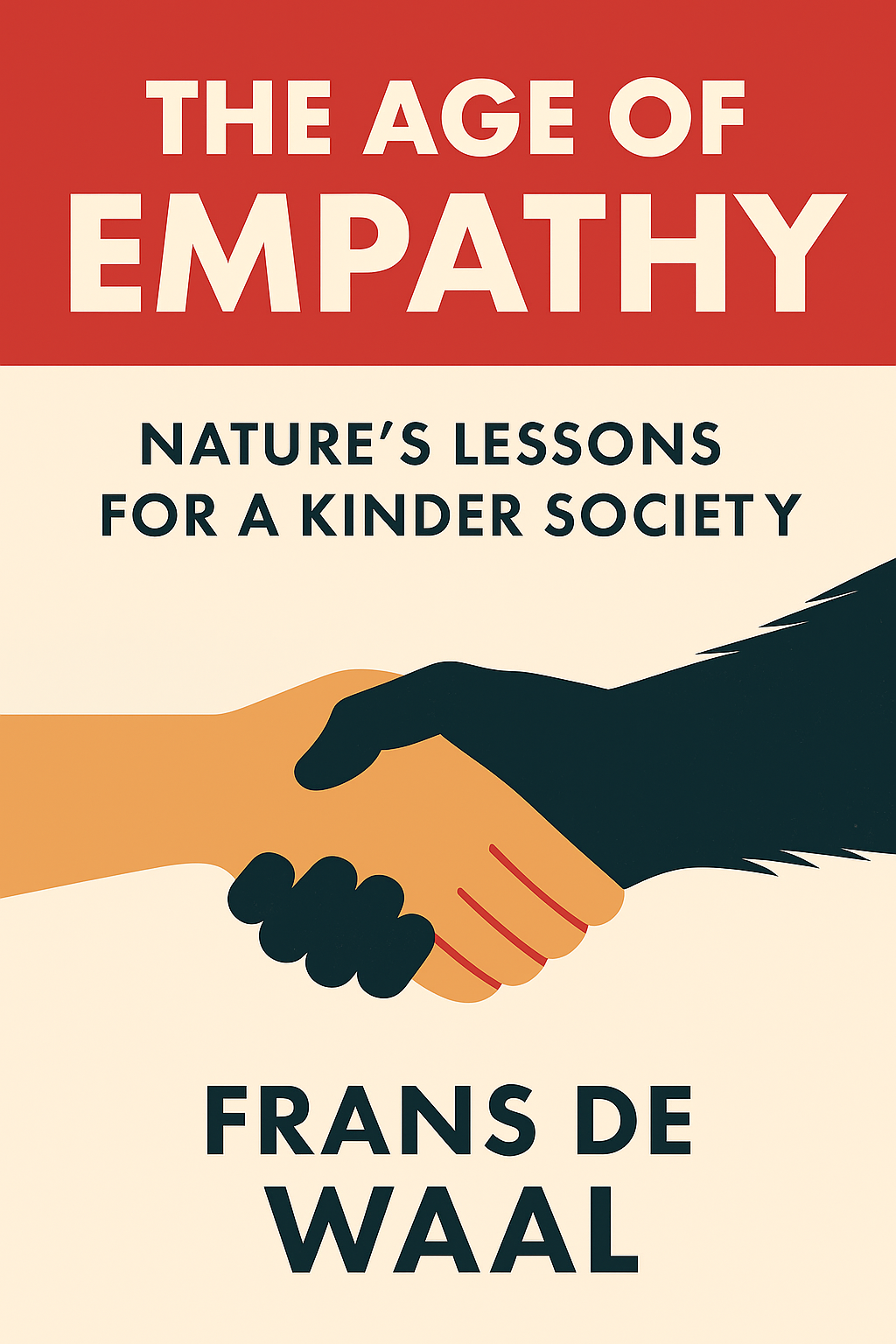
The Age of Empathy
Nature’s Lessons for a Kinder Society
Book Edition Details
Summary
Why do we care? Is it merely a survival tactic, or is there a deeper, more intrinsic part of us that reaches out beyond ourselves? "The Age of Empathy" by Frans de Waal invites you into a profound exploration of the tender ties that bind us not just to our kin but to all living creatures. With the deft touch of a storyteller and the precision of a scientist, de Waal reveals the compelling evidence of empathy's roots in the animal kingdom, from dolphins buoying their sick to elephants rumbling comfort to the distressed. Challenging the cold doctrines of selfishness, this book delves into how our primal instincts are wired for connection and care. As the world shifts, de Waal’s insights inspire a vision for an empathetic society, urging us to embrace our shared humanity in the face of adversity. A beacon of hope in turbulent times, this work isn't just a read—it's a rallying cry for a kinder tomorrow.
Introduction
Imagine watching a nature documentary where a baby elephant falls into a muddy waterhole, trumpeting in distress. Within seconds, the entire herd rushes to help, with adult elephants working together to lift the struggling calf to safety. As you watch from your living room, you find yourself holding your breath, feeling genuine relief when the rescue succeeds. This moment reveals something profound about both elephant society and human nature that challenges our most basic assumptions about the natural world. For too long, we've been told that nature is fundamentally about competition, survival of the fittest, and every creature for itself. Yet everywhere we look, from the smallest mammals to the largest land animals, we find evidence of cooperation, care, and genuine concern for others' wellbeing. The capacity to feel what others feel, to be moved by their distress, and to act on their behalf isn't a uniquely human achievement or a recent cultural invention. It's an ancient biological inheritance that connects us to countless other species and reveals empathy to be one of evolution's most remarkable innovations. Understanding how nature shaped our capacity to care not only transforms how we see ourselves but also offers hope for building more compassionate societies in an increasingly interconnected world.
The Biological Foundations of Emotional Connection
Empathy begins in the most fundamental place imaginable: the automatic, unconscious responses of our bodies to the emotions of others around us. When you see someone smile, your facial muscles subtly mimic that expression within milliseconds, even before you're consciously aware of it. When you witness someone in pain, your own brain's pain centers light up as if you were experiencing the hurt yourself. This isn't metaphorical or learned behavior, it's measurable biological activity that scientists call emotional contagion, the tendency to automatically mirror and internalize the emotions we observe in others. This biological foundation of empathy evolved over millions of years of mammalian development, beginning with the essential bond between mothers and their offspring. Females who were sensitive to their babies' needs, who felt genuine distress when their young were in trouble, consistently raised more surviving offspring than those who remained cold and indifferent. This created what researchers call the "caring brain," adding emotional centers to our neural architecture that allow us to experience deep concern for others' wellbeing. The same biological systems that ensure parental care also enable us to feel connected to friends, partners, and even strangers. The power of emotional contagion extends far beyond individual relationships to shape entire groups and communities. Think about how laughter spreads through a crowd, how tension ripples through a room when someone becomes upset, or how the calm presence of one person can soothe an entire gathering. These aren't conscious choices but automatic responses driven by ancient biological systems that helped our ancestors coordinate group activities, respond to threats, and maintain the cooperative bonds essential for survival. When one member of a group becomes alert to danger, their tension spreads rapidly through emotional contagion, preparing everyone for action without the need for verbal communication. What makes this biological perspective revolutionary is how it reframes human nature itself. Rather than being fundamentally selfish creatures who occasionally overcome our base instincts to help others, we're revealed as beings whose very survival has always depended on our ability to connect with and care for one another. Empathy isn't a weakness or a luxury that we can afford only in good times, it's one of our species' greatest evolutionary achievements, as essential to our success as our intelligence or our ability to use tools.
Mirror Neurons and Self-Recognition Across Species
In the 1990s, Italian neuroscientists studying macaque monkeys made a discovery that would revolutionize our understanding of how minds connect across the boundaries of individual bodies. They found specialized brain cells that fired not only when a monkey reached for a peanut, but also when it simply watched another monkey perform the same action. These "mirror neurons" essentially erase the boundary between self and other, creating a neural bridge that allows us to experience others' actions and emotions as if they were our own. This discovery helps solve one of empathy's greatest mysteries: how we manage to understand experiences that we're not directly having ourselves. The answer lies in our remarkable ability to map other bodies onto our own through internal simulation. When you watch a tennis player serve, mirror neurons in your brain activate the same motor patterns you would use to serve, creating a detailed internal model of their movement. When you see someone reach for a cup, your brain automatically runs through the neural sequence for grasping, giving you immediate understanding of their intention and likely success. The same system that helps us understand actions also allows us to share emotions across species boundaries. Research has revealed mirror neuron systems not just in primates but in many other mammals, from elephants who console distressed family members to dolphins who support injured companions at the water's surface. The most fascinating discovery is the connection between mirror neuron sophistication and self-recognition abilities. Species that can recognize themselves in mirrors, including humans, great apes, elephants, and dolphins, also show the most complex empathic behaviors, suggesting that understanding others requires first understanding yourself. This body-to-body communication operates below the level of conscious thought but profoundly shapes our social world. Consider how people who spend years together often begin to look alike, not because they chose similar partners, but because they've unconsciously mimicked each other's expressions so extensively that their faces have literally been reshaped. The resemblance is strongest among the happiest couples, revealing how physical synchronization reflects deep emotional connection. We become like those we love, not just emotionally but in measurable physical ways that demonstrate the power of our mirror neuron systems to bind us together.
Fairness and Cooperation in the Animal Kingdom
Perhaps nothing reveals the ancient roots of morality more clearly than discovering a sense of fairness in other species. In a groundbreaking experiment, researchers trained capuchin monkeys to exchange small tokens for food rewards. When both monkeys received cucumber slices for their tokens, they participated happily. But when one monkey received grapes, a much preferred treat, while the other still got cucumber for the same work, the shortchanged monkey would often refuse to participate further, sometimes throwing the cucumber back at the experimenter in what appeared to be genuine indignation. This wasn't simply about wanting better food, because when researchers showed monkeys grapes without giving them to a partner, the monkeys worked contentedly for cucumber. The protest emerged specifically from the unfairness of the situation, revealing that these primates possess what economists call "inequity aversion," the emotional foundation for all our more sophisticated concepts of justice and fair play. Similar experiments with chimpanzees, dogs, and even ravens have shown that many species have an innate sense of equity that governs their social interactions. The evolutionary logic behind fairness becomes clear when we consider the challenges of maintaining cooperation over time. When individuals work together, whether hunting large prey or defending territory, the benefits must be distributed in ways that make continued collaboration worthwhile for everyone involved. Those who consistently take more than their fair share risk being excluded from future partnerships, while those who share generously build reputations that attract valuable allies. This creates what researchers call a "biological marketplace," where animals compete not just through aggression but by being trustworthy, generous, and fair. Cooperation extends far beyond simple fairness to encompass complex systems of reciprocity and mutual aid throughout the animal kingdom. Vampire bats share blood with roost-mates who had unsuccessful hunting nights, creating insurance networks that help the entire group survive lean times. Chimpanzees engage in sophisticated exchanges, trading grooming services for food sharing, support in conflicts for future favors, and even planning ahead to curry favor with potential allies. These examples reveal that the building blocks of economic cooperation, from reciprocal exchange to reputation-based trust, exist throughout nature, suggesting that human moral systems build upon ancient biological foundations rather than emerging from cultural innovation alone.
From Animal Instincts to Human Moral Behavior
Human morality represents the extraordinary flowering of empathic capacities that have been evolving for millions of years across countless species. While other animals show impressive examples of helping, cooperation, and fairness, humans have taken these tendencies to unprecedented levels of complexity and scope. We can empathize with complete strangers, feel genuine concern for people we'll never meet, and create moral systems that extend consideration to entire populations, future generations, and even other species. This expansion of empathic concern beyond immediate family and social groups represents both humanity's greatest achievement and its most challenging limitation. Our evolved psychology was shaped by life in small groups where everyone knew everyone else, where reciprocity could be tracked personally, and where the consequences of actions were immediately visible. Modern life requires us to extend these same moral intuitions to vast, anonymous societies where the effects of our choices ripple out in ways we can barely comprehend. The shadow side of human empathy reveals itself in our tendency to empathize selectively, readily feeling for members of our own group while remaining indifferent to, or even taking satisfaction in, the suffering of those we consider outsiders. This same capacity for perspective-taking that allows us to console a crying child can be turned to destructive purposes, as our understanding of others' minds enables both extraordinary compassion and calculated cruelty. The challenge isn't to eliminate these tendencies, which are deeply embedded in our evolutionary heritage, but to expand the circle of those we consider worthy of moral consideration. Understanding the biological roots of morality doesn't diminish its importance or reduce it to mere animal instinct. Instead, it reveals that our capacity for ethical behavior grows from the same soil that nourishes empathy throughout the natural world. Because these tendencies are so deeply embedded in our biology, they emerge reliably in virtually every human society, providing a universal foundation that cultures can build upon. The goal isn't to create morality from scratch but to channel and expand the empathic capacities that evolution has already provided, helping people extend their natural circle of concern to include ever-wider communities of others who share our interconnected world.
Summary
The most revolutionary insight from studying empathy across species is that our capacity for connection, cooperation, and moral concern isn't a fragile cultural achievement layered over a fundamentally selfish nature, but rather represents the full expression of ancient biological tendencies that have been shaping behavior throughout the natural world for millions of years. From the automatic emotional mirroring that helps us understand others' feelings to the sophisticated moral reasoning that guides our largest institutions, empathy provides the foundation for nearly everything we value about human society and reveals our deep kinship with countless other species who share these remarkable capacities. This perspective suggests that when we appeal to humanity's "better angels," we're not asking people to transcend their nature but to express it more fully and expansively. As we face global challenges that require unprecedented levels of cooperation and concern for others, including future generations and the countless species with whom we share this planet, how might we harness our evolved capacity for empathy to expand our circle of moral consideration beyond the small groups that shaped our evolutionary past? What would our world look like if we truly understood that the capacity for connection and compassion isn't a luxury to be cultivated by the privileged few, but a fundamental part of what makes us human and connects us to the broader community of life on Earth?
Related Books
Download PDF & EPUB
To save this Black List summary for later, download the free PDF and EPUB. You can print it out, or read offline at your convenience.
By Frans de Waal
