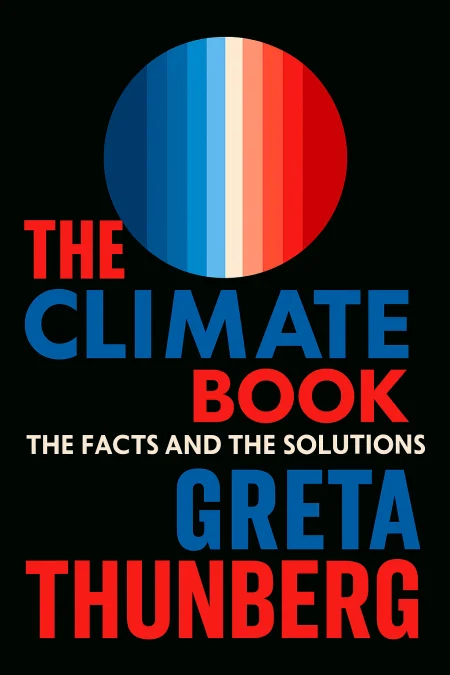
The Climate Book
The Facts and the Solutions
Book Edition Details
Summary
Amidst the clamor of a world in turmoil, Greta Thunberg rises with a battle cry for the planet's future. The Climate Book is not just another tome on environmental issues; it’s a rallying manifesto, a lighthouse guiding us through the storm of misinformation and apathy. Thunberg, with her unyielding spirit, curates a tapestry of insights from over a hundred luminaries—from indigenous sages to modern scientists—each voice weaving the complex narrative of our climate crisis. This isn’t just about survival; it’s a call to arms for humanity, urging us to transcend complacency and embrace collective action. What if the spark of a single school strike could ignite a revolution? What could we achieve if we united in urgency and purpose? The clock is ticking, and the time for change is now.
Introduction
In 1856, an American scientist named Eunice Foote conducted a simple experiment with glass cylinders and thermometers, discovering that carbon dioxide trapped heat more effectively than ordinary air. She had no idea her modest observation would eventually explain humanity's greatest challenge. Meanwhile, across the Atlantic, Swedish chemist Svante Arrhenius was calculating by hand how doubling atmospheric CO2 might warm the planet by several degrees. These early pioneers were unknowingly documenting the first clues to a crisis that would unfold over the next century and a half. This remarkable journey reveals how scientific discovery, corporate deception, political failure, and grassroots activism have shaped our response to climate change. From the coal-burning factories of the Industrial Revolution to today's youth climate strikes, we witness a pattern of human behavior that is both deeply troubling and ultimately hopeful. The story exposes how fossil fuel companies spent decades deliberately obscuring truth about their products, how governments repeatedly failed to act on clear scientific warnings, and how ordinary people worldwide are now demanding transformative change. This exploration proves essential for anyone seeking to understand not just what climate change is, but why our response has been so inadequate and what pathways remain open for meaningful action. It offers both a sobering account of missed opportunities and an inspiring vision of solutions that could still prevent the worst outcomes.
Early Warnings: Scientific Foundations and Initial Discoveries (1850s-1980s)
The foundations of climate science emerged during the height of the Industrial Revolution, when curious minds began noticing connections between human activity and atmospheric changes. In the 1850s and 1860s, scientists like Eunice Foote and John Tyndall demonstrated that certain gases, particularly carbon dioxide, could trap heat in ways that ordinary air could not. By the 1890s, Svante Arrhenius had calculated that doubling atmospheric CO2 concentrations could warm the planet by 5-6 degrees Celsius, a prediction that remains remarkably close to modern estimates. For nearly a century, these discoveries remained largely academic curiosities. The scientific community gradually built more sophisticated understanding of how greenhouse gases interact with Earth's energy balance, but the implications seemed distant and theoretical. This changed dramatically in the 1950s and 1960s, when researchers like Charles David Keeling began systematically measuring atmospheric CO2 concentrations at Mauna Loa Observatory. The resulting "Keeling Curve" showed an unmistakable upward trend that correlated perfectly with fossil fuel consumption. By the 1970s, climate scientists had reached consensus that human activities were indeed warming the planet, and effects would become increasingly severe. Sophisticated computer models developed by researchers like Syukuro Manabe painted an increasingly clear picture of future warming. As one scientist noted, "We are in the driver's seat, determining the future state of our home, planet Earth." The period culminated in 1988 when NASA scientist James Hansen testified before the U.S. Senate that global warming had begun, marking a pivotal moment when climate change entered mainstream political discourse. The scientific foundation was solid, the evidence was mounting, and the warnings were clear. What happened next would test humanity's capacity to act on long-term threats in the face of short-term interests.
The Great Acceleration: Rising Emissions Amid Growing Evidence (1990s-2010s)
The 1990s began with unprecedented hope for global climate action. The 1992 Earth Summit in Rio de Janeiro brought together world leaders who signed the UN Framework Convention on Climate Change, while the Kyoto Protocol in 1997 established binding targets for developed nations. Yet even as international frameworks took shape and public awareness grew, a troubling paradox emerged: emissions continued rising at an accelerating pace. This period witnessed what scientists call the "Great Acceleration," a dramatic surge in human impact on Earth's systems. Despite decades of climate conferences and mounting scientific evidence, more than half of all carbon dioxide ever emitted by human activities was released during these years. The irony was stark and undeniable: the more we learned about climate change, the more greenhouse gases we pumped into the atmosphere. Behind this contradiction lay a sophisticated campaign of doubt and delay orchestrated by fossil fuel companies and their allies. Internal documents later revealed that major oil corporations had understood the reality of climate change as early as the 1970s, yet chose to fund climate denial and disinformation rather than acknowledge the risks their products posed. These efforts successfully shifted debate from scientific consensus to manufactured controversy, buying decades of delay while emissions continued climbing. The consequences of this lost decade extended far beyond rising emissions. Critical tipping points in Earth's climate system moved closer, while the window for gradual, manageable transitions began to close. Political systems proved particularly ill-suited to addressing a problem requiring long-term thinking and international cooperation. The failure to act when action would have been most effective set the stage for more dramatic changes and urgent responses that would characterize the decades to follow.
Crisis Reality: Living with Climate Impacts and Systemic Failures (2010s-Present)
By 2021, the Intergovernmental Panel on Climate Change delivered an unequivocal verdict: human influence had warmed the planet by 1.1°C above pre-industrial levels, and impacts were no longer theoretical projections but observable realities reshaping life on Earth. From unprecedented heatwaves in the Pacific Northwest to catastrophic flooding in Europe, from accelerating ice loss in Greenland to coral bleaching across tropical seas, the fingerprints of climate change had become unmistakable. The human toll of this warming became increasingly apparent. Heat-related deaths were rising, with climate change responsible for roughly 37 percent of heat-related mortality between 1991 and 2018. Vector-borne diseases expanded their ranges, extreme weather events intensified, and vulnerable communities worldwide bore the brunt of impacts they had done little to cause. As one researcher noted, "We are not all in the same boat" when it comes to climate impacts, with the poorest and most marginalized populations suffering disproportionately. Perhaps most sobering was the realization that 1.1°C represented only the beginning. Even with immediate and dramatic action, additional warming was already locked in due to the long residence time of greenhouse gases in the atmosphere and the thermal inertia of the climate system. The question was no longer whether to prevent climate change, but how to limit its severity while adapting to changes already underway. As extreme weather events multiplied and climate impacts intensified, the costs of inaction became increasingly apparent. Yet political systems seemed structurally incapable of responding to long-term threats that required immediate sacrifice for future benefit. This new reality demanded a fundamental shift in thinking from prevention to what experts called "loss and damage," acknowledging that some impacts could no longer be avoided and would require unprecedented global cooperation to address.
Transformation Imperative: Justice, Solutions and Future Pathways
The current decade has witnessed a remarkable shift in climate discourse, driven largely by youth activists who have reframed climate change as a moral and justice issue rather than merely a technical challenge. Greta Thunberg's school strikes sparked a global movement that has fundamentally altered public perception, making climate action a political necessity rather than an option in many countries. This new framing emphasizes that climate change is not just an environmental problem but a crisis of inequality and injustice. The communities least responsible for causing the problem are often those most severely affected by its impacts. This recognition has led to calls for a "just transition" that addresses both climate change and social inequality simultaneously, ensuring that the shift to a sustainable economy doesn't leave vulnerable communities behind. Technological solutions have also reached a tipping point, with renewable energy becoming the cheapest source of electricity in most parts of the world. Electric vehicles, energy storage, and other clean technologies are scaling rapidly, creating new economic opportunities while reducing emissions. The dramatic decline in costs of renewable energy technologies has fundamentally altered the economics of the energy transition, making clean alternatives competitive with fossil fuels in most markets. The pathway forward requires acknowledging that the climate crisis is fundamentally a crisis of justice and democracy. The communities most affected by climate impacts must be centered in both the design of solutions and the distribution of resources for adaptation and recovery. This means not only rapid decarbonization but also reparations for historical emissions and support for those bearing the costs of a crisis they did not create. Only by addressing these deeper questions of equity and power can we build the broad coalition necessary to achieve the transformation our planet urgently needs.
Summary
The climate crisis represents perhaps the greatest test of humanity's ability to respond collectively to a global challenge that transcends national boundaries and short-term interests. The central tension throughout this story has been between the clarity of scientific understanding and the complexity of political and economic systems that resist change. From the earliest discoveries of the greenhouse effect to today's youth climate movements, we see a recurring pattern: scientific warnings followed by delay, denial, and incremental responses that fall far short of what the evidence demands. The historical record reveals that the primary barriers to climate action have not been technological or economic, but political and cultural. The fossil fuel industry's deliberate campaign to obscure climate science, combined with political systems designed for short-term thinking, created decades of delay that have made the challenge exponentially more difficult. Yet this same history also demonstrates humanity's capacity for rapid transformation when faced with existential threats, as seen in wartime mobilizations and recent responses to global emergencies. The path forward requires acknowledging that climate change is fundamentally a crisis of justice and democracy, not just environmental degradation. Solutions must address the root causes of both climate change and inequality, creating economic systems that prioritize long-term sustainability over short-term profits. This means supporting communities most affected by climate impacts, holding polluters accountable for damage they have caused, and ensuring that the transition to clean energy creates opportunities for everyone. The window for action is narrowing, but the tools for transformation have never been more powerful or more necessary.
Related Books
Download PDF & EPUB
To save this Black List summary for later, download the free PDF and EPUB. You can print it out, or read offline at your convenience.
By Greta Thunberg
