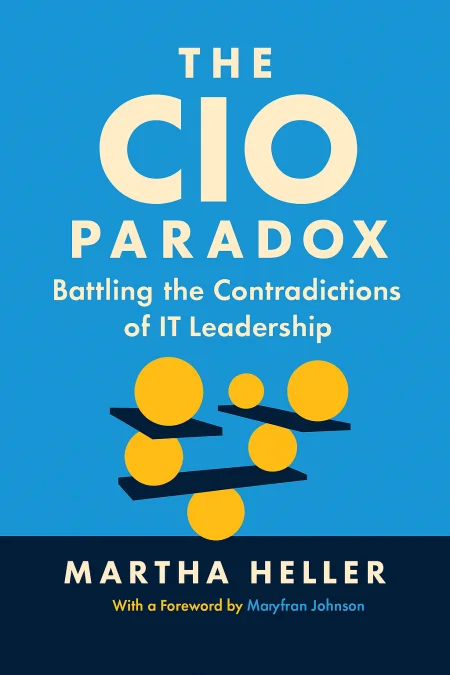
The CIO Paradox
Battling The Contradictions of IT Leadership
byMartha Heller, Maryfran Johnson
Book Edition Details
Summary
In the ever-evolving corporate landscape, a curious paradox emerges at the heart of technology leadership. "The CIO Paradox" by Martha Heller delves into the intricate dance that Chief Information Officers must perform—balancing the demands of relentless innovation with cost control, all while being tethered to legacy technology decisions. This compelling exploration unveils the contradictions that define a CIO's world, from navigating executive expectations to reshaping corporate culture. Drawing from her extensive experience and insightful interviews with seasoned CIOs, Heller crafts a masterful guide to transforming these challenges into opportunities. Discover how to harness the forces of governance, staffing, and industry dynamics to redefine IT success and elevate your organization's value in a tech-centric world.
Introduction
In an era where digital transformation defines competitive advantage, chief information officers find themselves caught between seemingly irreconcilable demands. They must simultaneously cut costs and drive innovation, maintain security while enabling flexibility, and serve as both operational managers and strategic visionaries. This fundamental tension reveals itself as a series of paradoxes that permeate every aspect of IT leadership. The modern CIO operates within a framework of contradictions that would challenge even the most seasoned executives. These paradoxes emerge from the unique position technology holds in contemporary organizations - simultaneously critical and misunderstood, pervasive yet specialized, transformative but risky. Understanding these contradictions and learning to navigate them successfully becomes the defining characteristic of effective IT leadership. The theoretical framework presented here examines how exceptional CIOs transcend these paradoxes not by resolving them, but by embracing the tension and finding dynamic balance. This approach recognizes that the contradictions inherent in IT leadership are not problems to be solved but realities to be managed through adaptive leadership strategies and organizational design principles.
The Role Paradoxes: Strategy vs Operations
The most fundamental contradiction facing IT leaders centers on the competing demands of strategic vision and operational excellence. CIOs are hired to be transformational business leaders who can envision the future and guide their organizations through digital disruption. Yet they spend the majority of their time managing infrastructure, resolving technical issues, and ensuring systems remain operational. This paradox manifests in multiple dimensions. At the organizational level, CIOs must balance long-term architectural planning with immediate firefighting. Their teams need both deep technical expertise to maintain complex legacy systems and broad business acumen to drive innovation initiatives. The budget must simultaneously support cost reduction efforts while funding experimental technologies that may not yield immediate returns. The resolution comes through what successful leaders call the "chameleon factor" - the ability to seamlessly shift between different modes of operation depending on context. Like a conductor who must understand every instrument while focusing on the overall symphony, effective CIOs develop the cognitive flexibility to move fluidly between strategic planning sessions and technical crisis management. They structure their organizations to handle both operational excellence and innovation simultaneously, often through parallel teams or dedicated innovation groups that operate under different metrics and expectations. The key insight is recognizing that operational excellence provides the credibility platform necessary for strategic influence. CIOs who attempt to focus solely on strategy while neglecting operational fundamentals quickly lose the trust required for transformational leadership. Conversely, those who become trapped in operational details never develop the forward-thinking capabilities their organizations desperately need.
Stakeholder Challenges: IT and Business Alignment
The relationship between IT and the broader business organization represents perhaps the most persistent challenge in technology leadership. Despite decades of discussion about alignment and partnership, many IT departments still operate as separate entities rather than integrated business functions. This separation creates a paradox where IT leaders have intimate knowledge of every business process yet remain marginalized in strategic discussions. The stakeholder alignment framework reveals several interconnected challenges. Business leaders often lack sufficient technical literacy to engage meaningfully with IT proposals, while IT professionals struggle to translate technical capabilities into business value propositions. The accountability structure becomes problematic when IT is held responsible for project success while business stakeholders control the resources and decisions that determine outcomes. Successful CIOs break through this paradox by fundamentally redefining the relationship dynamic. Rather than positioning IT as a service provider to business customers, they establish their organization as an integral part of each business function. This involves embedding IT professionals directly within business units, ensuring they report through dual structures that maintain both technical standards and business accountability. The transformation requires deliberate attention to language, communication patterns, and cultural integration. IT professionals must develop fluency in business metrics and decision-making frameworks, while business leaders need sufficient technical understanding to participate meaningfully in technology decisions. The goal is not perfect mutual comprehension but rather sufficient shared vocabulary and trust to enable collaborative problem-solving and shared accountability for outcomes.
Organizational Dynamics: Talent and Succession
The human capital challenges facing IT organizations create another layer of paradoxical tensions. Technology professionals must combine deep technical expertise with broad business acumen, analytical thinking with interpersonal skills, and specialized knowledge with adaptable learning capability. The pace of technological change means that technical skills become obsolete quickly, yet organizations still require deep expertise in legacy systems that may persist for decades. The talent development framework must address multiple competing demands simultaneously. Organizations need professionals who can architect complex systems while communicating effectively with non-technical stakeholders. They require specialists who understand specific technologies deeply enough to make sound architectural decisions, yet generalists who can adapt as business needs and technology platforms evolve. Succession planning compounds these challenges because the skills required for future IT leadership may differ significantly from those that created success in the past. The next generation of IT leaders will likely need stronger business development capabilities, customer relationship skills, and innovation management experience, while potentially requiring less hands-on technical depth. This creates a paradox where the best current performers may not represent the ideal future leaders. The resolution involves creating development programs that deliberately expose high-potential IT professionals to business operations, customer interactions, and general management challenges. Rather than promoting the strongest technical contributors into management roles, effective organizations identify individuals with the cognitive flexibility and interpersonal capabilities required for business leadership, then provide them with sufficient technical credibility to maintain organizational respect.
Breaking the Paradox: Leadership Excellence
The synthesis of these various paradoxes points toward a comprehensive leadership model that embraces contradiction rather than attempting resolution. Exceptional IT leaders develop what can be termed "paradox fluency" - the ability to hold multiple contradictory truths simultaneously and navigate between them based on situational demands and stakeholder needs. This leadership approach requires several core capabilities. First, cognitive complexity allows leaders to understand multiple perspectives and maintain awareness of competing priorities without becoming paralyzed by analysis. Second, communication agility enables them to adjust their message, vocabulary, and framing based on audience while maintaining consistency in underlying principles. Third, organizational design skills help them create structures that can accommodate different operating modes and success metrics simultaneously. The practical application involves building organizations with sufficient flexibility to handle both efficiency and innovation demands, developing talent with hybrid skill sets that bridge traditional functional boundaries, and establishing governance frameworks that can balance standardization with experimentation. Leaders must model the integration they seek, demonstrating both technical credibility and business acumen while maintaining authentic relationships across all stakeholder groups. Perhaps most importantly, breaking the paradox requires accepting that the tensions are permanent features of the role rather than temporary challenges to be overcome. This acceptance enables leaders to focus their energy on dynamic balance and adaptive responses rather than searching for perfect solutions that eliminate contradiction entirely.
Summary
The fundamental insight for navigating IT leadership lies in recognizing that paradoxes are not problems to be solved but realities to be managed through adaptive leadership strategies and organizational design. The most successful technology leaders develop the cognitive flexibility to move fluidly between competing demands while building organizations capable of excellence across multiple dimensions simultaneously. This approach transforms the contradictions of IT leadership from sources of stress and failure into wellsprings of competitive advantage and organizational resilience, ultimately creating technology organizations that serve as genuine strategic assets rather than necessary operational expenses.
Related Books
Download PDF & EPUB
To save this Black List summary for later, download the free PDF and EPUB. You can print it out, or read offline at your convenience.
By Martha Heller
