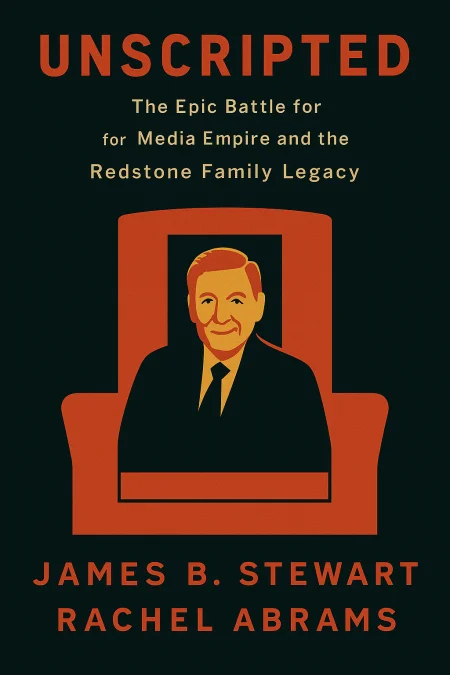
Unscripted
The Epic Battle for a Media Empire and the Redstone Family Legacy
byJames B. Stewart, Rachel Abrams
Book Edition Details
Summary
When a media empire teeters on the brink, the stage is set for an epic tale of ambition, betrayal, and corporate intrigue. "Unscripted" plunges into the tumultuous saga of Paramount Global, where the Redstone dynasty's grip on power becomes increasingly precarious. As Sumner Redstone, the nonagenarian titan, faces a public scandal, his daughter Shari battles a boardroom full of adversaries with knives out. Les Moonves, the charismatic yet embattled CBS executive, emerges as a formidable foe, with whispers of misconduct threatening his empire within an empire. Pulitzer Prize-winning journalists James B. Stewart and Rachel Abrams unravel the hidden machinations and seismic shifts within this beleaguered behemoth, against a backdrop of cultural upheaval and the crumbling foundations of old-world media. "Unscripted" is not just a story of corporate warfare—it's a piercing look into the chaos when the mighty fall and the relentless pursuit of power leads to ruin.
Introduction
In the gleaming towers of corporate America, few stories rival the Byzantine drama that unfolded within the Redstone media empire. Sumner Redstone, the brilliant Harvard-educated mogul who built a theater chain into an entertainment colossus controlling CBS and Viacom, found himself at the center of a shocking tale of manipulation, betrayal, and family warfare in his final years. As his mental faculties declined, two younger women moved into his Beverly Hills mansion, systematically isolating him from his family while extracting over $150 million in gifts. Meanwhile, his daughter Shari, long dismissed and belittled by her father, was forced into an epic battle to save both her family's legacy and two of America's most influential media companies. This extraordinary saga reveals the dark underbelly of corporate governance when vast wealth meets human frailty. Through Sumner's rise from a Boston theater owner to Hollywood royalty, we witness the making of a media titan whose relentless ambition and complex relationships would ultimately threaten everything he built. The story exposes how power dynamics, gender bias, and family dysfunction can collide with devastating consequences in the highest echelons of American business. Most profoundly, it demonstrates how one woman's determination to protect her father's empire became a fight for corporate democracy itself, challenging the old boys' network that had dominated media for generations.
Building a Media Empire: From Drive-ins to Hollywood Power
Sumner Redstone's transformation from a modest Boston theater operator into one of America's most powerful media moguls began with an almost supernatural will to survive. The pivotal moment came in 1979 when a fire engulfed his room at Boston's Copley Plaza Hotel. Hanging from a window ledge as flames seared his hand, Redstone refused to let go, later declaring that "the will to win is the will to survive." This near-death experience seemed to unlock an insatiable hunger for conquest that would define the rest of his career. Armed with his family's small chain of drive-in theaters, Redstone embarked on a series of audacious takeovers that stunned Wall Street. His opponents consistently underestimated the provincial Boston operator who showed up to meetings wearing discount store clothing with price tags still attached. But beneath this unpretentious exterior lay a razor-sharp intellect and an almost pathological determination to win. When competing with media titan Barry Diller for Paramount Communications in 1994, Redstone ignored his bankers' financial projections and told his CFO simply: "I just want to beat Barry. Do what we have to do to win." The crown jewel of Redstone's empire came with his $40 billion acquisition of CBS in 2000, creating a media colossus that spanned from Paramount Pictures to MTV, Comedy Central, and Nickelodeon. His fortune soared to an estimated $14 billion, making him one of the world's richest men. Yet success came at a personal cost. His relentless focus on business strained his marriage to Phyllis, leading to a bitter divorce that would establish a pattern of compartmentalizing his personal and professional lives. Throughout his rise, Redstone displayed an almost mystical belief in his own invincibility. He famously declared that he would never die, a boast that reflected both his enormous ego and his deep-seated fear of mortality. This complex psychology would later make him vulnerable to manipulation by those who promised to help him cheat death and find the love that had eluded him in his single-minded pursuit of power.
Family Feuds and Succession Battles: The Cost of Control
As Sumner Redstone aged into his eighties and nineties, his carefully constructed empire became the backdrop for an extraordinary tale of elder abuse and manipulation. The architect of this scheme was Sydney Holland, a financially struggling entrepreneur who met Sumner through celebrity matchmaker Patti Stanger. Holland, facing mounting debts and failed business ventures, quickly recognized the opportunity presented by the lonely billionaire's desperate need for companionship and his terror of dying alone. Holland's strategy was methodical and ruthless. She moved into Redstone's Beverly Hills mansion, taking on the roles of fiancée, secretary, and caregiver while systematically isolating him from his family. Working in alliance with Manuela Herzer, another former girlfriend who had maintained a relationship with Sumner, Holland created an elaborate system of control. They installed surveillance cameras throughout the house, subjected staff to lie detector tests, and blocked phone calls from Redstone's children and grandchildren while telling him his family never called. The financial exploitation was staggering in its scope. In a single day in May 2014, Holland convinced the increasingly frail Redstone to sell $236 million in stock and options, transferring $45 million each to her and Herzer within hours. This was just the tip of the iceberg. Over several years, the two women extracted over $150 million through a combination of cash gifts, real estate purchases, jewelry, and lavish lifestyle expenses. They even convinced Redstone to remove his daughter Shari from his will, replacing his grandchildren with themselves as primary beneficiaries. The psychological manipulation was as sophisticated as the financial scheme. Holland and Herzer repeatedly told Redstone that they were the only people who truly loved him, while painting his family as money-hungry vultures. They threatened to abandon him if he didn't comply with their demands, exploiting his deepest fear of dying alone. When Redstone's nurses tried to put through calls from his family, Holland and Herzer fired them, creating a reign of terror among the household staff that ensured their complete control over the aging mogul's daily life.
Corporate Scandals and the Fall of Les Moonves
The manipulation of Sumner Redstone had consequences far beyond his personal fortune, threatening the stability of two major public companies and triggering a corporate civil war that would reshape American media. At the center of this battle was Philippe Dauman, Redstone's longtime lawyer and protégé, whom Sumner had once called "the son I wish I had." As Redstone's mental faculties declined, Dauman saw an opportunity to cement his control over the empire by negotiating a secret deal to sell nearly half of Paramount Pictures to Chinese investors. Meanwhile, CBS chief executive Les Moonves embodied the golden age of network television, transforming the network from an also-ran into America's most-watched broadcaster through an almost supernatural ability to identify hit shows. His success made him one of Hollywood's most powerful executives, commanding a compensation package worth hundreds of millions. Yet beneath the polished exterior and legendary charm lay a pattern of sexual misconduct that would ultimately destroy everything he had built when the MeToo movement reached its peak. The downfall began when multiple women came forward with credible allegations of sexual assault and harassment spanning decades of Moonves' career. These weren't isolated incidents but part of a systematic pattern of predatory behavior that Moonves had concealed through legal settlements, non-disclosure agreements, and the complicity of subordinates who feared for their careers. Even as he publicly positioned himself as a champion of workplace reform, Moonves was simultaneously using his position to intimidate and silence his accusers. The board's response revealed the fundamental weakness of corporate governance in American media companies. Despite overwhelming evidence of misconduct, several directors continued to support Moonves, prioritizing short-term stock performance over ethical leadership. It took months of investigation and mounting public pressure before the board finally acted, stripping Moonves of his $120 million severance package and acknowledging the toxic culture that had enabled his behavior for decades.
Legacy of Power: Media Dynasty's Final Act
The convergence of Sumner's decline, the MeToo movement, and corporate governance failures created a perfect storm that would reshape one of America's largest media companies. Shari Redstone's emergence from years of marginalization to become the decisive leader who saved her father's empire represented more than just a family succession story. Her victory over those who would exploit her father's vulnerability demonstrated that integrity and perseverance could prevail even against seemingly insurmountable odds. The battle for control revealed fundamental tensions between family ownership and professional management in American business. Dauman and his allies argued they were protecting shareholders from an incapacitated owner and his manipulative daughter, but their own track record of value destruction and willingness to dismember Redstone's legacy exposed the hollowness of their claims. Shari's systematic removal of disloyal executives and predatory companions required a delicate balance of legal maneuvering, family diplomacy, and corporate strategy that transformed her from reluctant heiress into decisive leader. The new empire that emerged from this chaos was leaner, more focused, and better positioned for the challenges of a rapidly changing media landscape. Shari's successful merger of CBS and Viacom, which she had long advocated, created a more competitive entity capable of challenging streaming giants and tech companies. Her choice of leadership and focus on digital transformation showed she understood the industry's future in ways her predecessors had not. Yet the combined company faced enormous challenges in competing with platforms that had fundamentally altered the media landscape. The years of internal warfare had left both CBS and Viacom weakened and behind their competitors in crucial areas like streaming content and digital advertising. Sumner Redstone's death in 2020 marked the end of an era in American media, but also the beginning of a reckoning with the toxic culture and governance failures that had defined his companies' final years.
Summary
The Redstone family saga stands as one of the most extraordinary corporate dramas in American business history, revealing how vast wealth and media power can become both a blessing and a curse across generations. Sumner Redstone's transformation from a driven entrepreneur into a vulnerable victim of elder abuse demonstrates that even the most powerful individuals can fall prey to manipulation when isolated from family and consumed by fear of mortality. His daughter Shari's evolution from a dismissed family member into the decisive leader who saved her father's empire illustrates the profound changes reshaping corporate America in the twenty-first century. The story offers crucial lessons about the intersection of family dynamics, corporate governance, and social change in modern America. It shows how traditional power structures, dominated by aging executives and built on loyalty rather than competence, can become dangerously dysfunctional when challenged by technological disruption and evolving cultural norms. Most importantly, it demonstrates that real leadership often emerges not from those who seek power, but from those who accept responsibility when circumstances demand it. For anyone interested in understanding how American business is adapting to an era of greater accountability and transparency, the Redstone saga provides both a cautionary tale and a roadmap for navigating the complex challenges of family enterprise, media influence, and corporate responsibility in the modern world.
Related Books
Download PDF & EPUB
To save this Black List summary for later, download the free PDF and EPUB. You can print it out, or read offline at your convenience.
By James B. Stewart
