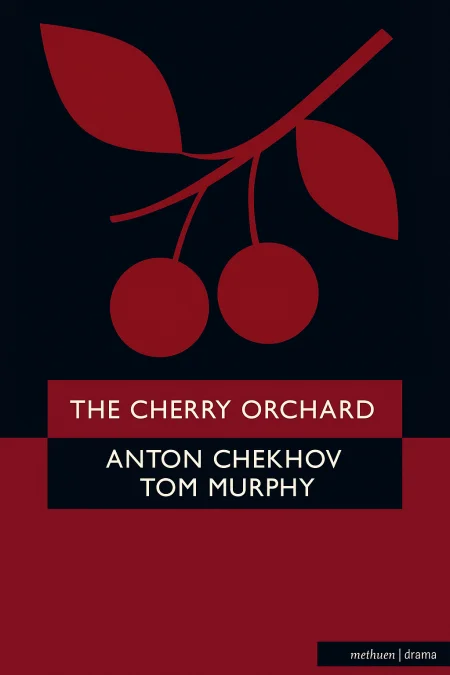
The Cherry Orchard
Uncover a Rich Tapestry of Family, Love, and Change
Book Edition Details
Summary
In the waning glow of a gilded era, the Gayev family faces an existential crossroads, their ancestral estate a crumbling testament to lost grandeur. In Anton Chekhov’s "The Cherry Orchard," a tapestry of tragi-comedy unfolds, revealing a society on the brink of transformation, where old-world aristocracy collides with the rising tide of modern materialism. Tom Murphy’s masterful adaptation breathes fresh life into this timeless classic, reimagining its resonant themes against the backdrop of the final days of Anglo-Irish colonialism. As the family clings to their beloved orchard, symbolic of their fading status, the irresistible forces of change loom large, embodied by a new-money mogul eager to pave over the past. This poignant narrative captures the heartache of inevitability, inviting readers to reflect on the universal struggle between nostalgia and progress.
Introduction
In the modest town of Taganrog on the Sea of Azov, where silt had long since clogged the once-prosperous port, a boy named Anton Pavlovich Chekhov was born in 1860 to a family still bearing the shadow of serfdom. His grandfather had purchased freedom for the family just nineteen years earlier, and his father ran a small grocery store where young Anton worked long hours, later reflecting that "in my childhood, there was no childhood." Yet from this unpromising beginning emerged one of literature's most profound voices, a man who would revolutionize both the short story and theatrical drama while practicing medicine and championing social causes across the Russian Empire. Chekhov's life offers a compelling study of artistic dedication transcending circumstance, revealing how a provincial doctor's son transformed personal struggle into universal art. Through his journey, we discover the making of literary genius through relentless work and observation, the development of a revolutionary artistic philosophy that found beauty in life's mundane moments, and the complex interplay between a writer's public success and private battles against both social limitation and mortal illness.
From Serf's Grandson to Medical Student and Writer
Anton Chekhov's early years were marked by the ambitious struggles of a family climbing Russia's rigid social ladder. His father Pavel, born a serf but risen to merchant status, possessed grand aspirations that far exceeded his practical abilities. The elder Chekhov's taste for religious ceremony and liturgical music led him to found and conduct a choir, enrolling his sons in performances that offered young Anton his first theatrical experiences. Yet beneath this veneer of respectability lay financial incompetence that would profoundly shape the future writer's worldview. The family's downfall came swiftly in 1876 when Pavel's mismanaged grocery business collapsed, forcing him to flee Taganrog in the dead of night to escape debtor's prison. Left behind to complete his education, sixteen-year-old Anton suddenly found himself supporting himself through tutoring while living in a house now owned by strangers. This early experience of dispossession would echo throughout his later works, particularly in plays like The Cherry Orchard, where aristocratic families face the loss of their ancestral homes. When Anton finally rejoined his impoverished family in Moscow in 1879 to begin medical studies, he discovered himself thrust into the role of family breadwinner. His father now worked as a humble clerk, his older brothers lived bohemian, alcoholic lives, and his younger siblings still required education. The young medical student was compelled to carve out a simultaneous career as a journalist, writing comic sketches and anecdotes for humor magazines at the meager rate of ten to twelve kopeks per line. This period of grinding necessity proved formative for Chekhov's artistic development. Writing under various pseudonyms, most notably "Antosha Chekhonte," he learned to observe Moscow life with the clinical eye that would later distinguish his mature work. His theatrical gossip column provided access to greenrooms and backstage areas, while his medical training instilled the objectivity that would become his artistic hallmark. Even as he struggled financially, these early years taught him that literature must emerge from direct observation of life rather than abstract theorizing.
Finding His Voice: Literary Breakthrough and Recognition
The transformation from hack journalist to serious artist began in 1884, the year Chekhov established his medical practice and published his first story collection. More significantly, it marked his first symptoms of tuberculosis, though he would maintain a willful denial of this mortal diagnosis for years to come. This collision between professional success and physical fragility created the tension that would drive his most productive period. The turning point came through a letter from the elderly critic Dmitry Grigorovich in 1886, who recognized exceptional talent beneath Chekhov's hasty commercial work. "If I had known that was how they were reading me," Chekhov wrote his brother, "I would not have written like a hack." This recognition coincided with his acceptance by Aleksey Suvorin's influential newspaper New Times, providing both better pay and a more sophisticated readership. Stories like "Grief" and "The Huntsman" demonstrated his emerging mastery of psychological subtlety and atmospheric detail. Chekhov's artistic philosophy crystallized during these breakthrough years around a radical commitment to objectivity. Rejecting the didactic tradition of Russian literature that demanded writers provide moral solutions to social problems, he insisted that an author's role was to pose questions rather than supply answers. "Let juries pass verdicts on horse thieves," he wrote, "as for me, my work is only to show them as they are." This approach freed him to explore the complex humanity of all his characters without judgment, finding profound meaning in ordinary moments and everyday failures. The publication of "The Steppe" in 1888 established Chekhov among Russia's leading writers, earning him the Pushkin Prize and recognition from the Imperial Academy of Sciences. His success on the stage began with Ivanov in 1887, a controversial work that divided audiences but demonstrated his ability to translate his psychological insights into dramatic form. By the end of the 1880s, the former serf's grandson had achieved national prominence while maintaining his medical practice and supporting his extended family.
The Mature Artist: Theatrical Innovation and Personal Struggles
The 1890s marked Chekhov's emergence as a mature artist grappling with increasingly complex personal and creative challenges. His decision to undertake an arduous journey to the Sakhalin penal colony in 1890 reflected both his social conscience and a desire to test himself against larger subjects. The resulting documentary study revealed depths of human suffering that deepened the philosophical pessimism underlying his later masterpieces, even as he maintained his commitment to artistic objectivity over political advocacy. The purchase of the Melikhovo estate in 1891 provided Chekhov with the rural setting that would inspire his greatest theatrical works. Here he transformed himself into a country gentleman, planting orchards, installing modern amenities, and serving as both doctor and social reformer to the local peasantry. During cholera epidemics and famines, his medical work brought him face-to-face with the harsh realities of Russian rural life, experiences that enriched his understanding of the social dynamics he would later dramatize. This period produced Chekhov's revolutionary theatrical masterpieces, beginning with The Seagull in 1896. The play's disastrous opening night at St. Petersburg's Alexandra Theatre temporarily drove him from the theater, but its eventual success with the Moscow Art Theatre established a partnership that would define modern drama. Working with directors Stanislavsky and Nemirovich-Danchenko, Chekhov developed a new dramatic language that found profound meaning in subtext, silence, and the rhythms of ordinary conversation. His mature theatrical works—Uncle Vanya, Three Sisters, and The Cherry Orchard—revolutionized dramatic structure by abandoning traditional plot mechanics in favor of atmospheric mood and psychological revelation. Characters in these plays rarely achieve their stated goals, yet they reveal profound truths about human longing, social change, and the passage of time. Chekhov's ability to blend comedy and pathos within single scenes created a theatrical form that influenced writers worldwide, though he often disagreed with productions that emphasized tragedy over the complex emotional textures he intended.
Final Years: Love, Loss, and Literary Legacy
Chekhov's final years unfolded under the dual constraints of declining health and increasing literary fame. The definitive diagnosis of tuberculosis in 1897 forced him to relocate to Yalta's milder climate, beginning a pattern of seasonal migrations between the Black Sea and European spas that would define his remaining years. This geographic isolation from Moscow's literary life created a poignant tension between his public success and private struggles with mortality. The surprise of his marriage to actress Olga Knipper in 1900, when he was forty years old, brought unexpected happiness to his final period. Their relationship, conducted largely through correspondence due to his health and her theatrical commitments, revealed a playful, affectionate side that contrasted sharply with the melancholy reputation his works had earned. Knipper's interpretation of his female characters, particularly in the Moscow Art Theatre productions, helped shape how audiences understood his dramatic innovations. The Cherry Orchard, completed in 1903, represented both the culmination of his theatrical achievement and a conscious farewell to his artistic career. Though he intended the play as a comedy, directors and audiences inevitably found deeper tragic resonances in its portrayal of social transformation and personal loss. The work's opening night coincided with celebrations of his twenty-fifth anniversary as a writer, creating a bittersweet recognition of his literary legacy even as his health visibly failed. His death in the German spa town of Badenweiler in July 1904, at age forty-four, marked the end of a career that had fundamentally altered both Russian literature and world theater. His final words, accepting a glass of champagne with the observation that "it's been a long time since I've drunk champagne," captured the gentle irony that had characterized both his life and art. Even his funeral became an inadvertent comedy when his body was transported in a railway car marked "Fresh Oysters," a detail that would have amused the writer who found profound meaning in life's absurd moments.
Summary
Anton Chekhov's greatest achievement lay in discovering the extraordinary within the ordinary, transforming the mundane struggles of provincial Russian life into art of universal resonance and enduring power. His journey from a serf's grandson struggling to escape poverty to a literary master who revolutionized both short fiction and dramatic form demonstrates that artistic genius emerges not from privileged circumstances, but from relentless observation, compassionate understanding, and unwavering commitment to truth over convention. From Chekhov's example, we learn that meaningful art requires the courage to present life without false consolations or easy answers, and that true artistic objectivity paradoxically reveals deeper human truths than partisan advocacy ever could. His legacy offers inspiration to anyone seeking to transform personal limitation into creative achievement, reminding us that the most profound insights often emerge from careful attention to the seemingly insignificant moments that comprise daily existence.
Related Books
Download PDF & EPUB
To save this Black List summary for later, download the free PDF and EPUB. You can print it out, or read offline at your convenience.
By Anton Chekhov
