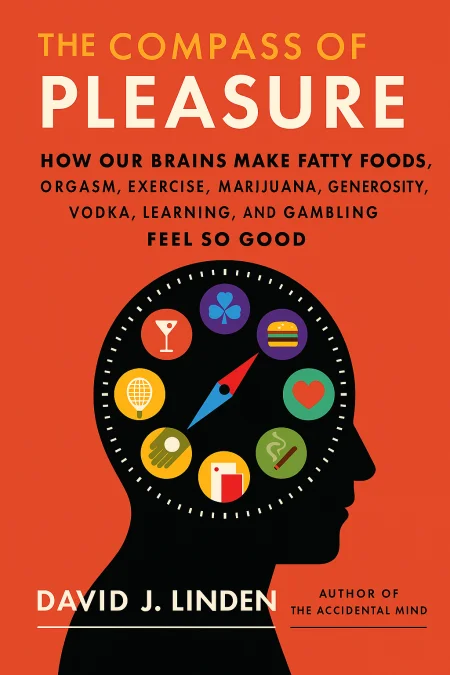
The Compass of Pleasure
How Our Brains Make Fatty Foods, Orgasm, Exercise, Marijuana, Generosity, Vodka, Learning and Gambling Feel So Good
Book Edition Details
Summary
Pleasure: a word that dances on the tongue, yet its true essence plays out deep within our brains. In "The Compass of Pleasure," neuroscientist David J. Linden invites readers to traverse the intricate pathways of our mind where delight and compulsion collide. Through vivid storytelling and groundbreaking research, Linden unravels why certain substances ensnare us in addiction's grip, while others do not. He delves into the common thread linking a charitable act with an opiate's embrace, unveiling how these pleasures rewire our cerebral circuits. As the narrative unfolds, ponder the tantalizing possibilities of a future where our pleasure centers might be activated with unprecedented precision. An insightful journey that challenges our understanding of joy and its darker shadows, this book is a must-read for anyone curious about the mysteries of human desire.
Introduction
Why do we crave that perfect slice of chocolate cake, feel euphoric after a morning run, or find ourselves scrolling endlessly through social media? What makes falling in love feel so intoxicating, or causes some people to gamble away their life savings? The answer lies deep within our brains, in a remarkable network of neurons that scientists call the pleasure circuit. This ancient system, evolved over millions of years to help our ancestors survive by making essential activities like eating and mating feel rewarding, now governs nearly every aspect of our modern experience of joy, satisfaction, and desire. The story of pleasure in the brain begins with a serendipitous discovery in the 1950s when researchers accidentally found that rats would press a lever thousands of times just to stimulate certain areas of their brains. This groundbreaking finding revealed that pleasure isn't just a byproduct of getting what we need, but rather a fundamental drive that can be directly activated in the brain. What's truly fascinating is that this same neural circuitry responds not only to life's obvious pleasures like food and sex, but also to seemingly disparate experiences like charitable giving, meditation, and even the anticipation of good news. You'll discover how this single system can explain both our noblest virtues and our most destructive vices, why addiction hijacks our brain's reward pathways, and how understanding the neuroscience of pleasure might help us make better choices about everything from what we eat to how we spend our free time.
The Brain's Pleasure Circuit: From Discovery to Dopamine
The discovery of the brain's pleasure circuit happened entirely by accident. In 1953, two researchers at McGill University were trying to study sleep centers in rat brains, but their electrode placement went slightly astray. Instead of making the rats sleepy, electrical stimulation made them return repeatedly to the spot where they received the stimulation. When the researchers set up an experiment allowing rats to press a lever to stimulate their own brains, the results were astounding. The rats pressed the lever up to seven thousand times per hour, ignoring food, water, and even potential mates. They had to be disconnected from the apparatus to prevent them from starving to death in pursuit of this artificial pleasure. This revolutionary experiment revealed the existence of what scientists now call the medial forebrain pleasure circuit. The key player in this system is a neurotransmitter called dopamine, released by neurons in a brain region called the ventral tegmental area. When these neurons fire, they release dopamine into several target areas, including the nucleus accumbens, creating the sensation we experience as pleasure or reward. Think of dopamine as the brain's currency of desire, the chemical signal that says "this is good, do this again." This system evolved to make survival-essential activities feel good, ensuring our ancestors would seek out food when hungry and mates when fertile. Remarkably, this same circuit responds to both natural rewards and artificial stimulation. When researchers studied humans with electrodes implanted for medical reasons, they found that direct stimulation of these brain areas produced intense euphoria. One patient stimulated his pleasure circuit so compulsively that he had to be forcibly disconnected despite his vigorous protests. The universality of this system across species suggests that the basic architecture of pleasure has remained remarkably consistent throughout evolution. What makes this discovery so profound is that it reveals pleasure not as some mysterious, intangible experience, but as a measurable biological process. The firing of specific neurons, the release of particular chemicals, the activation of certain brain circuits - these concrete, physical events are what create our subjective experience of joy, satisfaction, and craving. Understanding this mechanism is the first step toward understanding why humans seek pleasure in such diverse ways, from the most virtuous to the most destructive.
Drugs, Food, and Sex: Hijacking Our Reward System
Psychoactive drugs work by hijacking the brain's natural pleasure circuits, but they accomplish this through surprisingly different mechanisms. Cocaine and amphetamines block the normal cleanup process that removes dopamine from synapses, causing pleasure signals to last longer and feel more intense. Heroin and other opiates work indirectly by removing the brakes from dopamine neurons, allowing them to fire more freely. Even alcohol increases the release of the brain's natural cannabis-like molecules, which then disinhibit the pleasure circuit. Despite their different chemical pathways, all addictive drugs share one crucial feature: they cause dopamine release in the brain's reward centers, often more powerfully than any natural stimulus. The foods we crave most intensely are essentially drug-like in their effects on the brain. Modern food manufacturers have discovered that combinations of fat, sugar, and salt activate pleasure circuits far more powerfully than any single ingredient alone. This explains why we might feel satisfied after a healthy meal yet still have "room for dessert" when presented with a rich, sweet treat. Our brains evolved to find these energy-dense combinations irresistible because they were rare and valuable in our ancestral environment. Today's food industry exploits this ancient wiring, creating products that deliver concentrated pleasure hits through precisely engineered combinations of taste, texture, and rapid digestibility. Sexual behavior represents perhaps the most complex activation of pleasure circuits, involving not just physical sensation but also emotional bonding and social connection. Brain imaging studies show that viewing erotic images activates the same dopamine pathways engaged by drugs, but sexual pleasure also triggers the release of oxytocin, often called the "bonding hormone." This explains why sexual experiences can create such powerful emotional attachments and why the loss of sexual desire is often an early sign of depression or addiction to other substances. The common thread connecting drugs, food, and sex is their ability to commandeer evolutionary systems designed to promote survival and reproduction. A slice of cheesecake activates the same neural pathways that once ensured our ancestors sought out rare, high-energy foods. The euphoria of falling in love engages circuits that promote pair bonding and cooperative child-rearing. Even the artificial high of cocaine mimics the reward signals that originally taught animals to repeat beneficial behaviors. Understanding these connections helps explain why pleasure-seeking can become so compulsive and why moderation often feels like fighting against our own biology.
When Pleasure Becomes Addiction: The Dark Side of Dopamine
Addiction transforms the brain's pleasure system in ways that seem almost cruelly ironic. While we might expect addicts to experience more pleasure from their drug of choice, the opposite is often true. Chronic drug use actually blunts the brain's ability to experience pleasure, a phenomenon scientists call "hedonic dampening." Brain scans of long-term cocaine users show reduced activity in reward circuits, meaning they need larger amounts of the drug to feel normal, not euphoric. This explains the tragic trajectory of addiction, where what begins as the pursuit of intense pleasure eventually becomes a desperate attempt to avoid feeling terrible. The biological changes underlying addiction occur at the level of individual brain cells and their connections. Repeated drug exposure causes lasting alterations in the strength of synaptic connections within the pleasure circuit, similar to the changes that occur when we form long-term memories. These modifications involve both structural changes, like the growth of new dendritic spines on neurons, and functional changes in how strongly cells respond to chemical signals. The same mechanisms the brain uses to remember important experiences become hijacked to create pathological memories of drug-taking that can persist for years. Perhaps most insidiously, addiction changes not just how the brain responds to drugs, but how it processes all of life's natural rewards. Addicted individuals often report that food tastes bland, music sounds flat, and activities that once brought joy feel meaningless. This happens because the artificially intense stimulation of pleasure circuits by drugs causes the brain to dial down its sensitivity to normal rewards. It's as if the system's volume control gets permanently adjusted downward, making ordinary pleasures seem inadequate by comparison. The development of tolerance, craving, and relapse all stem from these persistent neural changes. Tolerance occurs because altered brain circuits require ever-increasing amounts of stimulation to produce the same effect. Cravings result from hypersensitive responses to drug-associated cues, which can trigger intense wanting even in the absence of actual pleasure. Relapse happens because stress and environmental triggers can reactivate these modified neural pathways months or years after drug use has stopped. Understanding addiction as a form of pathological learning, rather than a moral failing or lack of willpower, has profound implications for how we treat and prevent these devastating disorders.
Virtuous Pleasures and the Future of Human Experience
The same neural circuits that respond to drugs and other vices also light up during activities we consider virtuous. Brain imaging reveals that charitable giving, meditation, vigorous exercise, and even learning new information all activate the dopamine-driven pleasure system. This discovery suggests that humans possess what neuroscientist Read Montague calls a "superpower": the ability to find pleasure in abstract concepts and moral actions that have no direct survival benefit. When volunteers in brain scanners donate money to charity, their nucleus accumbens shows activity patterns remarkably similar to those seen when people receive money or consume addictive drugs. This neural unity of virtue and vice helps explain why some people become as compulsive about exercise or work as others do about gambling or substances. A runner who trains obsessively despite stress fractures, or a workaholic who sacrifices relationships for career advancement, may be driven by the same fundamental brain mechanisms as someone addicted to cocaine. The difference lies not in the underlying neurobiology, but in the social consequences and health outcomes of different pleasure-seeking behaviors. Perhaps most remarkably, humans can derive pleasure from completely abstract rewards like information itself. Studies with monkeys show that they will choose to receive advance information about upcoming rewards even when that information provides no practical advantage. The same dopamine neurons that respond to food and water also fire when anticipating knowledge, suggesting that curiosity and the joy of discovery tap into our most ancient reward systems. This may explain why humans are so driven to create art, explore space, solve mathematical theorems, and pursue other activities that seem disconnected from basic survival needs. Looking toward the future, our growing understanding of pleasure circuits opens both exciting possibilities and concerning questions. Researchers are developing more sophisticated treatments for addiction by targeting specific aspects of reward system dysfunction. Brain stimulation techniques might eventually allow precise control over mood and motivation. Yet these advances also raise profound ethical questions about human nature and authenticity. If we can technologically enhance or artificially induce any pleasurable experience, what happens to concepts like earning rewards, delayed gratification, and the meaning we derive from struggle and achievement? The neuroscience of pleasure may ultimately force us to reconsider fundamental assumptions about what makes life worth living.
Summary
The brain's pleasure circuit reveals itself as both our greatest ally and our most dangerous vulnerability, a double-edged system that drives us toward both transcendent experiences and destructive compulsions. By understanding that everything from heroin addiction to charitable giving activates the same fundamental neural pathways, we gain unprecedented insight into human motivation and the biological roots of both virtue and vice. This knowledge challenges us to reconsider age-old questions about free will, moral responsibility, and what it truly means to live a fulfilling life. As we stand on the brink of technologies that could allow unprecedented control over our pleasure systems, we must grapple with profound questions: Should we use neuroscience to eliminate addiction, and if so, at what cost to human agency and authentic experience? How might understanding the biology of pleasure change our approaches to education, criminal justice, and mental health treatment? The answers will likely reshape not only how we treat disorders of pleasure and motivation, but how we understand the very essence of human experience in an age where the boundaries between biology and technology continue to blur.
Related Books
Download PDF & EPUB
To save this Black List summary for later, download the free PDF and EPUB. You can print it out, or read offline at your convenience.
By David J. Linden
