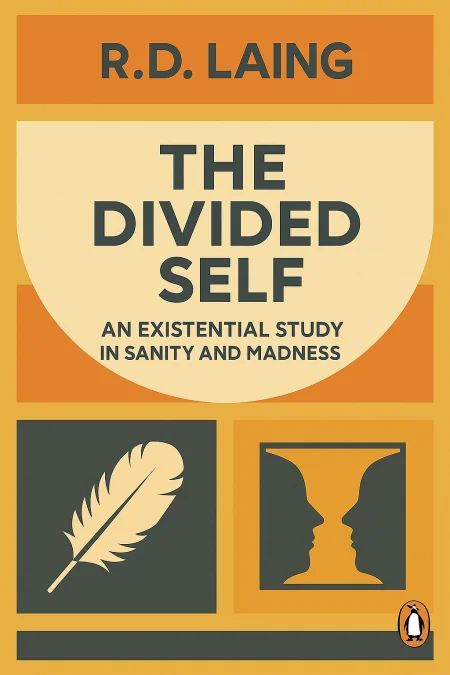
The Divided Self
An Existential Study in Sanity and Madness
Book Edition Details
Summary
In "The Divided Self," Dr. R.D. Laing embarks on a profound exploration of the human psyche, unraveling the delicate dance between sanity and madness. Through vivid case studies of individuals grappling with schizophrenia, Laing reveals how the very fabric of identity can fray, leading to profound alienation. He posits that madness is not a distant realm but a spectrum of human experience, challenging us to reconsider our perceptions of reality. This existential journey probes the haunting disconnection from one's true self, where the creation of a false persona becomes both refuge and prison. Laing’s work is a thought-provoking dive into the existential shadows of the mind, urging readers to reflect on the nature of authenticity and the essence of being real.
Introduction
Human existence presents a fundamental challenge: how do we maintain our authentic selfhood while navigating relationships with others and the world around us? This exploration delves into the most extreme manifestations of this existential dilemma, examining individuals who experience such profound ontological insecurity that they develop radical splits within their very being. Through detailed phenomenological analysis, we encounter people who feel more unreal than real, more dead than alive, and who construct elaborate false-self systems to navigate a world that feels perpetually threatening to their core identity. The investigation employs existential-phenomenological methods rather than traditional psychiatric categorization, revealing the meaningful structure underlying experiences typically dismissed as mere symptoms of mental illness. This approach illuminates how certain defensive strategies, initially developed to preserve the self, can paradoxically lead to its fragmentation and dissolution. The analysis traces the progression from basic ontological insecurity through schizoid withdrawal to complete psychotic breakdown, demonstrating that even the most bizarre manifestations of human distress contain comprehensible patterns when viewed from the experiential perspective of the sufferer.
The Schizoid Condition: Ontological Insecurity and Self-World Division
The foundation of human psychological development rests upon achieving what can be termed primary ontological security - a basic sense that one exists as a real, alive, whole, and continuous person in a world populated by equally real others. This fundamental assurance typically develops so naturally in early life that it becomes an unquestioned backdrop for all subsequent experience. However, some individuals emerge from infancy without this essential foundation, experiencing instead a pervasive sense of unreality, fragmentation, and precarious existence. Ontological insecurity manifests through three characteristic forms of anxiety that rarely trouble the ontologically secure person. Engulfment anxiety involves the dread that any relationship, however benign, threatens to swallow up one's fragile sense of autonomous identity. The individual fears that being understood, loved, or even simply seen will result in complete absorption into the other person, leading to the obliteration of the self. Implosion anxiety reflects the experience of emptiness at the core of one's being, creating terror that external reality might crash in like air rushing into a vacuum, obliterating the tenuous sense of selfhood. Petrification anxiety encompasses the fear of being turned from a living person into a dead thing, either through one's own defensive maneuvers or through the objectifying gaze of others. These anxieties create a paradoxical situation where the very relationships necessary for human flourishing become sources of existential threat. The ontologically insecure person cannot simply take their own existence for granted and proceed to engage with life's challenges and opportunities. Instead, every moment requires vigilant protection of a selfhood that feels constantly on the verge of dissolution. This defensive orientation fundamentally alters the meaning and function of all human relationships, transforming potential sources of nourishment into perceived dangers that must be carefully managed or avoided altogether. The resulting existential position represents a tragic inversion of normal human development. Rather than moving from basic security toward increasingly sophisticated forms of relatedness and self-expression, the ontologically insecure individual must constantly retreat from authentic engagement in order to preserve whatever fragile sense of selfhood they possess. This creates the foundation for the more dramatic splits and defensive maneuvers that characterize the fully developed schizoid condition.
The False Self System: Compliance, Impersonation, and Inner Withdrawal
When faced with overwhelming ontological insecurity, individuals often develop a characteristic defensive organization involving a radical split between an inner "true" self and an outer "false" self system. The true self retreats into a position of pure subjectivity, becoming unembodied and transcendent, observing but never directly participating in the world of action and relationship. Meanwhile, the false self system manages all actual transactions with reality, creating an elaborate performance designed to meet the perceived expectations of others while concealing the vulnerable inner core. This false self system operates primarily through compliance and impersonation. The individual learns to be what others want them to be, developing an extraordinary sensitivity to external expectations and a willingness to sacrifice authentic self-expression in favor of maintaining safety through conformity. The compliant self may appear perfectly normal, even exemplary, displaying all the socially approved behaviors while revealing nothing of the person's actual inner experience. This creates the curious phenomenon of individuals who seem well-adapted on the surface but feel profoundly fraudulent and empty within. Impersonation represents a more complex defensive strategy wherein the false self takes on the characteristics of other people, sometimes consciously and deliberately, sometimes compulsively and without full awareness. These impersonations may begin as simple mimicry but can evolve into elaborate personality fragments, each with its own gestures, mannerisms, and ways of relating. The individual may cycle through various personas, never feeling genuinely present in any of them, yet unable to access any more authentic mode of being. The tragic irony of the false self system lies in its self-defeating nature. While designed to preserve the true self by keeping it hidden and safe, this strategy actually accelerates the process of inner emptiness and unreality. The true self, deprived of genuine contact with others and the world, begins to wither from lack of nourishment. It becomes increasingly phantastic and volatilized, losing touch with the very reality it sought to protect itself from. Meanwhile, the false self system, despite its apparent competence, feels mechanical and lifeless to the individual, creating a persistent sense of futility and meaninglessness. The person experiences themselves as living a lie, going through the motions of existence without ever truly being present in their own life.
From Schizoid to Psychotic: The Breakdown of Personal Integration
The schizoid organization, while representing a significant departure from normal psychological development, can sometimes achieve a precarious stability for extended periods. However, the internal contradictions and tensions within this defensive structure make it inherently vulnerable to breakdown. The transition from schizoid functioning to frank psychosis occurs when the splits within the personality become so extreme that they can no longer be maintained as part of a unified, if divided, self. Several factors contribute to this breakdown of integration. The inner self, isolated from genuine contact with reality, becomes increasingly populated with phantastic relationships and magical thinking. Deprived of the corrective influence of real engagement with others, this inner world can become dominated by paranoid fears, grandiose fantasies, or destructive impulses that bear little relationship to external reality. Simultaneously, the false self system may become overextended or internally contradictory, harboring multiple incompatible personas that begin to operate autonomously rather than under any central control. The breakdown often involves a catastrophic loss of the boundary between inner and outer reality. Aspects of the inner phantastic world begin to be experienced as external perceptions, leading to hallucinations and delusions. Conversely, external events become interpreted through the lens of inner preoccupations, creating paranoid ideation and ideas of reference. The individual may feel that their thoughts are being stolen, that they are being controlled by external forces, or that they possess magical powers that can influence the world around them. Perhaps most tragically, the breakdown may involve a deliberate attempt to "murder" the self as the ultimate defensive maneuver. Unable to bear the anxiety of existing in a threatening world, and unable to find genuine connection with others, the individual may embrace a state of psychotic non-being as preferable to the agony of maintaining their precarious existence. This represents the final paradox of the schizoid defense: the attempt to preserve life through a kind of chosen death, to avoid being killed by embracing a form of suicide that preserves biological existence while destroying psychological selfhood. The resulting psychotic state represents not simply a deterioration of normal functioning, but a comprehensible, if tragic, outcome of the individual's attempts to solve the impossible existential problems created by their fundamental ontological insecurity. Understanding this progression reveals psychotic symptoms not as meaningless pathology, but as desperate attempts at communication and self-preservation by a profoundly threatened human being.
Clinical Cases: Understanding Madness Through Existential Analysis
The theoretical framework of ontological insecurity and schizoid defense takes on concrete meaning through detailed examination of individual cases, revealing how these abstract concepts manifest in actual human lives. Each case demonstrates the unique way that fundamental existential problems can unfold, while also illuminating the common underlying patterns that make such experiences comprehensible rather than simply bizarre or pathological. One particularly illuminating case involves a young woman whose psychosis centered around the conviction that "a child had been murdered." From a conventional psychiatric perspective, this appeared to be a straightforward delusion requiring medical management. However, existential analysis revealed that this statement contained profound existential truth about her experience of having her authentic selfhood destroyed through subtle but persistent invalidation by her family environment. Her "delusional" accusation that her mother had murdered a child represented an accurate, if symbolically expressed, understanding of what had happened to her own possibilities for genuine self-development. Another case demonstrates how the false self system can achieve such apparent normality that even trained professionals may miss the underlying schizoid organization. A young man appeared to function adequately in work and social situations, yet privately experienced himself as completely fraudulent, going through elaborate rituals of concealment and impersonation to maintain his facade of normalcy. His eventual psychotic breakdown seemed to come "out of nowhere" to external observers, but represented the inevitable collapse of an increasingly untenable defensive structure. These cases reveal that recovery requires more than simply eliminating symptoms or restoring social functioning. True healing involves helping the individual develop, often for the first time, a genuine sense of embodied selfhood that can engage authentically with others without being overwhelmed by engulfment anxiety. This process demands extraordinary patience and skill from therapists, who must learn to recognize and respond to the person's real communications rather than being misled by the false self presentations or dismissed by the apparent bizarreness of psychotic expression. The therapeutic relationship itself becomes a crucial testing ground where the individual can experiment with revealing their authentic self without facing the annihilation they have always feared. Through this process of genuine encounter, the fragments of the divided self can potentially be reunited into a more integrated and viable form of human existence, though the damage done by years of ontological insecurity can never be completely undone.
Summary
At its core, this analysis reveals that human madness, in its most extreme forms, represents not the breakdown of an essentially healthy mind, but the tragic outcome of attempts to preserve selfhood under conditions of fundamental existential threat. The elaborate defensive structures that develop in response to ontological insecurity - the splits between true and false selves, the retreat into phantasy, the desperate attempts at connection through impersonation and compliance - all represent comprehensible human responses to an impossible situation. Even the final dissolution into psychotic fragmentation follows a logic that becomes clear when viewed from the experiential perspective of the sufferer rather than the observational stance of the clinician. This understanding transforms our approach to human distress, suggesting that healing requires not the suppression of symptoms but the patient reconstruction of basic ontological security through authentic human relationship. The work speaks particularly to those seeking to understand the deepest structures of human existence and the conditions necessary for psychological health and authentic selfhood.
Related Books
Download PDF & EPUB
To save this Black List summary for later, download the free PDF and EPUB. You can print it out, or read offline at your convenience.
By R.D. Laing
