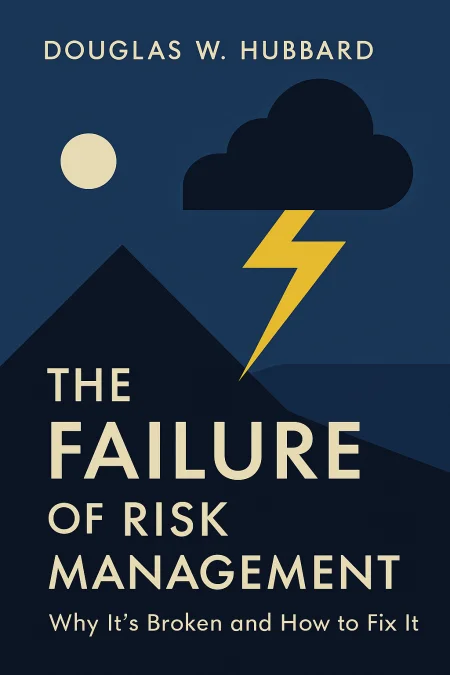
The Failure of Risk Management
Why it’s Broken and How to Fix It
Book Edition Details
Summary
In the world of risk management, familiar practices often masquerade as science, yet too often resemble superstition. Douglas W. Hubbard dismantles these illusions with razor-sharp insight in "The Failure of Risk Management." Through vivid examples drawn from financial meltdowns and engineering catastrophes, Hubbard exposes the shortcomings of conventional methods, revealing them as dangerously inadequate. But fear not: the book illuminates a path forward, blending proven strategies from high-stakes arenas like nuclear power and oil exploration. Hubbard, a pioneer in Applied Information Economics, shows that by fostering cross-industry collaboration, we can transform the way we approach risk. Essential reading for anyone navigating the turbulent waters of uncertainty, this guide promises not just critique, but a revolution in how we perceive and manage the unforeseen.
Introduction
Why do organizations with sophisticated risk management systems still experience catastrophic failures that their elaborate assessment processes failed to predict? This fundamental paradox reveals a troubling reality: the very methodologies designed to protect organizations from uncertainty often create dangerous illusions of control while systematically underestimating genuine threats. The theoretical framework presented here challenges the entire foundation of contemporary risk management, exposing how popular approaches violate basic principles of probability theory, measurement science, and human psychology. The core analytical structure demonstrates that effective risk assessment requires a radical shift from subjective scoring systems to calibrated probabilistic modeling, where uncertainty becomes measurable rather than merely categorizable. This transformation addresses critical questions about why expert judgment consistently fails under uncertainty, how mathematical models can incorporate rather than ignore human cognitive limitations, and what empirical validation processes can distinguish genuine predictive capability from elaborate organizational theater. The ultimate theoretical contribution lies in establishing risk management as a quantitative discipline grounded in observable outcomes rather than consensus-building exercises disguised as scientific analysis.
The Crisis in Modern Risk Management
The contemporary risk management landscape exhibits a systematic pattern of methodological failure that transcends individual organizational shortcomings and reveals fundamental flaws in the theoretical foundations underlying popular approaches. This crisis manifests through what can be characterized as the "risk management paradox" where increased investment in formal assessment processes correlates with continued exposure to preventable catastrophic failures. The theoretical framework for understanding this phenomenon begins with recognizing that most widely adopted risk methodologies function as sophisticated placebos, providing psychological comfort through the appearance of rigorous analysis while offering no genuine predictive capability. The structural dimensions of this crisis emerge from the proliferation of incompatible assessment frameworks, each claiming scientific authority while lacking empirical validation of their effectiveness. Professional certification programs multiply, consulting revenues expand, and regulatory compliance requirements increase, yet objective measures of improved decision-making outcomes remain conspicuously absent. This pattern resembles other management fads that generate substantial activity without demonstrable results, suggesting that the field has become more concerned with process completion than outcome improvement. The psychological components of the crisis prove equally significant, as risk management practitioners consistently exhibit overconfidence in their subjective assessments while remaining unaware of their systematic biases. Organizational incentive structures compound this problem by rewarding the appearance of control rather than genuine predictive accuracy, creating what the author terms "risk theater" where elaborate presentations mask fundamental analytical inadequacies. Survey data revealing widespread satisfaction among practitioners with current methodologies becomes particularly troubling when examined against the continued frequency of organizational disasters that these same methodologies failed to anticipate. The stakes of this crisis extend far beyond corporate profits to encompass public safety, national security, and economic stability, as demonstrated by the cascading effects of risk management failures in financial institutions, critical infrastructure, and healthcare systems. The urgent need for evidence-based alternatives becomes clear when considering that flawed risk assessment may actually increase organizational vulnerability by directing attention and resources away from genuine threats toward imaginary ones identified through systematically biased analytical processes.
Why Current Risk Assessment Methods Fail
The theoretical foundation for understanding systematic failures in contemporary risk assessment rests on three interconnected categories of methodological error that compound to create dangerously misleading analyses. The first category encompasses the complete neglect of well-documented psychological biases that affect human judgment under uncertainty, despite decades of research in decision psychology that has identified consistent patterns of overconfidence, probability misestimation, and logical errors that plague expert assessments across domains. The mathematical problems inherent in popular scoring systems constitute the second failure category, where ordinal scales and qualitative rankings violate basic principles of measurement theory while creating an illusion of precision where none exists. When analysts assign risks categorical ratings such as "high," "medium," or "low," they lose essential quantitative information about probability distributions and magnitude relationships that are crucial for rational decision-making. These arbitrary measurement schemes introduce their own sources of systematic error through range compression effects, where meaningful distinctions between different risk levels disappear into averaged categories that obscure rather than illuminate genuine threats. The third category involves fundamental conceptual errors in quantitative approaches that appear mathematically sophisticated but violate basic principles of probability theory and statistical analysis. Even complex models can produce systematically misleading results when built on false assumptions about system behavior, independence of events, or the nature of extreme outcomes. Financial models assuming normal distributions of returns consistently underestimate the frequency of market crashes, while engineering models that ignore human factors miss critical failure modes that emerge from the interaction between technical systems and human operators. These three failure categories interact synergistically to create risk assessments that are simultaneously overconfident and inaccurate, potentially increasing organizational exposure to catastrophic events while providing false reassurance about preparedness levels. The combination of uncorrected human bias, arbitrary measurement scales, and flawed mathematical assumptions produces what can be characterized as a perfect storm of analytical dysfunction that explains why sophisticated risk management systems consistently fail to prevent foreseeable disasters.
Human Bias and Quantitative Model Errors
The systematic patterns of error in human probability assessment represent one of the most well-documented phenomena in decision psychology, yet mainstream risk management approaches continue to treat expert judgment as reliable input without implementing any correction mechanisms. Research consistently demonstrates that individuals exhibit severe overconfidence when estimating probabilities, typically assigning confidence levels that are far too high relative to their actual accuracy rates. When experts claim ninety percent confidence in their predictions, they are typically correct only about seventy percent of the time, representing a catastrophic level of miscalibration that becomes particularly dangerous when assessing rare but high-impact events. The overconfidence phenomenon extends beyond simple probability estimates to encompass range assessments, where experts provide confidence intervals that capture actual outcomes far less frequently than their stated confidence levels would suggest. This systematic underestimation of uncertainty leads to inadequate preparation for scenarios that are more likely than decision-makers realize, creating organizational vulnerabilities that remain invisible until disasters strike. The tendency becomes especially pronounced when evaluating complex systems where multiple interdependent factors can interact in unexpected ways to produce outcomes that fall outside the narrow ranges that overconfident experts consider plausible. Beyond overconfidence, human judgment suffers from numerous other cognitive limitations including representativeness errors, conjunction fallacies, and insensitivity to base rates that affect not only probability assessments but also the identification of relevant risks and evaluation of potential consequences. These biases operate automatically and unconsciously, making them particularly difficult to detect and correct through conventional training approaches that focus on technical knowledge rather than cognitive calibration. Even sophisticated quantitative models prove vulnerable to systematic errors when they fail to account for human limitations or make unrealistic assumptions about the behavior of complex systems. Mathematical elegance provides no protection against models that assume independence where correlation exists, normal distributions where fat tails dominate, or rational behavior where psychological factors drive decisions. The combination of biased human inputs and flawed mathematical assumptions creates models that appear rigorous while producing dangerously misleading results that can guide organizations toward rather than away from catastrophic outcomes.
Building Scientific Risk Management Systems
The transformation toward scientific risk management begins with the fundamental recognition that uncertainty can be measured and human judgment can be systematically improved through calibration training that teaches experts to overcome their natural cognitive biases. This process involves repeated practice with probability estimation exercises where individuals receive immediate feedback on their accuracy, gradually developing an intuitive understanding of uncertainty that translates into more reliable risk assessments. Calibration training typically requires hundreds of practice questions across diverse domains, but the investment pays substantial dividends in improved decision-making capability. The computational foundation for scientific risk management lies in Monte Carlo simulation and other probabilistic modeling techniques that preserve the full distribution of possible outcomes rather than reducing rich uncertainty information to crude categorical scores. These methods allow complex systems with multiple interacting uncertainties to be modeled appropriately, capturing cascade effects and interdependencies that conventional approaches systematically ignore. Monte Carlo techniques enable analysts to explore thousands of potential scenarios, identifying not just the most likely outcomes but also the tail risks that could prove catastrophic despite their low individual probabilities. Empirical validation represents the crucial distinguishing feature that separates scientific risk management from its pseudoscientific predecessors, requiring systematic comparison of predicted probability distributions with actual outcomes over extended time periods. This validation process creates feedback loops that enable continuous refinement of both human judgment and mathematical models based on their demonstrated performance rather than their theoretical elegance or popularity among practitioners. Organizations implementing scientific approaches must track their forecasts systematically, identifying patterns of bias and adjusting their methodologies accordingly. The implementation of scientific risk management demands organizational changes that support intellectual honesty, reward predictive accuracy over consensus building, and create incentives for continuous improvement based on empirical evidence. This cultural transformation requires abandoning comfortable illusions of control in favor of transparent acknowledgment of uncertainty, where admitting ignorance becomes a strength rather than a weakness and where the quality of decision-making processes matters more than the appearance of confident authority. The ultimate goal is creating learning organizations that become progressively better at anticipating and managing genuine risks rather than merely satisfying compliance requirements or providing false reassurance to stakeholders.
Summary
The fundamental insight that emerges from this comprehensive analysis is that effective risk management requires treating uncertainty as a measurable quantity subject to scientific investigation rather than an unknowable mystery that can only be addressed through subjective consensus, transforming organizational decision-making from elaborate guesswork into calibrated probabilistic reasoning grounded in empirical validation. This theoretical framework promises not only superior protection against catastrophic failures but also enhanced strategic capability to identify and capitalize on opportunities that traditional approaches would systematically overlook or mischaracterize. The long-term significance of this transformation extends beyond individual organizational outcomes to encompass the restoration of public trust in institutional risk management through transparent, testable, and continuously improving analytical frameworks that can demonstrate their effectiveness through observable results rather than merely claiming authority through professional credentials or regulatory compliance.
Related Books
Download PDF & EPUB
To save this Black List summary for later, download the free PDF and EPUB. You can print it out, or read offline at your convenience.
By Douglas W. Hubbard
