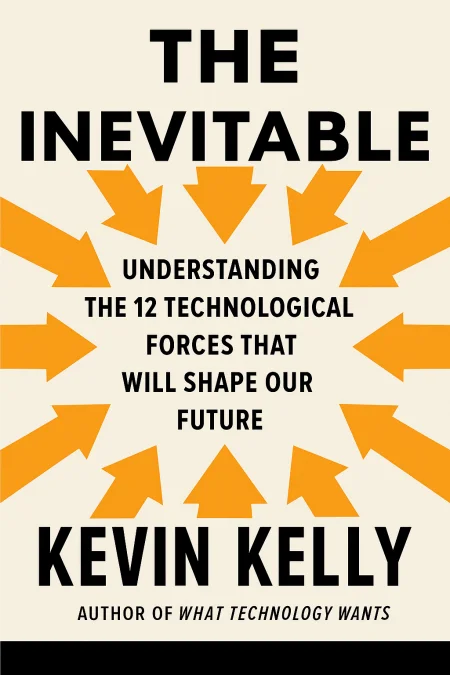
The Inevitable
Understanding the 12 Technological Forces That Will Shape Our Future
Book Edition Details
Summary
Kevin Kelly's visionary manifesto invites you to gaze into the horizon of technology's future—a tapestry woven from twelve transformative threads that promise to redefine human experience over the next three decades. As digital currents surge forward, Kelly reveals an interconnected dance of forces—where artificial intelligence, virtual realms, and the relentless flow of information converge to reshape our existence. This dynamic interplay will revolutionize how we engage with the world: altering commerce, creativity, learning, and communication. Far from a dystopian forecast, Kelly’s work is a beacon of optimism, urging us to navigate and harness these shifts for our collective benefit. Whether you’re a dreamer, innovator, or cautious observer, Kelly equips you with the insight to thrive in this inevitable evolution, sparking a thoughtful dialogue on our shared digital destiny.
Introduction
We stand at the threshold of a technological transformation so profound that it will reshape every aspect of human existence. The digital revolution is not merely changing how we work, communicate, or entertain ourselves—it is fundamentally altering the nature of reality itself. This transformation follows predictable patterns and trajectories that, while not determining specific outcomes, create powerful currents that guide our collective future. Understanding these underlying forces becomes essential for anyone seeking to navigate the coming decades with wisdom and purpose. The technological ecosystem operates according to inherent biases and tendencies that transcend individual companies, governments, or cultural preferences. These forces emerge from the basic physics of information, the mathematics of networks, and the fundamental properties of digital systems. They represent the deep structural changes occurring beneath the surface of daily technological news and product announcements. By recognizing these patterns, we can better prepare for a future that will be simultaneously more connected, more fluid, and more intelligent than anything humanity has previously experienced.
From Products to Processes: Becoming, Cognifying, and Flowing
The most fundamental shift occurring in our technological landscape involves the transformation of static objects into dynamic processes. This represents a move away from the industrial age paradigm of fixed, finished products toward an era of continuous becoming, where everything exists in a state of perpetual upgrade and evolution. Rather than purchasing completed items that remain unchanged, we increasingly engage with services and systems that adapt, learn, and improve over time. This transformation manifests through three interconnected forces. Becoming describes the shift from products to processes, where traditional nouns become verbs and static objects become flowing services. Nothing remains finished or final—everything exists in beta, constantly updating and evolving. Cognifying refers to the embedding of artificial intelligence into previously inert objects and systems, making them responsive, adaptive, and increasingly capable of independent decision-making. Flowing represents the movement from ownership-based models to access-based systems, where value lies not in possessing things but in participating in streams of continuous improvement and customization. Consider how these forces reshape something as mundane as transportation. The traditional model involved purchasing a car—a fixed object that depreciated over time and required individual maintenance. The emerging model transforms transportation into a service that combines artificial intelligence for routing and safety, continuous software updates that improve performance, and access-based sharing that eliminates the burden of ownership. The vehicle becomes a node in an intelligent network rather than an isolated possession, constantly learning from collective usage patterns and adapting to individual preferences. This paradigm shift extends far beyond technology products into every domain of human activity. Education transforms from discrete courses to lifelong learning streams. Healthcare evolves from episodic treatments to continuous monitoring and optimization. Even physical infrastructure begins to exhibit these characteristics as sensors, connectivity, and intelligence transform static systems into responsive networks. The implications challenge fundamental assumptions about property, value, and the nature of progress itself.
Digital Culture Revolution: Screening, Accessing, and Sharing
The second major transformation involves the fundamental reorganization of how humans interact with information, media, and each other. This shift moves us from a culture centered on books and fixed media to one organized around screens and dynamic content. Simultaneously, it transforms our relationship with material goods from ownership-based to access-based models, while creating new forms of social organization based on sharing and collaboration. Screening represents the transition from the linear, hierarchical world of books to the networked, interactive realm of digital displays. This involves more than simply reading text on screens—it encompasses a new form of literacy that combines text, images, sound, and interactivity into fluid, responsive experiences. The screen becomes a portal into vast networks of interconnected information rather than a window into isolated documents. This transformation changes not just how we consume information but how we think, process ideas, and understand reality itself. Accessing emerges as the dominant economic model as digital technologies make it more efficient to provide services on demand rather than requiring individual ownership. The combination of cloud computing, mobile connectivity, and intelligent algorithms enables instant access to virtually any resource without the costs and complications of possession. This shift affects everything from entertainment and transportation to tools and expertise, creating new forms of value based on convenience, customization, and continuous improvement rather than accumulation of objects. Sharing becomes the fundamental organizing principle of digital culture, enabling new forms of collaboration and collective intelligence that transcend traditional institutional boundaries. This goes beyond simple file sharing to encompass the collaborative creation of knowledge, the pooling of resources and capabilities, and the emergence of peer-to-peer networks that can accomplish tasks previously requiring large organizations. The sharing economy represents just the beginning of this transformation, which ultimately points toward new forms of social organization based on voluntary cooperation and mutual benefit. These forces work together to create a culture that is more fluid, responsive, and collectively intelligent than previous forms of social organization. They enable rapid adaptation to changing circumstances while creating new challenges around privacy, security, and the distribution of benefits from collective efforts.
Navigating Abundance: Filtering and Remixing in the Information Age
The third transformation addresses the fundamental challenge of abundance in digital systems. As the cost of creating and distributing content approaches zero, we face an explosion of choices that overwhelms human cognitive capacity. This creates the need for sophisticated filtering systems while simultaneously enabling new forms of creativity through remixing and recombination of existing elements. Filtering becomes essential as the volume of available content grows exponentially. Traditional gatekeepers—publishers, broadcasters, retailers—lose their monopoly on curation as algorithmic systems and social networks create new ways of sorting through infinite options. These systems must balance personalization with discovery, helping individuals find content that matches their preferences while avoiding the trap of filter bubbles that limit exposure to new ideas. The challenge lies in creating filters that enhance human agency rather than replacing human judgment, serving as tools for exploration rather than mechanisms of control. Remixing emerges as the dominant mode of cultural creation as digital tools make it easier to combine and recombine existing elements than to create entirely original works. This represents a return to the historical norm of cultural development, where new works built upon previous traditions through adaptation and reinterpretation. Digital technologies simply make this process more visible and accessible, enabling anyone to participate in cultural creation by building upon the vast commons of existing works. The interaction between filtering and remixing creates a dynamic ecosystem where the abundance of choices drives innovation in curation, while the ease of remixing generates even more content that requires filtering. This creates positive feedback loops that accelerate cultural development while challenging traditional notions of authorship, originality, and intellectual property. The result is a more participatory culture where the boundaries between creators and consumers blur, and where value increasingly lies in the ability to navigate and synthesize rather than to create from scratch. These forces point toward a future where human creativity is augmented by intelligent systems that help us discover, combine, and refine ideas in ways that would be impossible through individual effort alone. The challenge lies in maintaining human agency and meaning within systems that can process information at scales far beyond human capacity.
Human-AI Collaboration and the Platform Economy
The final transformation involves the emergence of new forms of collaboration between humans and artificial intelligence, facilitated by platform-based economic models that transcend traditional organizational boundaries. This represents a fundamental shift from viewing technology as a tool to understanding it as a collaborative partner in human endeavors, while simultaneously creating new economic structures that enable unprecedented coordination and value creation. Human-AI collaboration leverages the complementary strengths of biological and artificial intelligence. Humans excel at creativity, emotional intelligence, ethical reasoning, and handling ambiguous situations, while AI excels at processing vast amounts of data, recognizing patterns, performing calculations, and maintaining consistency. When combined, these capabilities create hybrid systems that outperform either humans or machines working independently. This collaborative model appears across domains from medical diagnosis to creative arts, where the combination of human insight and machine processing power achieves results neither could accomplish alone. The platform economy provides the infrastructure for these new forms of collaboration by creating digital spaces where resources, capabilities, and intelligence can be shared and combined in novel ways. Platforms enable the coordination of distributed networks of participants, allowing individuals and organizations to contribute their unique capabilities to collective endeavors without requiring traditional hierarchical structures. This creates new possibilities for innovation and value creation that transcend the limitations of individual organizations or geographic boundaries. The convergence of human-AI collaboration and platform economics points toward a future where intelligence becomes a shared resource rather than a scarce commodity, and where the boundaries between human and machine capabilities become increasingly fluid. This transformation promises to unlock new forms of creativity and problem-solving while raising important questions about the distribution of benefits and the preservation of human agency in an increasingly automated world.
Summary
The future emerges not from the specific technologies we create, but from the deeper forces that guide technological development toward greater connectivity, intelligence, and fluidity. These forces operate with the inevitability of natural laws, creating currents that shape our collective destiny regardless of individual choices or institutional resistance. By understanding and working with these forces rather than against them, we can harness their power to create a future that serves human flourishing while embracing the transformative potential of our technological capabilities. The ultimate significance of this framework lies not in predicting specific outcomes, but in providing the conceptual tools necessary to navigate an era of unprecedented change with wisdom, purpose, and hope.
Related Books
Download PDF & EPUB
To save this Black List summary for later, download the free PDF and EPUB. You can print it out, or read offline at your convenience.
By Kevin Kelly
