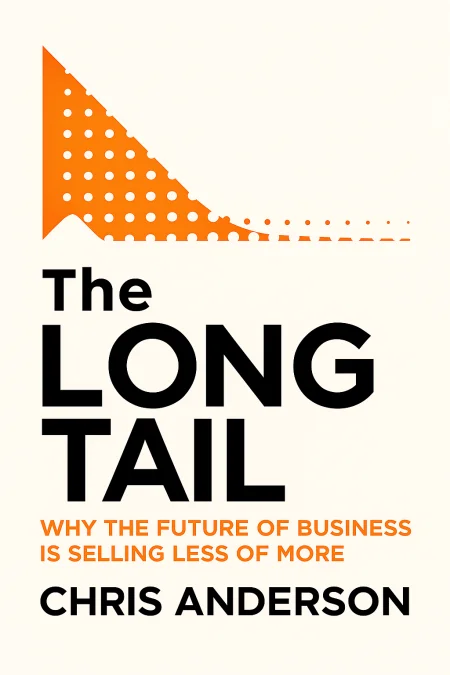
The Long Tail
Why the Future of Business is Selling Less of More
Book Edition Details
Summary
In a world where traditional hits lose their luster, Chris Anderson's groundbreaking narrative reveals the hidden goldmine of the marketplace—the overlooked "misses" of the demand curve. "The Long Tail" reimagines commerce and culture, showcasing how the internet reshapes industries by empowering niche markets. With an innovative blend of insightful analysis and engaging storytelling, Anderson argues that the future belongs to those who embrace diversity in products and ideas, turning the conventional blockbuster model on its head. As the digital landscape transforms, this seminal work challenges you to see beyond the obvious, discovering profits in the myriad choices that cater to unique tastes. Whether you're an entrepreneur, a consumer, or simply curious about the evolving world of business, this book is a must-read.
Introduction
Why do we continue to organize our economy around hits when technology has made it possible to serve every niche? For decades, the entertainment industry, retail, and media have operated under the assumption that only blockbusters matter, that success means appealing to the largest possible audience. This scarcity-driven mindset emerged from physical limitations: limited shelf space in stores, finite broadcast channels, and the high costs of distribution. But digital technology has fundamentally altered these constraints, creating unprecedented opportunities for niche markets to flourish. The theoretical framework explored here challenges the traditional hit-driven economy by revealing how digital distribution creates what economists call a "power law" demand curve. This curve demonstrates that while hits remain important, the collective market for niche products can rival or exceed the market for mainstream offerings. The theory encompasses three fundamental forces: the democratization of production tools, the democratization of distribution channels, and the emergence of sophisticated filtering mechanisms that help consumers navigate infinite choice. Together, these forces are reshaping how we think about supply, demand, and consumer behavior in the digital age. This transformation raises profound questions about the future of culture, commerce, and the very nature of popular taste in an era of unlimited variety.
The Economics of Abundance: From Scarcity to Infinite Choice
The fundamental shift from scarcity to abundance represents one of the most significant economic transformations of our time. Traditional economics has long been defined as the study of choice under scarcity, focusing on how to allocate limited resources among unlimited wants. This framework made perfect sense in a world where shelf space was expensive, distribution channels were few, and storage costs were prohibitive. The famous 80/20 rule emerged from these constraints, suggesting that 20 percent of products generate 80 percent of revenues, making it economically rational to focus exclusively on potential hits. Digital technology has inverted this logic by making storage virtually free and distribution nearly costless. When Amazon can offer millions of books compared to a physical bookstore's thousands, or when Netflix can provide tens of thousands of films versus a video store's hundreds, the economics of variety fundamentally change. The marginal cost of carrying additional inventory approaches zero, eliminating the traditional trade-offs between variety and profitability. This abundance doesn't just mean more choice; it reveals previously hidden demand for products that never had a chance to find their audience. The implications extend far beyond simple inventory expansion. In abundant markets, the shape of demand itself transforms from a steep curve dominated by a few hits to a flatter distribution where niche products collectively represent substantial value. Consider how Google's advertising model succeeds precisely because it can economically serve millions of small advertisers who were previously ignored by traditional media. The company discovered that the collective value of serving countless micro-markets could rival the revenue from major advertisers. This abundance economy rewards different strategies: instead of predicting hits, successful companies focus on aggregating everything and letting sophisticated filtering help consumers find what they want. The result is not chaos but a more efficient matching of supply with the true diversity of human demand. When storage and distribution costs disappear, the economics of variety become fundamentally different, revealing that our culture and economy are far more diverse than traditional hit-driven markets suggested.
Digital Democratization: New Producers and Distribution Channels
The democratization of production tools has fundamentally altered who can create and distribute content. Professional-grade software that once cost tens of thousands of dollars now runs on consumer laptops, while high-quality cameras fit in smartphones and recording studios exist in bedrooms. This technological shift has lowered barriers to entry across industries, enabling millions of individuals to become producers rather than mere consumers. The phenomenon extends beyond creative industries to manufacturing, where 3D printing and computer-aided design tools allow small-scale production that was previously impossible. Equally transformative is the democratization of distribution channels. Traditional gatekeepers like record labels, publishers, and broadcast networks once controlled access to audiences, creating artificial scarcity in what could reach the market. Digital platforms have eliminated these bottlenecks, allowing anyone to publish a book, release music, or broadcast video to global audiences. YouTube processes more video uploads in a single day than all television networks combined broadcast in decades. This shift from push to pull distribution means that instead of a few entities deciding what audiences should see, millions of creators can offer their work directly to consumers who actively seek it out. The convergence of democratized production and distribution creates what economists call "peer production" networks. Wikipedia exemplifies this model, where thousands of volunteers collectively create an encyclopedia that rivals traditional reference works in scope and often exceeds them in timeliness and depth. Similarly, open-source software projects demonstrate how distributed collaboration can produce complex products without traditional corporate structures. These examples illustrate a broader principle: when the costs of coordination drop dramatically, new organizational forms become possible. The result is an explosion of variety and innovation that no centralized system could match, as millions of individuals pursue their particular interests and expertise, collectively serving niches that were previously too small to address profitably. This democratization doesn't eliminate professional creators but rather expands the ecosystem to include countless specialized producers who can find their specific audiences in the vast digital marketplace.
Filters and Recommendation Systems: Navigating the Long Tail
The explosion of choice created by digital abundance presents a fundamental challenge: how do consumers navigate millions of options without becoming overwhelmed? Traditional retail solved this problem through physical constraints and professional curation, but infinite digital shelves require new approaches. Sophisticated filtering mechanisms have emerged as the critical infrastructure that makes abundance manageable, transforming what could be paralyzing choice into personalized discovery experiences. Recommendation systems represent the most powerful of these filters, using collaborative filtering algorithms to predict what individuals might enjoy based on the preferences of similar users. Amazon's "customers who bought this also bought" feature exemplifies this approach, creating a form of automated word-of-mouth that helps products find their natural audiences. These systems work particularly well for niche products because they can identify the small but passionate communities that exist for almost any interest. Netflix's recommendation engine, for instance, helps obscure documentaries and foreign films find viewers who would never encounter them through traditional marketing channels. Search technologies provide another crucial filtering layer, allowing consumers to actively seek specific content rather than passively accepting whatever appears on limited shelves. Google's PageRank algorithm essentially democratizes authority by measuring how many other sites link to a particular page, creating a reputation system that helps quality content rise above noise. Social filtering adds another dimension, as platforms like Reddit and Digg allow communities to collectively identify and promote content worth attention. User-generated reviews and ratings provide yet another filter, offering peer perspectives that often prove more trustworthy than professional critics. The sophistication of these filtering systems continues to evolve, incorporating machine learning, natural language processing, and behavioral analysis to better understand individual preferences. The goal is not to limit choice but to organize it intelligently, helping consumers discover products that match their specific tastes rather than settling for lowest-common-denominator offerings. When filters work effectively, they create a virtuous cycle: better recommendations lead to more satisfied customers, who provide more data that improves future recommendations, ultimately making the entire system more efficient at connecting supply with demand across the full spectrum of human interests.
Cultural Fragmentation: From Mass Markets to Niche Communities
The shift from mass markets to niche communities represents a fundamental transformation in how culture forms and spreads. The twentieth century was defined by shared cultural experiences: everyone watched the same television shows, listened to the same radio stations, and read the same magazines. This mass culture created common reference points and social cohesion, but it also meant that diverse interests and perspectives were marginalized in favor of content designed to appeal to the broadest possible audience. Digital technology has fragmented this unified cultural landscape into millions of microcultures, each organized around specific interests, values, or identities. Instead of three television networks serving everyone, we now have countless online communities serving every conceivable niche. Fans of obscure music genres can connect globally, hobbyists can find others who share their particular passions, and subcultures that were once isolated can flourish in digital spaces. This fragmentation doesn't necessarily mean cultural isolation; rather, it allows for more authentic expressions of identity and interest. The implications of this cultural shift extend beyond entertainment to politics, education, and social organization. When people can easily find others who share their specific interests, they form stronger communities around those shared passions. A blogger writing about a highly specialized topic can find a global audience of hundreds or thousands of engaged readers, creating a sustainable community that would be impossible in a mass-media environment. These niche communities often demonstrate higher levels of engagement and loyalty than mass audiences, precisely because the content speaks directly to their specific interests and needs. However, this fragmentation also raises important questions about social cohesion and shared understanding. Critics worry that when everyone retreats into their own cultural bubble, society loses the common experiences that bind communities together. Yet evidence suggests that people don't simply narrow their interests when given more choice; instead, they explore more diverse content than ever before. Netflix users, for example, rent films across many more genres than they would encounter in a traditional video store. The key insight is that cultural fragmentation doesn't necessarily mean cultural impoverishment, but rather enables a richer, more diverse cultural ecosystem where niche interests can flourish alongside mainstream entertainment.
Summary
The digital revolution has fundamentally inverted the economics of scarcity, revealing that in a world of infinite shelf space and zero marginal distribution costs, the collective market for niche products can rival the economics of hits. This transformation encompasses the democratization of production tools and distribution channels, the emergence of sophisticated filtering systems that help consumers navigate unlimited choice, and the fragmentation of mass culture into countless thriving microcultures. The theoretical framework demonstrates that abundance doesn't create chaos but rather enables a more efficient matching of supply with the true diversity of human demand. For individuals, this shift means unprecedented access to content, products, and communities that align with their specific interests and needs. For businesses, it suggests new strategies focused on aggregation and curation rather than hit prediction. For society, it promises a more diverse and inclusive cultural landscape where niche interests can flourish alongside mainstream entertainment, ultimately creating richer experiences for everyone while challenging us to develop new ways of maintaining social cohesion in an increasingly fragmented world.
Related Books
Download PDF & EPUB
To save this Black List summary for later, download the free PDF and EPUB. You can print it out, or read offline at your convenience.
By Chris Anderson
