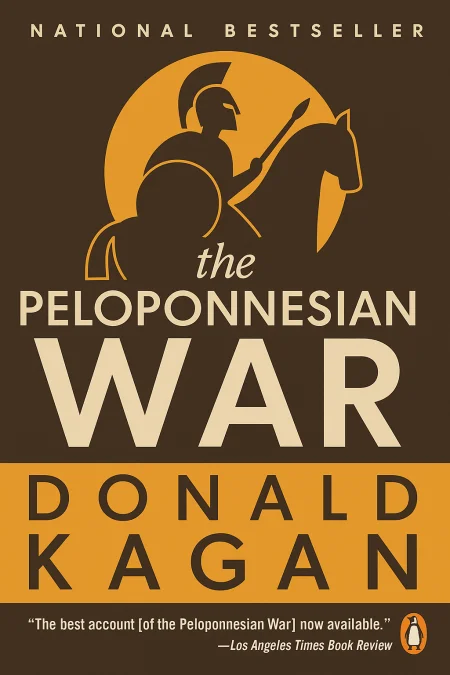
The Peloponnesian War
Get a primer on the epic Peloponnesian War
Book Edition Details
Summary
In the tumultuous realm of ancient Greece, a colossal clash erupted, reshaping the fabric of history—the Peloponnesian War. Donald Kagan, a revered figure in classical and military history, unveils an electrifying chronicle of this intense struggle, where Athens and Sparta, once allies, became fierce adversaries. This gripping narrative transcends mere historical recounting, offering a vivid tapestry of a world besieged by chaos, where democracy battled oligarchy, and naval power redefined the art of war. As Kagan breathes life into long-vanished cities and battlefields, the reader is drawn into a saga of ambition and downfall, whose echoes still stir the conscience of our modern age.
Introduction
In the autumn of 413 BC, as news of the catastrophic defeat in Sicily reached Athens, the greatest democracy of the ancient world stood at a crossroads that would determine not only its survival but the very nature of democratic governance under extreme pressure. The Athenian Empire, which had dominated the Aegean for decades, suddenly found itself facing enemies on multiple fronts while grappling with internal divisions that threatened to tear apart the fabric of its democratic institutions. This pivotal decade reveals how external military pressures can expose and amplify internal political contradictions, forcing societies to choose between their ideals and their survival. The story illuminates three profound questions that resonate across history: How do democracies respond when faced with existential threats? What happens when military necessity conflicts with democratic principles? And can a society maintain its core values while adapting to radically changed circumstances? The narrative that unfolds offers invaluable insights for anyone seeking to understand the dynamics of political crisis, the fragility of democratic institutions, and the eternal tension between security and freedom. Students of history, political science, and leadership will find in these events a compelling case study of how individual decisions in moments of crisis can reshape the destiny of nations and the course of civilization itself.
Sicilian Disaster to Constitutional Crisis (413-411 BC)
The catastrophic news from Sicily struck Athens like a thunderbolt in September 413 BC. The great expedition that had departed with such fanfare and confidence had ended in total annihilation, with thousands of Athenian soldiers dead or enslaved in Syracusan quarries. The immediate reaction was disbelief, then anger, then a creeping fear as the full implications became clear. Athens had lost not just an army and fleet, but its aura of invincibility. The disaster exposed the empire's fundamental vulnerabilities. With perhaps only 9,000 adult male citizens of military age remaining from a pre-war population of 25,000, Athens faced a manpower crisis of staggering proportions. The treasury was nearly empty, the emergency reserve fund exhausted, and rebellions were already stirring throughout the empire as subject cities sensed weakness. Most ominously, Sparta had established a permanent garrison at Decelea in Attica, creating a year-round threat that prevented normal agricultural activity and forced Athens to import food by longer, more expensive routes. In this moment of crisis, the Athenians made a remarkable decision that revealed both their democratic resilience and their recognition of the need for extraordinary measures. They elected a board of ten probouloi, older men of proven experience, to provide guidance and stability. This was not yet oligarchy, but it represented a significant modification of normal democratic procedures, placing unprecedented power in the hands of a small group chosen for their wisdom rather than their popularity. The psychological impact of these changes rippled through Athenian society, creating the conditions for more radical transformations to come. As traditional democratic leaders lay dead in Sicily and the remaining politicians faced an increasingly desperate situation, new voices began to emerge with new solutions, setting the stage for the constitutional upheavals that would soon follow.
Oligarchic Revolution and Democratic Restoration (411-410 BC)
The movement to overthrow Athenian democracy began not in Athens itself, but in the military camps of Samos, where Athenian forces struggled to maintain control of their rebellious empire. The catalyst was Alcibiades, the brilliant but treacherous exile who had already betrayed Athens to Sparta and now sought to betray Sparta to Persia. From his precarious position at the court of the Persian satrap Tissaphernes, Alcibiades dangled an irresistible promise before his former countrymen: he could bring Persian gold and ships to Athens' side, but only if they abandoned their democracy and recalled him from exile. The message found receptive ears among the Athenian commanders and wealthy citizens serving at Samos, but for different reasons. Men like Thrasybulus, who would later become democracy's greatest champion, saw constitutional change as a bitter but necessary medicine to save the city. Others, including the generals Phrynichus and Peisander, embraced oligarchy as an end in itself, viewing the crisis as an opportunity to overthrow a system they had long despised. When Peisander returned to Athens to present the proposal to the assembly, he faced a hostile crowd that erupted in protest at the mention of recalling the cursed traitor Alcibiades. His response was masterful political theater. Rather than defend the proposals, he challenged each opponent to offer an alternative path to salvation. With Sparta commanding equal naval forces, Persian gold flowing to Athens' enemies, and the treasury empty, what other hope existed? The assembly, faced with this stark choice between constitutional change and probable destruction, reluctantly voted to send negotiators to treat with Alcibiades and Tissaphernes. The oligarchic revolution immediately faced the fundamental problem that had doomed it from the start: the Athenian fleet at Samos refused to accept the new regime. Led by Thrasybulus and other democratic commanders, the sailors and soldiers declared themselves the true representatives of the Athenian people and elected their own generals. The restoration of democracy came through a carefully managed transition that avoided the bloodbath that might have been expected, demonstrating both the resilience of democratic ideals and the continuing divisions within Athenian society.
Naval Revival and the Final Struggle (410-405 BC)
The restored democracy's initial successes created a dangerous overconfidence that ultimately proved fatal. A series of brilliant naval victories, culminating in the triumph at Arginusae in 406 BC, seemed to vindicate the democratic system and suggest that Athens might yet prevail in the long struggle. At Cyzicus, Thrasybulus had orchestrated a masterpiece of naval strategy, destroying the Spartan fleet and killing its commander Mindarus. These triumphs restored Athenian control of the Hellespont and prompted Sparta to offer peace terms that would have preserved most of Athens' empire. However, these very successes contained the seeds of final disaster, as they led to strategic overextension and a fatal breakdown in the unity that had made the restoration possible. The battle of Arginusae, while a tactical masterpiece, became a political catastrophe when a storm prevented the rescue of survivors from damaged ships. The democratic assembly, in a fit of rage and grief, violated its own legal procedures to execute six of the victorious generals, including the son of Pericles. This judicial murder eliminated many of Athens' most competent commanders at the very moment when their skills were most desperately needed. The incident revealed how democratic institutions, under extreme stress, could turn against the very individuals whose talents were essential for the city's survival. When Alcibiades fell from favor again, Athens lost its most capable, if problematic, commander at the moment when his skills were most needed. The appointment of Lysander as Spartan navarch brought a new level of strategic thinking to the Spartan war effort. Unlike his predecessors, Lysander understood that naval warfare required not just tactical excellence but also secure financial backing and effective diplomacy. His partnership with the young Persian prince Cyrus ensured steady funding and higher pay for Spartan crews, gradually eroding one of Athens' key advantages as experienced rowers increasingly defected to better-paid Spartan service.
Collapse and Historical Lessons (404 BC)
The final act came at Aegospotami in 405 BC, where Lysander achieved a complete surprise attack that destroyed the last Athenian fleet. The defeat was as much a product of poor leadership and complacency as of enemy skill, but its consequences were absolute. With no ships to protect the grain supply or maintain the empire, Athens faced starvation and surrender. The great democracy that had dominated the Greek world for nearly a century was forced to tear down its walls, surrender its fleet, and accept a Spartan-imposed oligarchy. The collapse of the Athenian Empire marked not just the end of a particular state, but the failure of the first great experiment in democratic imperialism. The contradiction between ruling others and governing oneself democratically had created tensions that the crisis of war brought to a breaking point. The oligarchic government imposed by Sparta after Athens' surrender proved so brutal that it discredited oligarchy forever in Athenian eyes, yet the damage to democratic institutions had been severe. The speed with which democracy was restored after the fall of the Thirty Tyrants demonstrated the deep roots that democratic ideals had taken in Athenian soil, suggesting that the failure was one of execution rather than principle. When Thrasybulus led the democratic restoration in 403 BC, he established a more moderate democracy that learned from the excesses of both oligarchy and radical democracy, creating a more stable system that would endure for generations. The Athenian experience revealed how quickly political systems can unravel when citizens lose faith in their institutions' effectiveness. Fear, desperation, and genuine patriotism can motivate support for radical change, but the cure may prove worse than the disease. The period demonstrated that the greatest threat to democracy often comes not from external enemies but from citizens who lose faith in their own system's capacity for renewal and adaptation.
Summary
The fall of the Athenian Empire reveals the eternal tension between democratic ideals and the harsh necessities of survival in a competitive world. At its heart, this is a story about how external pressures can expose and amplify internal contradictions, forcing societies to choose between their values and their existence. The Athenians discovered that maintaining democratic institutions while exercising imperial power created inherent instabilities that crisis could transform into fatal weaknesses. The historical record offers three crucial lessons for modern democracies facing existential challenges. First, the temptation to abandon democratic procedures in the name of efficiency or security almost invariably backfires, as the oligarchic coup of 411 BC demonstrated. Second, democratic societies must resist the urge to turn on their most capable leaders during times of crisis, as the execution of the Arginusae generals tragically illustrated. Finally, the speed of Athens' recovery after 403 BC shows that democratic institutions, once deeply rooted, possess remarkable resilience and can survive even catastrophic defeats if their underlying principles retain popular support. These lessons resonate powerfully in our own era of global competition and internal division. Modern democracies facing external threats or economic crisis would do well to remember that their greatest strength lies not in abandoning their principles but in applying them more thoughtfully and consistently. The Athenian example suggests that democratic societies can survive almost any external challenge if they maintain internal unity and resist the siren call of authoritarian solutions that promise quick fixes to complex problems.
Related Books
Download PDF & EPUB
To save this Black List summary for later, download the free PDF and EPUB. You can print it out, or read offline at your convenience.
By Donald Kagan
