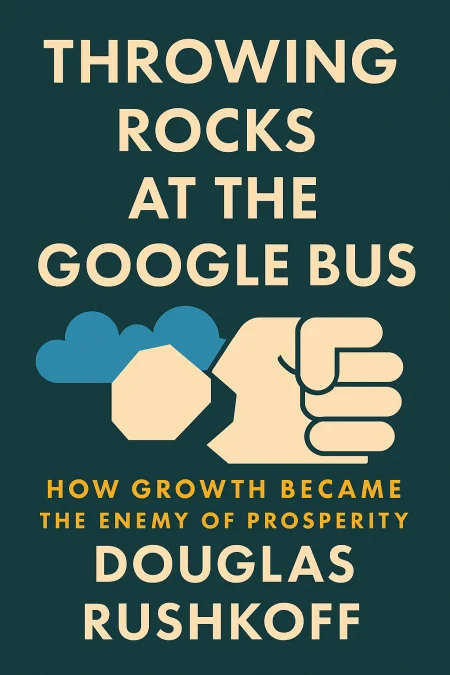
Throwing Rocks at the Google Bus
How Growth Became the Enemy of Prosperity
Book Edition Details
Summary
In an era where digital dreams promised unending affluence, we've found ourselves tangled in a web of relentless economic demands. Instead of liberating us, the technology that was supposed to empower has intensified industrial capitalism's grip, fueling an unsustainable growth obsession. Enter Douglas Rushkoff, a visionary at the forefront of societal critique, who charts a daring course to break free from this economic stalemate. Through a fusion of historical insights and modern challenges, Rushkoff unveils a transformative blueprint for harnessing the internet's distributive potential. Rejecting conventional economic dogma, he offers pragmatic steps to redefine value creation, empowering consumers, businesses, and policymakers to foster a shared prosperity. "Throwing Rocks at the Google Bus" isn't just a critique; it's a rallying cry for a more equitable economic landscape, blending optimism with actionable solutions for a future unshackled by the confines of the past.
Introduction
The digital revolution was supposed to democratize commerce, empower individuals, and create widespread prosperity. Instead, we find ourselves trapped in an economy that systematically removes human beings from the value equation while concentrating wealth in fewer hands than ever before. This fundamental contradiction between technology's promise and its current reality stems from a critical oversight: rather than questioning the underlying assumptions of industrial capitalism, we have simply digitized them, amplifying their most destructive tendencies. The platforms we celebrate as innovations—from social media networks to ride-sharing apps—operate according to the same extractive logic that drove medieval monopolies and colonial enterprises. They create winner-takes-all markets, eliminate middle-class jobs, and transform users into unpaid laborers whose data becomes the primary source of profit. The growth imperative that once required conquering new continents now demands the financialization of every human interaction. This analysis reveals how our current predicament is neither inevitable nor natural, but the result of specific programmatic choices embedded in our economic operating systems. By examining the historical origins of central currency, corporate structure, and investment models, we can identify the precise mechanisms that prioritize capital accumulation over human flourishing. More importantly, we can envision and implement alternative approaches that leverage digital technology's genuine potential for distributed value creation, peer-to-peer exchange, and sustainable prosperity that serves communities rather than extracting from them.
The Growth Imperative: How Digital Platforms Amplify Industrial Extraction
Digital platforms represent the ultimate expression of industrial capitalism's core mandate: the systematic removal of human beings from economic activity. Where once factories replaced skilled craftsmen with mechanized production, today's algorithms replace human decision-making with automated optimization. The drive toward efficiency that characterized the industrial age has become a relentless pursuit of frictionless transactions that eliminate human agency at every possible point. The transformation from artisanal to industrial to digital follows a consistent pattern of devaluing human contributions. Medieval markets operated through direct relationships between producers and consumers, with local currencies designed to facilitate exchange rather than accumulate wealth. Industrial processes broke these connections, creating mass markets where branded products replaced personal relationships. Digital platforms complete this evolution by transforming even human relationships into algorithmic processes, where "likes" and "shares" become new forms of currency that users generate freely while platforms capture their value. The fundamental architecture of digital business models reveals their extractive nature. Whether examining social media networks, e-commerce platforms, or app-based services, the pattern remains consistent: users provide content, data, and labor while a centralized platform captures and monetizes this activity. The "sharing economy" exemplifies this dynamic, where individuals supply their homes, cars, and time to corporate platforms that extract value while socializing risks and costs. This digital amplification of industrial extraction operates at unprecedented speed and scale. Where traditional corporations might take decades to establish market dominance, digital platforms can achieve monopolistic control in months or years. The network effects that make platforms more valuable as they grow create winner-takes-all dynamics that concentrate power and wealth far more rapidly than previous economic models, ultimately serving to accelerate rather than challenge the fundamental inequities of the industrial system.
Platform Monopolies vs. Human Value Creation in Digital Markets
The corporation, originally designed as a medieval tool for monarchs to control trade and extract wealth from emerging markets, has found its perfect digital expression in the platform monopoly. These entities operate according to the same core programming that drove chartered monopolies: extract value, eliminate peer-to-peer markets, expand territorial control, and ultimately achieve the rights and powers of personhood without corresponding responsibilities. Modern platform monopolies systematically dismantle the conditions that enable distributed value creation. Amazon's dominance in e-commerce eliminates not just competitors but entire ecosystems of independent retailers, publishers, and service providers. The company's ability to operate at a loss while building market share demonstrates how accumulated capital can be deployed to destroy existing value networks and replace them with extractive systems that channel wealth upward. The winner-takes-all dynamics of digital markets represent a fundamental departure from earlier economic models that supported broader participation. Where traditional markets might support thousands of moderately successful participants, algorithmic optimization creates power-law distributions that reward a tiny elite while leaving the vast majority with essentially nothing. This is not an accident or unintended consequence, but the logical result of systems designed to maximize efficiency and growth above all other considerations. The speed and scale of digital operations amplify these extractive effects beyond anything previously possible. High-frequency trading algorithms can extract value from millions of transactions in microseconds, while recommendation systems create artificial scarcity and manipulate consumer behavior in real-time. The same technologies that could enable unprecedented collaboration and distributed prosperity are instead deployed to concentrate wealth and power in ways that make traditional monopolies seem almost benevolent by comparison.
Alternative Economic Models: Local Currencies and Cooperative Structures
The development of alternative economic models begins with recognizing money itself as a form of technology—one that can be programmed to serve different purposes and embody different values. Central currency systems designed around scarcity and interest-bearing debt naturally create conditions that favor capital accumulation over circulation. Local currencies, time banks, and cooperative exchange systems demonstrate how monetary tools can be designed to promote transaction velocity and community resilience rather than wealth extraction. Local currency systems like BerkShares create bounded economic networks that keep value circulating within communities rather than being extracted by distant corporations. These systems work by creating incentives for local spending while making it difficult for large chains to absorb and redirect local wealth. More sophisticated approaches like LETS (Local Exchange Trading Systems) allow communities to create value without requiring scarce central currency, enabling economic activity even during periods of monetary contraction. The success of these alternative systems depends on their ability to create sustainable boundaries that protect local value creation while remaining open to beneficial external exchange. The principle of subsidiarity—organizing economic activity at the smallest viable scale—provides a framework for designing systems that can meet human needs without requiring endless growth or territorial expansion. Cooperative ownership structures extend these principles to business organization itself. Worker-owned cooperatives, platform cooperatives, and distributed autonomous organizations represent attempts to create enterprises where those who contribute labor, resources, and creativity maintain ownership and control rather than surrendering value to distant shareholders. These models demonstrate that efficiency and innovation do not require the systematic exploitation of human contributors.
From Exit-Driven Investment to Sustainable Digital Distributism
The venture capital model that dominates digital business development operates according to portfolio logic that requires spectacular failures and exits rather than sustainable success. This system forces entrepreneurs to pursue winner-takes-all outcomes that maximize capital appreciation for investors rather than creating value for users, workers, or communities. The exit-driven approach treats businesses as temporary vessels for capital accumulation rather than ongoing enterprises that serve human needs. Alternative investment models focus on long-term value creation rather than spectacular exits. Crowdfunding, direct public offerings, and community investment approaches allow businesses to raise capital from stakeholders who benefit from ongoing success rather than quick liquidation. These models enable companies to optimize for sustainability and community benefit rather than exponential growth that ultimately serves only a small investor class. The principles of distributism—wide distribution of productive assets and economic decision-making power—provide a framework for designing digital systems that serve human flourishing rather than capital accumulation. This approach recognizes that sustainable prosperity emerges from enabling broad participation in value creation rather than concentrating wealth and power in the hands of platform owners and passive investors. Digital distributism envisions an economy where technology serves to distribute rather than concentrate economic power. Blockchain-based cooperative structures, peer-to-peer exchange protocols, and community-owned infrastructure represent early experiments in creating systems that embody these values. The goal is not to return to pre-industrial conditions but to retrieve the human-centered values of earlier economic models while leveraging digital technology's genuine potential for coordination, transparency, and distributed decision-making.
Summary
The current digital economy represents not technological progress but the successful digitization of medieval extraction mechanisms that prioritize capital growth over human welfare. True advancement lies in recognizing that our economic operating systems are programmable and can be redesigned to serve distributed prosperity rather than concentrated wealth. The alternative requires moving beyond the false choice between corporate capitalism and state socialism toward distributist models that enable broad participation in value creation while maintaining the benefits of technological coordination and efficiency. This transformation demands not just new technologies but new ways of thinking about ownership, value, and the fundamental purpose of economic activity in serving human communities rather than abstract financial returns.
Related Books
Download PDF & EPUB
To save this Black List summary for later, download the free PDF and EPUB. You can print it out, or read offline at your convenience.
By Douglas Rushkoff
