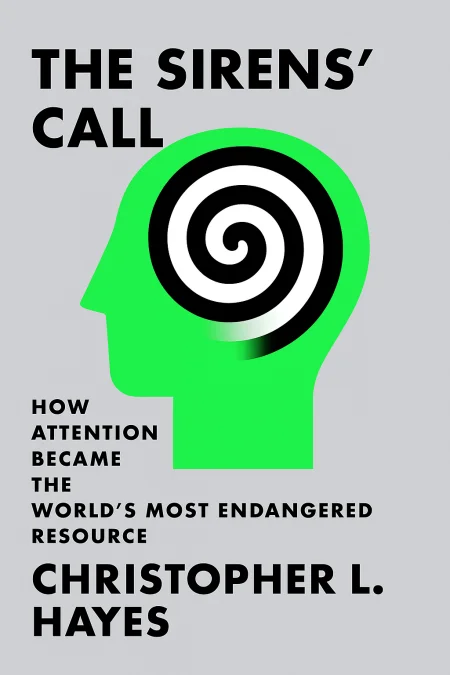
The Sirens' Call
How Attention Became the World's Most Endangered Resource
Book Edition Details
Summary
In a world where the glow of screens dictates our waking hours, "The Sirens’ Call" by Chris Hayes confronts the insidious grip of attention capitalism. This searing narrative cuts through the noise to reveal how our deepest desires and instincts have been hijacked by tech giants, turning human attention into the ultimate currency. As we navigate through a landscape where private lives bleed into public domains, Hayes offers a clarion call to reclaim our minds and societies. With urgency and insight, he maps the seismic shifts reshaping politics and culture, urging us to recognize and resist the forces that manipulate our very essence. This is not just a book; it's a manifesto for our times.
Introduction
The digital revolution has fundamentally transformed the nature of economic exploitation, moving beyond the extraction of physical labor to target the very essence of human consciousness itself. What emerges is a sophisticated system where our most intimate cognitive processes—our capacity to focus, reflect, and direct mental energy—have become the primary raw materials for unprecedented wealth accumulation. This transformation operates through mechanisms so subtle and pervasive that we often mistake the symptoms of systematic attention harvesting for personal moral failings or individual weakness. The analysis that follows employs a multi-layered approach, examining psychological research on attention mechanisms, economic theory regarding resource commodification, and historical parallels to previous forms of capitalist expansion. By tracing how digital platforms exploit evolutionary adaptations in human cognition, we can understand why resistance feels so difficult and why individual solutions remain insufficient without systemic change. The investigation reveals how the commodification of consciousness creates new forms of alienation that extend far beyond personal productivity, fundamentally undermining the shared focus necessary for democratic deliberation and collective problem-solving. Through this lens, contemporary phenomena like political polarization, mental health crises, and the collapse of expert authority emerge not as isolated problems but as predictable consequences of economic systems designed to profit from human distraction.
How Attention Became Capitalism's Most Valuable Commodity
The transformation of attention into a tradeable resource follows economic principles observed throughout capitalist development, yet operates at an unprecedented level of intimacy with human consciousness. Unlike traditional commodities that exist independently of human perception, attention represents the very medium through which we experience reality. When this fundamental cognitive capacity becomes subject to market forces, the boundary between self and commodity dissolves in ways that previous forms of economic exploitation never achieved. The mechanics of this commodification rely on converting qualitatively different forms of attention into quantitatively equivalent units of measurement. The focused concentration we bring to meaningful work, the idle curiosity that leads to discovery, the contemplative awareness that enables wisdom—all become flattened into standardized metrics of engagement measured in clicks, views, and screen time. This reduction mirrors the industrial revolution's transformation of skilled craft labor into interchangeable factory work, but operates within the realm of consciousness itself. Digital platforms have mastered the art of capturing attention through what researchers term "persuasive design"—interfaces explicitly engineered to trigger involuntary responses that bypass conscious decision-making. These systems exploit evolutionary adaptations that once served survival purposes, using notification sounds, visual alerts, and social validation mechanisms to activate ancient neural pathways associated with threat detection and social belonging. The result is a form of cognitive hijacking that feels natural while serving purely commercial interests. The economic logic underlying this system treats human consciousness as a finite resource to be extracted and sold to advertisers. Every moment of focus becomes a potential transaction, creating markets where the marginal cost of capturing attention approaches zero while the value of that captured attention can be enormous. This asymmetry between extraction costs and resource value generates the fundamental dynamics that shape digital life, where our scarcest cognitive resources are harvested by systems designed to make that harvesting feel effortless and inevitable.
The Systematic Engineering of Digital Addiction and Behavioral Control
The architecture of digital platforms reveals sophisticated understanding of psychological mechanisms that govern human behavior, particularly the pathways through which attention can be compelled rather than earned. These systems operate through three distinct channels: involuntary attention that responds to sudden stimuli, voluntary attention that we consciously direct, and social attention that involves recognition from others. The most successful platforms trigger involuntary responses while maintaining the illusion of voluntary engagement. Variable reward schedules provide the foundational mechanism for this behavioral control, employing the same psychological principles that make gambling addictive. Social media platforms, video games, and news websites deploy unpredictable bursts of stimulation—likes, comments, breaking news alerts—that activate dopamine pathways and create compulsive usage patterns. Users experience agency while being guided through carefully constructed behavioral funnels designed to maximize engagement time regardless of user satisfaction or wellbeing. Social validation represents the most powerful vector for sustained engagement, exploiting fundamental human needs for recognition and belonging. Platforms create synthetic versions of social connection through quantified feedback systems, algorithmic amplification of user-generated content, and notification mechanisms that simulate genuine human interaction. These systems deliver intermittent reinforcement that maintains engagement while providing something far less nourishing than authentic social relationships, creating paradoxes where increased digital social stimulation coincides with increased loneliness and social isolation. The business models underlying these platforms create inherent conflicts between user wellbeing and corporate profitability. Companies profit by converting captured attention into advertising revenue, creating three-way markets where users provide attention, advertisers purchase access to that attention, and platforms maximize transaction volume. This structure incentivizes design choices that prioritize compulsion over satisfaction, activation over contentment, and engagement duration over user benefit, leading to systematic optimization for addictive rather than beneficial user experiences.
Democratic Collapse Through Algorithmic Fragmentation of Public Discourse
The commodification of attention produces social consequences that extend far beyond individual psychological effects, fundamentally undermining the shared focus necessary for democratic deliberation and collective decision-making. Traditional democratic institutions assumed the existence of common informational foundations—shared facts, agreed-upon sources of authority, and collective attention to important issues. The attention economy systematically fragments these foundations by creating individualized information environments optimized for engagement rather than accuracy or democratic participation. Algorithmic curation systems prioritize content that generates strong emotional responses, creating information environments where sensationalism and polarization consistently triumph over nuanced discussion and collaborative problem-solving. When public discourse becomes subject to the same market forces that drive social media engagement, false but emotionally compelling content systematically outperforms true but mundane reporting. The economic incentives of digital platforms reward the most divisive voices while marginalizing moderate perspectives that fail to generate intense reactions. This fragmentation manifests most clearly in the rise of conspiracy theories, political extremism, and the systematic breakdown of expert authority. Citizens increasingly inhabit separate reality bubbles, each reinforced by recommendation algorithms that prioritize user retention over factual accuracy. The result is not merely political polarization but something more fundamental: the dissolution of shared reality itself. Without common objects of attention, societies lose the capacity to identify problems collectively, much less develop coordinated responses to complex challenges. The collapse of collective focus particularly undermines society's capacity to address long-term challenges requiring sustained public attention and coordinated action. Climate change, infrastructure decay, educational reform, and public health crises all demand the kind of patient, shared focus that becomes nearly impossible when public consciousness is fragmented into millions of individual attention streams, each optimized for immediate engagement rather than sustained consideration of complex problems requiring collective deliberation and coordinated response over extended time periods.
Reclaiming Cognitive Autonomy from Corporate Surveillance Systems
Resistance to attention capitalism requires understanding both individual psychology and systemic forces, recognizing that personal strategies alone cannot address structural problems embedded in the economic foundations of digital technology. Individual approaches include developing practices of intentional focus, creating technology-free environments, and choosing platforms that prioritize user wellbeing over engagement maximization. These personal tactics, while necessary for immediate relief, remain insufficient without broader structural changes that challenge the economic incentives driving manipulative design. Regulatory frameworks offer more comprehensive solutions by treating attention as a public resource requiring protection from predatory business practices. Legal restrictions on behavioral advertising, age limits for social media access, requirements for algorithmic transparency, and digital rights legislation could constrain the most harmful aspects of attention extraction. Some jurisdictions have already implemented privacy protections and data ownership rights that give users greater control over their digital experiences and the commercial use of their behavioral data. Alternative economic models demonstrate that technology can serve human flourishing rather than exploit psychological vulnerabilities for profit maximization. Non-profit platforms, subscription-based services, cooperative ownership structures, and public digital infrastructure can align business incentives with user wellbeing rather than attention extraction. The success of privacy-focused technologies, advertising-free platforms, and community-owned digital resources suggests growing market demand for alternatives to surveillance capitalism. The most promising approaches combine technological innovation with social organization, creating communities of practice around intentional technology use and collective resistance to manipulative design. These movements recognize that reclaiming cognitive autonomy requires coordinated efforts to build alternative systems that prioritize human agency over corporate profit. The goal involves not rejecting technology but ensuring that technological development serves human purposes rather than treating human consciousness as a resource to be systematically harvested for shareholder value while leaving users increasingly distracted, isolated, and cognitively depleted.
Summary
The commodification of human consciousness represents a civilizational transformation as profound as industrialization, creating new forms of economic exploitation that operate through the systematic manipulation of our most intimate cognitive processes. This transformation follows predictable patterns of capitalist expansion while introducing unprecedented challenges to individual autonomy, democratic governance, and collective problem-solving capacity. The attention economy generates enormous wealth for technology companies while producing widespread experiences of distraction, alienation, and social fragmentation among those whose consciousness is being harvested. Understanding these mechanisms reveals both the scope of the challenge and pathways toward solutions that prioritize human wellbeing over corporate profit, recognizing that the quality of attention available to individuals and societies ultimately determines our capacity for wisdom, creativity, moral reasoning, and the kind of sustained collective focus that democracy and human development require in an increasingly complex world.
Related Books
Download PDF & EPUB
To save this Black List summary for later, download the free PDF and EPUB. You can print it out, or read offline at your convenience.
By Christopher L. Hayes
