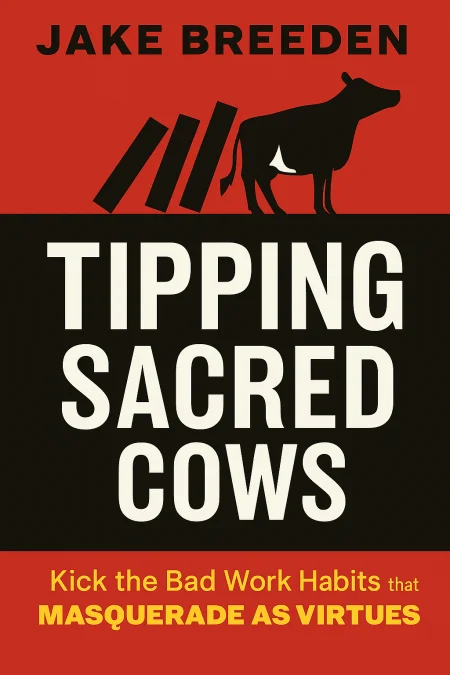
Tipping Sacred Cows
Kick the Bad Work Habits that Masquerade as Virtues
Book Edition Details
Summary
At the heart of every bustling workplace lie cherished beliefs that seem like guiding stars but can secretly steer you off course. Jake Breeden's "Tipping Sacred Cows" dares to question these entrenched mantras—like balance, creativity, and passion—unmasking them as potential pitfalls rather than virtues. Drawing on his extensive coaching experience across 27 countries and cutting-edge research from behavioral economics to neuroscience, Breeden offers a fresh perspective on workplace success. This book isn't just an exposé; it's a toolkit for recognizing and conquering the seven "sacred cows" that might be stalling your career. With Breeden's insights, unlock a new level of leadership where true progress is possible, free from the constraints of outdated wisdom.
Introduction
What happens when our most cherished workplace values become our greatest obstacles to success? In boardrooms and cubicles across the globe, well-intentioned leaders find themselves trapped by the very virtues they believe will propel them forward. The theory of sacred cows in organizational behavior reveals how unexamined workplace virtues can transform from assets into liabilities, creating invisible barriers that limit both individual and organizational potential. This phenomenon emerges from a fundamental tension between virtue and effectiveness. While values like collaboration, creativity, and excellence serve as moral compasses in our professional lives, they can become rigid orthodoxies when applied without critical examination. The theoretical framework presented here challenges leaders to distinguish between purposeful virtue and reflexive habit, offering a systematic approach to identifying when good intentions produce counterproductive results. Through this lens, we can understand how balance becomes blandness, how fairness creates inequity, and how preparation prevents performance.
The Seven Sacred Cows: From Balance to Preparation
The sacred cow theory identifies seven primary workplace virtues that most commonly transform into organizational obstacles. These virtues operate along a spectrum from healthy application to destructive obsession, with the tipping point occurring when leaders apply them automatically rather than strategically. Balance represents the first sacred cow, manifesting as the relentless pursuit of equilibrium across all dimensions of work and life. When balance becomes a sacred cow, leaders default to compromise rather than making bold choices, resulting in mediocrity rather than excellence. The theoretical distinction lies between bold balance, which involves sequential focus and strategic trade-offs, and bland balance, which seeks to do everything at once and achieves nothing particularly well. Collaboration transforms into a sacred cow when working together becomes the default mode rather than a strategic choice. The theory distinguishes between accountable collaboration, where teams form with clear purpose and individual responsibility, and automatic collaboration, where group work occurs simply because it feels safer than individual accountability. This shift from purposeful teamwork to reflexive committee-building creates diffusion of responsibility and reduces individual agency. Creativity becomes counterproductive when the pursuit of novelty overshadows the need for utility. The framework differentiates between narcissistic creativity, driven by ego and the desire to leave one's mark, and useful creativity, which focuses on solving genuine problems through innovative means. The sacred cow emerges when leaders feel compelled to reinvent rather than adapt, prioritizing originality over effectiveness.
When Good Intentions Lead to Bad Outcomes
The transformation of virtues into sacred cows follows predictable psychological and organizational patterns. Understanding these mechanisms allows leaders to recognize when their best intentions are producing their worst results. Excellence becomes destructive when leaders focus on process perfection rather than outcome achievement. The theoretical model distinguishes between outcome excellence, which tolerates messy progress toward meaningful goals, and process excellence, which demands perfection at every step and ultimately paralyzes progress. This phenomenon occurs because the psychological reward of maintaining high standards in small tasks can become addictive, leading to misplaced priorities and wasted energy. Fairness transforms into a sacred cow through two primary mechanisms: projection and sameness. Projection occurs when leaders assume others want what they themselves want, leading to misguided attempts at equity. Sameness emerges when leaders treat fairness as uniformity rather than justice, creating systems that ignore individual differences in favor of blanket policies. The theory reveals how the neurochemical reward of feeling fair can override rational assessment of what actually serves people's needs. Passion becomes problematic when it shifts from harmonious to obsessive. Harmonious passion enhances all aspects of life and work, while obsessive passion crowds out other important elements and creates unsustainable pressure. The theoretical framework shows how obsessive passion often stems from external validation needs rather than intrinsic motivation, leading to burnout and ethical compromises as leaders become willing to sacrifice anything to feed their passion.
Transforming Sacred Cows into Strategic Leadership Tools
The solution to sacred cow dysfunction lies not in abandoning these virtues but in developing the awareness and skill to apply them strategically. This transformation requires leaders to cultivate what can be called "virtuous mindfulness" – the ability to recognize when and how to deploy different values for maximum effectiveness. Preparation illustrates this principle clearly through the distinction between backstage and onstage preparation. Backstage preparation involves extensive planning in isolation, often leading to rigid scripts that prevent real-time adaptation. Onstage preparation embraces the reality that all work is performance, requiring leaders to practice with the same intensity they bring to execution while remaining flexible enough to adapt to changing circumstances. The strategic application of these virtues requires leaders to develop diagnostic capabilities – the ability to assess situations and determine which virtues are most needed at specific moments. Rather than applying all virtues equally at all times, effective leaders learn to calibrate their approach based on context, stakeholder needs, and organizational goals. This represents a shift from virtue as identity to virtue as tool, allowing leaders to maintain their values while maximizing their impact. The transformation process also involves creating organizational cultures that support nuanced thinking about virtue. This means establishing norms that encourage questioning of established practices, rewarding adaptive behavior over consistent behavior, and celebrating leaders who can balance competing values rather than those who simply embody a single virtue intensely.
Building Mindful Leadership Beyond Conventional Wisdom
The ultimate goal of understanding sacred cows is to develop what might be called "paradoxical leadership" – the ability to hold seemingly contradictory truths simultaneously and act effectively despite ambiguity. This represents a mature form of leadership that transcends simple rule-following in favor of contextual wisdom. Mindful leadership requires developing comfort with complexity and contradiction. Leaders must learn to embrace both individual accountability and team collaboration, both creative innovation and practical efficiency, both high standards and rapid iteration. This does not mean compromising between extremes but rather learning when each approach serves the larger purpose most effectively. The practice of mindful leadership also involves regular self-examination and feedback loops. Leaders must develop the habit of questioning their own motivations, examining the results of their actions, and adjusting their approach based on evidence rather than ideology. This creates a learning-oriented leadership style that can adapt to changing circumstances while maintaining core values. Finally, mindful leadership requires the courage to act counter-culturally when necessary. Sometimes the most virtuous action involves appearing to violate a virtue – being unfair in service of justice, being unbalanced in service of effectiveness, or being uncolaborative in service of the team's ultimate success. This level of leadership sophistication allows leaders to serve their highest values even when doing so requires tactical flexibility in how those values are expressed.
Summary
True leadership wisdom lies not in the rigid application of workplace virtues, but in understanding when and how these virtues serve their intended purpose versus when they become obstacles to effectiveness. The sacred cow phenomenon reveals that our greatest strengths often contain the seeds of our most significant limitations, requiring leaders to develop the sophistication to apply virtue strategically rather than automatically. This framework offers a pathway to more nuanced, effective leadership that honors both moral principles and practical results, ultimately creating organizations that achieve sustainable success while maintaining their humanity.
Related Books
Download PDF & EPUB
To save this Black List summary for later, download the free PDF and EPUB. You can print it out, or read offline at your convenience.
By Jake Breeden
