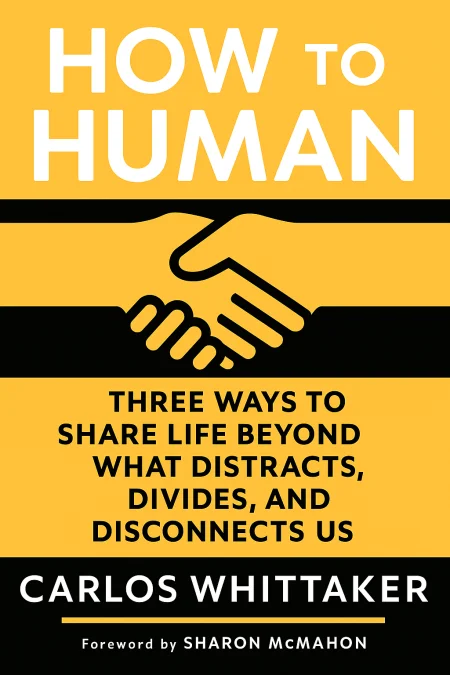
How to Human
Three Ways to Share Life Beyond What Distracts, Divides, and Disconnects Us
byCarlos Whittaker, Sharon McMahon
Book Edition Details
Summary
In the heart of our modern chaos, where division and disconnection reign, Carlos Whittaker extends a lifeline of hope with "How to Human." This isn't just a book—it's a rallying cry for transformation. Carlos challenges us to break free from the shackles of anxiety and isolation by embracing a radical shift from "me" to "we." With humor, heart, and a touch of audacity, he lays out a path to rediscover what it means to be truly alive, fostering genuine connections with ourselves, others, and a higher purpose. Prepare to be inspired by a call to action that is both deeply personal and profoundly communal. It's time to step boldly into a love-driven life that defies fear and builds bridges. This is your invitation to experience the exhilarating joy of being fully human.
Introduction
The year 2020 stripped away our illusions about how well we knew ourselves and each other. In a matter of months, we watched friendships crumble over masks, families divide over politics, and neighbors become strangers. The very fabric of human connection seemed to unravel before our eyes, leaving many of us wondering if we'd forgotten something fundamental about what it means to be human together. Yet amid the chaos, something remarkable kept happening. Strangers still rushed to help when someone was in trouble. Healthcare workers sacrificed for patients they'd never met. Neighbors checked on each other during lockdowns. Even in our most divided moments, sparks of authentic humanity kept breaking through the noise. These moments reminded us that beneath all our differences lies something deeper—a shared longing to see and be seen, to matter and to help others matter. The path back to genuine connection isn't as complicated as our fractured world makes it seem. It begins with remembering three essential movements that have always defined our best human moments: learning to be authentically ourselves, truly seeing others beyond our assumptions, and finding ways to set each other free from whatever holds us back. When we rediscover these rhythms, we don't just heal our own hearts—we become part of healing a world that desperately needs more people who know how to be beautifully, courageously human.
The Mall Chase: When Strangers Become Heroes
In 1985, a ten-year-old boy was getting his hair cut at a barbershop in Northlake Mall when chaos erupted outside. A man was running past the window, carrying a young child, chased by a screaming woman. Without hesitation, the barber dropped his clippers and sprinted out the door. Within moments, other men joined the chase—a heavyset older Black man, two young white brothers, a well-dressed businessman. They didn't stop to ask questions or check each other's backgrounds. They simply ran toward the danger, united by an instinctive drive to help. The kidnapper was caught. The child was safe. As the dust settled, the boy watched these strangers who had nothing in common except their willingness to act. The barber returned, out of breath but grinning, ready to finish the haircut as if nothing extraordinary had happened. Yet something profound had just been revealed: when crisis calls, our differences fade and our shared humanity emerges. This moment captures what we've lost and desperately need to rediscover. Before we became defined by our opinions, our tribes, our carefully curated online personas, we were simply humans with an innate capacity for goodness. That capacity hasn't disappeared—it's just been buried under layers of division and distraction. The path forward begins with remembering that our first instinct, our truest nature, is to run toward each other, not away.
The Black Bunny: Confronting Our Hidden Biases
For four years, a man lived across the street from his neighbor without ever speaking to him. Every attempt at friendly conversation was met with scowls and silence. The neighbor was an elderly white man with an American flag draped across his door, and every encounter reinforced painful assumptions born from past experiences with racism. The invisible wall between them seemed permanent, built on judgment and maintained by distance. Then one morning, something changed. The old man emerged with a can of black paint and began carefully painting one of the two white stone bunnies in his yard. Half the decoration remained white, half became black. The symbolism was unmistakable, but its meaning remained a mystery. Was this some kind of statement? After days of wondering, the neighbor finally walked across the street to ask. "With everything that's going on in the country today, with all the protests and everything happening with all the Black stuff," the old man explained with genuine warmth, "I figured this was my way of saying I believe your life matters." In that moment, four years of assumptions crumbled. The "racist" neighbor had been quietly standing for justice all along, while his own biases had created a barrier that never should have existed. We all carry invisible bunny stories—moments when our assumptions blind us to the humanity right in front of us. The courage to cross the street and ask the real questions, to get close enough to see clearly, transforms not just our understanding but our hearts. Sometimes the person we most need to see is the one we've been most determined to avoid.
The January 6th Mirror: America's Humanity Crisis
January 6, 2021, shattered something in the American soul. As images flooded social media of the Capitol under siege, of Confederate flags waving in the halls of democracy, many felt the ground shift beneath their feet. This wasn't just political violence—it was a mirror reflecting how far we'd drifted from our shared values, how completely we'd failed to see each other as fellow travelers in the same national story. The aftermath revealed our crisis wasn't really about politics at all. It was about humanity. Friends who had supported each other through every life crisis suddenly couldn't speak to each other. Families split at dinner tables. Communities fractured along invisible lines that had always been there but had never seemed so deep or so permanent. The question wasn't who was right or wrong about this policy or that candidate—it was whether we could find our way back to treating each other as human beings worthy of respect and understanding. In the days following, something unexpected happened. Three simple words arrived in a text message: "I see now." They came from a friend who had walked a different political path but had chosen relationship over ideology, understanding over agreement. Those words carried more healing power than a thousand arguments ever could, because they acknowledged what had been lost and offered a bridge back to connection. The mirror of our national crisis reflects a deeper truth: we can disagree about everything and still choose to see each other. We can hold our convictions firmly while holding each other gently. The choice between being right and being human is the choice that will determine not just our individual relationships, but the future of our shared life together.
The Airport Pianist: The Power of Radical Empathy
At a busy airport, a man sat at a piano, his fingers dancing across the keys with remarkable skill. His tip jar held maybe twenty dollars, and travelers rushed past without a glance, eyes glued to phones and departure boards. This was Tonee, who spent twelve hours every night on kidney dialysis but still showed up to share his gift with a world too hurried to notice. He had learned not to expect much attention—just hoped someone might pause long enough to appreciate the music. When asked about his biggest tip ever, Tonee mentioned six hundred dollars, earned over countless hours of playing for largely indifferent crowds. But something extraordinary was about to happen. A single social media post shared his story with thousands of people, asking them to see this invisible artist who had been blessing travelers with beauty while battling his own health struggles behind the scenes. Within thirty minutes, Tonee's tip jar had grown by ten thousand dollars. By the end of the day, sixty thousand dollars poured in from strangers around the world who suddenly saw him not as background music but as a human being worthy of dignity and celebration. The money was overwhelming, but what broke him open was simpler: "My faith in humanity has been restored." He had been seen, truly seen, perhaps for the first time in years. The most powerful force for healing our fractured world isn't complex policy or sophisticated strategy—it's the radical act of paying attention to the people everyone else overlooks. When we slow down enough to see the Tonees all around us, when we let their stories touch our hearts deeply enough to move us to action, we discover that empathy isn't just feeling for someone—it's feeling with them so intensely that their freedom becomes inseparable from our own.
Summary
The path back to authentic human connection winds through three essential territories: learning to be genuinely ourselves, developing eyes that truly see others, and discovering how setting others free liberates our own hearts as well. These aren't abstract principles but lived realities that transform ordinary moments into opportunities for extraordinary grace. The barbers who drop their tools to chase kidnappers, the neighbors who paint bunnies black to declare that lives matter, the strangers who shower airport pianists with unexpected generosity—they all understand something we're in danger of forgetting. Humanity doesn't need to be rebuilt from scratch; it needs to be recalibrated to its original design. Like a computer that's been slowed by too many conflicting processes, we've been overwhelmed by the noise of division and distraction. But the core programming remains intact—that fundamental drive to help, to see, to care for each other that emerges whenever crisis strips away our pretenses and reveals our truest selves. The invitation is both simple and revolutionary: to wake up each day choosing connection over comfort, curiosity over judgment, generosity over scarcity. To risk crossing streets and asking real questions, to slow down long enough to notice the invisible people making our world more beautiful, to believe that the person who disagrees with us most might be the very one who helps us see most clearly. This is how we human—not perfectly, but courageously, with hearts wide open to the possibility that our next encounter might be the one that changes everything.
Related Books
Download PDF & EPUB
To save this Black List summary for later, download the free PDF and EPUB. You can print it out, or read offline at your convenience.
By Carlos Whittaker
