
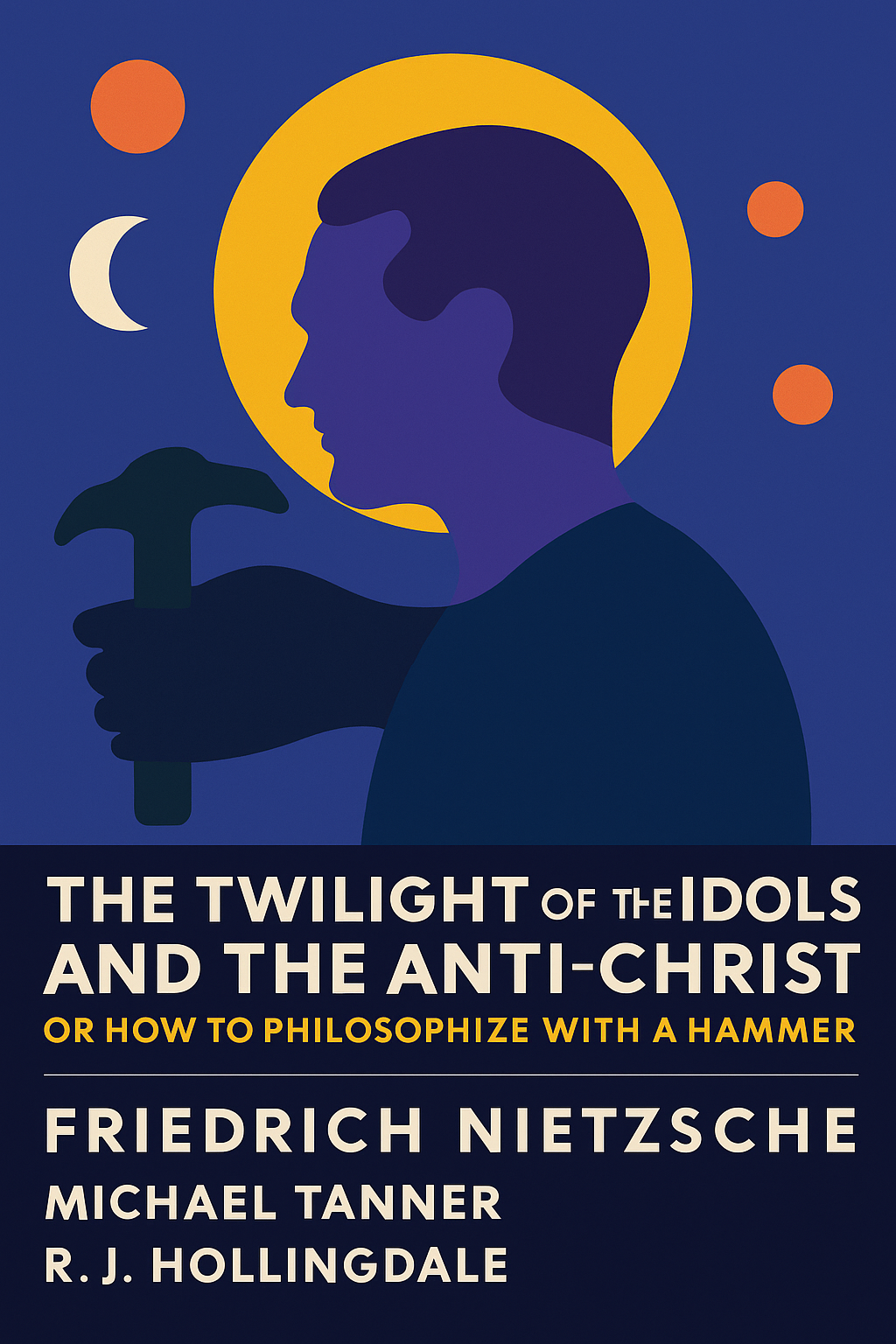
Twilight of the Idols and The Anti-Christ
or How to Philosophize with a Hammer
byFriedrich Nietzsche, Michael Tanner, R. J. Hollingdale
Book Edition Details
Summary
In the throes of 1888, Friedrich Nietzsche unleashes a twin salvo against the very bedrock of Western thought. "Twilight of the Idols" and "The Anti-Christ" stand as a provocative manifesto, daring to dismantle the crumbling pillars of conventional morality and religion. With a philosopher's scalpel, Nietzsche dissects the hypocrisies of his era, all while extolling the chaotic brilliance of the 'Dionysian' spirit. His gaze, both fierce and unexpectedly tender, pits the relentless vigor of Goethe and Borgia against the serene strength of Christ—his only true rival. Through these works, Nietzsche's biting wit and perceptive insights reveal a startling portrait of human pettiness, yet beneath the storm, an indomitable optimism flickers. A challenge to the status quo, this is a clarion call for the courageous, inviting readers to question, to defy, and ultimately, to redefine their own truths.
Introduction
Western civilization stands at a crossroads where its most cherished moral foundations reveal themselves as obstacles to human flourishing. The sacred values that have guided European culture for centuries—Christianity's emphasis on humility, self-denial, and otherworldly salvation—emerge not as eternal truths but as symptoms of cultural decline. This philosophical examination dismantles the illusion that Christian morality represents the pinnacle of human ethical development, exposing instead how these values systematically weaken the human spirit and drain life of its natural vitality. The critique operates through a dual methodology: psychological analysis of the motives behind moral systems and genealogical investigation of their historical origins. Rather than accepting moral proclamations at face value, this approach traces how certain values emerged from specific psychological needs and social conditions. The analysis reveals that what presents itself as divine command or rational principle often masks deeper impulses of resentment, weakness, and life-denial. Modern readers encounter a radical challenge to moral assumptions they may have never questioned. The investigation proceeds by examining how Christian values conquered the ancient world, analyzing the psychological types that created and propagated these values, and demonstrating their harmful effects on human development. Through this systematic deconstruction, a vision emerges of what human values might become when freed from the constraints of otherworldly morality.
The Corruption of Western Values Through Christian Morality
Christian morality represents a fundamental inversion of natural human values, transforming strength into weakness and health into sickness. The moral system that dominates Western civilization systematically undermines the instincts that promote life, growth, and human excellence. Where ancient cultures celebrated power, beauty, and aristocratic virtue, Christianity elevated suffering, humility, and self-abnegation as the highest ideals. This value system operates through a sophisticated mechanism of guilt and redemption that creates artificial problems requiring supernatural solutions. The concept of original sin transforms natural human impulses into sources of shame, while promising salvation through self-denial and obedience to otherworldly authorities. The result is a morality that thrives on human weakness and perpetuates the very suffering it claims to alleviate. The psychological machinery of Christian morality reveals itself most clearly in its treatment of the body and natural desires. Sexuality becomes sin, pride becomes vanity, and the pursuit of earthly excellence becomes spiritual danger. This systematic devaluation of life creates individuals who are perpetually at war with their own nature, seeking escape from the very conditions that make human flourishing possible. The historical success of Christianity demonstrates not the truth of its claims but the effectiveness of its appeal to the psychologically damaged. It conquered the Roman Empire not through superior wisdom but by offering comfort to the weak, the failed, and the resentful. The triumph of Christian values represents the victory of décadence over nobility, of sickness over health.
The Psychology of Décadence and the Priestly Instinct
The architects of Christian morality emerge from a specific psychological type characterized by an instinctive hostility toward life and health. These priestly natures cannot tolerate the sight of natural human excellence and must therefore create value systems that diminish and control such manifestations. Their morality serves not as a path to human flourishing but as a tool for psychological domination over healthier types. The priestly instinct operates through the creation of artificial guilt and the promise of equally artificial redemption. By declaring natural human drives to be sinful, the priest creates a market for his services as intermediary between humanity and the divine. This psychological economy depends entirely on maintaining human beings in a state of spiritual dependence and self-doubt. Décadence reveals itself in the preference for concepts over reality, for promises over present experience, and for suffering over joy. The décadent type cannot bear the sight of genuine health and strength because these qualities highlight his own deficiencies. Instead of acknowledging this limitation, the décadent creates moral systems that redefine weakness as strength and sickness as holiness. The psychology of Christian morality becomes transparent when examined alongside its historical alternatives. Buddhism, emerging from similar conditions of cultural exhaustion, offers a more honest response to the problem of suffering. Where Buddhism seeks to minimize pain through disciplined detachment, Christianity multiplies suffering through guilt and then offers redemption through submission to authority. The comparison reveals Christianity as the more dishonest and psychologically destructive response to the human condition.
The Historical Falsification of Truth and Natural Values
The historical triumph of Christianity required the systematic falsification of both the past and the present, transforming natural human experiences into supernatural dramas of sin and salvation. This process involved not merely the creation of new beliefs but the deliberate distortion of human psychology and the reinterpretation of natural phenomena through the lens of moral judgment. The Christian rewriting of history presented the ancient world as a realm of darkness awaiting enlightenment, while simultaneously appropriating its achievements for Christian purposes. The vitality and accomplishment of Greek and Roman civilization became mere preparation for the Christian revelation, robbed of their independent value and significance. This historical revisionism served to legitimate Christian claims while undermining appreciation for pre-Christian human achievement. The falsification extended beyond history to encompass the fundamental categories of human experience. Natural causation gave way to moral causation, with every event interpreted as reward or punishment from a divine judge. Human psychology was reinterpreted through the concepts of sin and grace, transforming healthy self-assertion into pride and natural desires into temptations requiring supernatural intervention. The most profound falsification involved the figure of Jesus himself, who was transformed from whatever historical reality he may have represented into a symbol serving priestly purposes. The simple message of inner peace and love became a complex theology of sacrifice and redemption, complete with promises of eternal reward and threats of eternal punishment. This transformation reveals how Christianity systematically corrupts even its own foundational insights in service of institutional power.
Toward a Revaluation of All Values Beyond Good and Evil
The critique of Christian morality points toward the possibility of new values based on life-affirmation rather than life-denial. Such a revaluation would not simply invert existing moral categories but would transcend the entire framework that divides human experience into moral and immoral. The goal is not to create new commandments but to liberate human creativity from the constraints of otherworldly morality. Life-affirming values would celebrate human excellence in all its forms, from physical health and beauty to intellectual achievement and artistic creation. Rather than seeking to diminish human differences in the name of equality, these values would recognize hierarchy as natural and necessary for cultural development. The strong would be honored for their strength, the creative for their creativity, and the noble for their nobility. This revaluation requires the cultivation of new human types capable of creating values rather than merely following them. Such individuals would possess the psychological health to affirm existence without need for supernatural consolation or justification. They would find meaning in the creative transformation of themselves and their world rather than in submission to external authority. The transition beyond Christian morality represents not merely a philosophical shift but a physiological and cultural transformation. It requires the development of human beings capable of bearing the responsibility of creating their own values while maintaining the discipline necessary for genuine achievement. This transformation would mark the emergence of humanity from its self-imposed tutelage to otherworldly authorities and its assumption of full responsibility for its own destiny.
Summary
The systematic examination of Christian morality reveals it to be not the culmination of human ethical development but a sophisticated system of life-denial that has impoverished Western civilization for nearly two millennia. The psychological analysis of its creators and propagators exposes the resentment and weakness that motivated this moral revolution, while the genealogical investigation traces its historical triumph over healthier value systems. The ultimate insight concerns the possibility of human existence beyond the categories of traditional morality—an existence that affirms life in all its complexity without requiring supernatural justification or consolation. This vision challenges readers to question their deepest assumptions about virtue and vice, good and evil, and to consider what human culture might achieve when freed from the constraints of otherworldly morality.
Related Books
Download PDF & EPUB
To save this Black List summary for later, download the free PDF and EPUB. You can print it out, or read offline at your convenience.
By Friedrich Nietzsche
