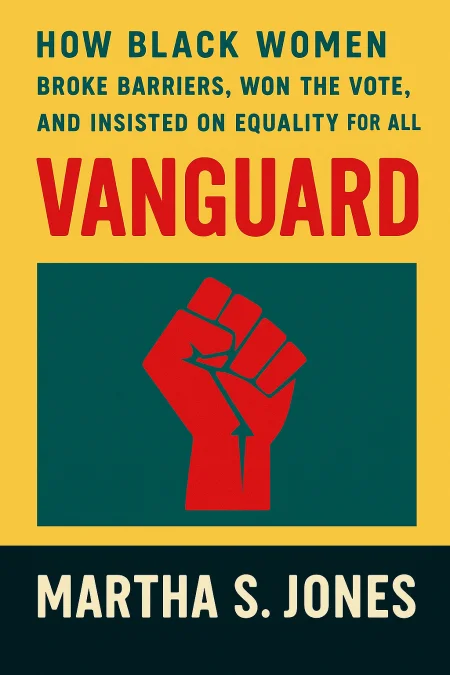
Vanguard
How Black Women Broke Barriers, Won the Vote, and Insisted on Equality for All
Book Edition Details
Summary
In the shadows of American history lies an untold saga of courage and tenacity: the relentless pursuit of political power by African American women. "Vanguard" by Martha S. Jones redefines the narrative, shifting the spotlight from the familiar stories of suffrage to reveal the fierce battles fought by trailblazers like Maria Stewart and Fannie Lou Hamer. This book chronicles their audacious defiance against a backdrop of racism and sexism, as they carved pathways to justice and equality. Jones takes readers on a riveting journey through time, uncovering the vibrant tapestry of alliances and struggles that culminated in the Voting Rights Act of 1965. Here, the voices that demanded America honor its revolutionary ideals finally take center stage, reshaping our understanding of what it truly means to be at the forefront of change.
Introduction
Picture Maria Stewart standing before a hostile crowd in Boston's African Meeting House in 1833, delivering what she knew would be her final public speech. As the first American woman to address mixed audiences on political matters, she faced ridicule from her own community. Yet her defiant words that September evening would echo through generations: "What if I am a woman; is not the God of ancient times the God of these modern days?" This moment captures the essence of a remarkable two-century journey that fundamentally transformed American democracy. This story reveals how Black women became the true architects of American political progress, breaking barriers not just for themselves but for all marginalized groups. From the pulpits of the 1820s to the polling places of the 1960s, these women developed a revolutionary political philosophy that refused to separate the fight against racism from the battle against sexism. They understood that their liberation was bound up with everyone's freedom, creating what Frances Ellen Watkins Harper called "one great bundle of humanity." For anyone seeking to understand how marginalized groups gain political power, how social movements sustain themselves across generations, or how American democracy actually expanded to include all citizens, this narrative offers profound insights. It demonstrates that the most transformative political changes often emerge not from the center of power, but from those who have been systematically excluded yet refuse to accept that exclusion as permanent.
Breaking Barriers: From Pulpits to Political Platforms (1820s-1860s)
The American Revolution had promised equality, but by the 1820s, free Black women in Northern cities discovered that freedom meant little without the power to shape their own destinies. As gradual abolition laws freed enslaved people in states like Pennsylvania and New York, a new generation of African American women emerged who refused to accept the narrow roles society prescribed for them. They lived in a world where even sympathetic white allies expected them to remain silent helpmeets, raising funds and serving meals while men controlled the podiums and pulpits. Jarena Lee shattered these expectations when she claimed her divine calling to preach in the African Methodist Episcopal Church. Born free in New Jersey in 1783, Lee spent decades battling church authorities who questioned whether women could legitimately interpret scripture. Her breakthrough came during a service when a male minister faltered, and Lee spontaneously rose to deliver an impromptu sermon that convinced Bishop Richard Allen of her genuine calling. Over the next thirty years, she traveled thousands of miles annually, delivering hundreds of sermons and proving that women could convert souls as effectively as any man. Maria Stewart took an even bolder step by becoming the first American woman to address mixed audiences on political topics. After losing her husband and his estate to predatory business associates, Stewart channeled her grief into fiery prose that challenged both slavery and the subordination of women. Her speeches at Boston's Franklin Hall demanded that Black women claim their rightful place in public discourse, declaring that African Americans must "awake, arise, no longer sleep nor slumber, but distinguish yourselves." These early pioneers understood that their individual breakthroughs were meaningless unless they created lasting institutional change. They fought not just for personal recognition but for systemic transformation that would open doors for all women. Their courage in facing ridicule, ostracism, and violence established the foundation for a movement that would eventually reshape American politics, creating pathways through which future generations would march toward full political equality.
Reconstruction's Promise and Betrayal: Rights and Resistance (1860s-1920)
The Civil War created unprecedented opportunities for Black women to demonstrate their political capabilities on a national stage. As the conflict transformed from a war to preserve the Union into a crusade for human freedom, women like Harriet Tubman and Sojourner Truth moved beyond their local communities to shape federal policy. Tubman served as a spy and scout for the Union Army, while Truth combined relief work with civil rights activism, successfully suing a streetcar conductor who assaulted her and establishing legal precedent for equal treatment in public transportation. The promise of Reconstruction briefly opened doors that had been sealed shut for generations. Black women seized these opportunities with remarkable strategic thinking, understanding that their political rights were inseparable from those of Black men and white women. Frances Ellen Watkins Harper emerged as one of the era's most influential speakers, addressing audiences across the country about the interconnected nature of all liberation struggles. When she spoke to the American Equal Rights Association in 1866, Harper articulated a vision that would define Black women's politics for generations. However, the coalition that had seemed so promising during the war years fractured over the question of voting rights. When Congress debated the Fifteenth Amendment, white women's rights leaders like Elizabeth Cady Stanton and Susan B. Anthony opposed extending the vote to Black men unless white women received it simultaneously. This betrayal taught Black women a crucial lesson about the limitations of cross-racial alliances and the need for independent political organization. Mary Ann Shadd Cary responded by becoming one of the first women to attend law school while simultaneously lobbying Congress directly for voting rights. The ratification of the Fifteenth Amendment in 1870 represented both victory and defeat for Black women. While they celebrated the political empowerment of their fathers, husbands, and sons, they also recognized that their own disenfranchisement left them vulnerable to the same forces that would soon strip Black men of their newly won rights. This realization drove them to seek power through alternative channels, building the organizational skills and political consciousness that would sustain them through the dark years ahead.
Jim Crow to New Deal: Building Power Through Exclusion (1890s-1940s)
As the federal government abandoned Reconstruction and white supremacists imposed the Jim Crow system across the South, Black women discovered that churches and clubs offered crucial spaces where they could develop and exercise political power. The emergence of the club movement in the 1890s marked their most sophisticated organizational response to systematic exclusion from mainstream political life. Led by figures like Mary Church Terrell and Ida B. Wells-Barnett, the National Association of Colored Women created a parallel political infrastructure under the motto "Lifting as we climb." These clubs provided essential services to their communities while serving as training grounds for political leadership. Women learned to run meetings, manage budgets, lobby officials, and build coalitions across regional and class lines. The club movement's greatest achievement was creating an alternative political structure that operated parallel to the formal electoral system from which most Black Americans were excluded. Through their organizations, women like Nannie Helen Burroughs and Maggie Lena Walker built influence that extended far beyond their local communities. The suffrage era revealed both the possibilities and limitations of interracial political cooperation. When the Nineteenth Amendment passed in 1920, it created new opportunities and new frustrations for Black women. While Northern Black women gained access to the ballot, Southern women faced the same discriminatory barriers that prevented Black men from voting. Poll taxes, literacy tests, and outright intimidation kept millions of Black women from exercising their constitutional rights, forcing them to develop dual strategies of working within the system while maintaining pressure for federal intervention. The New Deal era brought Black women into federal government positions for the first time, with Mary McLeod Bethune serving as an advisor to President Roosevelt and leading the National Youth Administration's Division of Negro Affairs. These appointments represented both genuine progress and the tokenism that would characterize Black women's political advancement for decades. Yet Bethune's work demonstrated how Black women could leverage limited opportunities to create lasting change, building institutions and networks that would prove crucial when the opportunity for broader political participation finally emerged in the civil rights era.
Civil Rights to Modern Politics: From Movement to Mainstream (1940s-Present)
The modern civil rights movement witnessed Black women's emergence as both grassroots organizers and national leaders, though their contributions were often overshadowed by male counterparts. Rosa Parks's refusal to give up her bus seat represented not a spontaneous act of defiance but the culmination of years of political training through the NAACP and voter registration work. Similarly, Fannie Lou Hamer's powerful testimony at the 1964 Democratic National Convention grew from her experience as a sharecropper who understood that political power was essential to economic survival. Behind the scenes, women like Diane Nash developed the strategic thinking that made major civil rights victories possible. Nash's planning for the Selma campaign demonstrated the sophisticated political analysis that Black women brought to the movement, understanding how to create the conditions for federal intervention while maintaining nonviolent discipline. Pauli Murray's concept of "Jane Crow" provided the intellectual framework for understanding how racism and sexism intersected, laying the groundwork for later feminist theory and legal challenges. The passage of the Voting Rights Act in 1965 finally delivered the promise of political participation that Black women had been fighting for since the 1860s. The sight of women like Patricia Roberts Harris standing alongside President Johnson as he signed the legislation symbolized both how far Black women had traveled and how much work remained. Harris's subsequent appointment as the first Black woman ambassador demonstrated the new possibilities that political access could create. The contemporary era has seen Black women emerge as the Democratic Party's most reliable voting bloc and increasingly as candidates for the highest offices in the land. From Shirley Chisholm's groundbreaking 1972 presidential campaign to Stacey Abrams's transformative work in voter registration and mobilization, Black women have continued to push the boundaries of political possibility. Their success reflects not just individual achievement but the culmination of a two-century struggle to claim their rightful place in American democracy, carrying forward the legacy of all who came before while opening new paths for future generations.
Summary
The two-century struggle chronicled in this narrative reveals a fundamental truth about American democracy: its expansion has always depended on the courage and persistence of those it initially excluded. Black women's political development followed a distinctive pattern that rejected false choices between fighting racism and combating sexism, instead insisting that all forms of oppression were interconnected and must be challenged simultaneously. Their approach was inherently intersectional, recognizing that their liberation was bound up with the freedom of all humanity. This history offers three crucial lessons for contemporary political movements. First, sustainable change requires building independent institutions and power bases rather than relying solely on the goodwill of existing authorities. The clubs, churches, and organizations that Black women created provided the infrastructure for long-term resistance and eventual breakthrough. Second, effective coalitions must be based on genuine equality and shared decision-making rather than asking marginalized groups to subordinate their interests to a supposedly greater cause. Third, the most transformative political visions often emerge from those who experience multiple forms of oppression and therefore understand the interconnected nature of social problems. The legacy of these pioneering women continues to shape American politics today, from the voting patterns that make Black women the Democratic Party's most reliable constituency to the leadership styles that prioritize community organizing and intersectional analysis. Their example reminds us that political progress is neither automatic nor permanent, but requires constant vigilance and the willingness to challenge systems of power that claim to be immutable. In our own era of democratic crisis and social upheaval, their story provides both inspiration and a practical roadmap for building the inclusive democracy they envisioned but never fully achieved.
Related Books
Download PDF & EPUB
To save this Black List summary for later, download the free PDF and EPUB. You can print it out, or read offline at your convenience.
By Martha S. Jones
