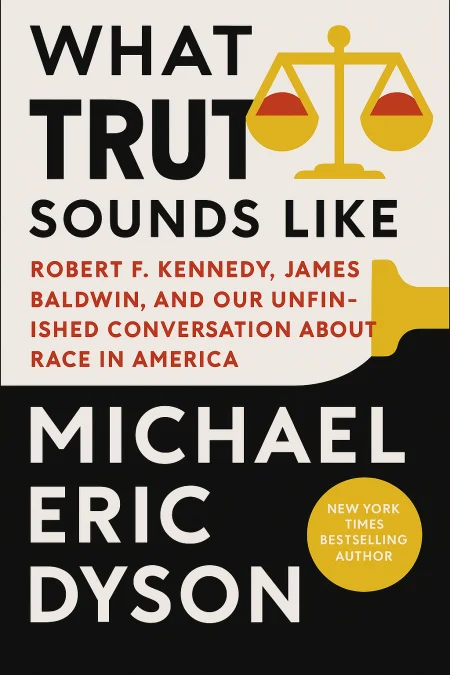
What Truth Sounds Like
Robert F. Kennedy, James Baldwin, and Our Unfinished Conversation About Race in America
Book Edition Details
Summary
In the crucible of 1963, a clandestine meeting between Robert Kennedy and a cadre of black visionaries ignited a firestorm of dialogue that would forever alter the American racial landscape. Michael Eric Dyson's "What Truth Sounds Like" captures this pivotal moment with electrifying prose, illuminating how a torrent of unfiltered truths broke the dam of political complacency. As Kennedy clashed with the raw, unyielding voices of James Baldwin and his allies, he was forced to confront a visceral reality—a moment that echoes in today's struggle for racial justice. Dyson deftly bridges past and present, revealing the undying tension between political maneuvering and moral clarity. This book stands as a clarion call for empathy and transformation, urging a society at the crossroads of race and democracy to listen, reflect, and act.
Introduction
The collision between progressive politics and racial truth has never been more urgent than in America's current moment of reckoning. This exploration delves into a pivotal 1963 meeting between Attorney General Robert F. Kennedy and a group of prominent Black intellectuals, artists, and activists led by James Baldwin, revealing how the fundamental tensions between policy solutions and moral witness continue to shape contemporary debates about racial justice. The meeting exposed a critical divide: Kennedy's faith in legislative remedies clashed with Baldwin's insistence on confronting the deeper psychological and spiritual dimensions of white supremacy. The encounter illuminates why technical policy fixes often fail to address the existential reality of racial oppression, while simultaneously revealing the limitations of moral testimony without institutional power. Through examining the distinct yet interconnected roles of politicians, artists, intellectuals, and activists in advancing racial justice, this analysis demonstrates how effective social transformation requires both the pragmatic mechanisms of policy and the prophetic force of witness. The framework established in that contentious room continues to define the strategic choices facing contemporary movements from Black Lives Matter to political campaigns, forcing us to grapple with whether America can ever reconcile its democratic ideals with the persistent reality of racial hierarchy.
The Power of Witness Over Policy in Racial Justice
The fundamental argument emerges from a recognition that American racial oppression operates simultaneously as a system of material exploitation and psychological domination. Policy approaches, while necessary for addressing concrete inequalities, fail to penetrate the deeper structures of racial meaning that sustain white supremacy across generations. The power of witness lies in its capacity to expose and challenge the moral and emotional investments that make racial hierarchy feel natural and inevitable to those who benefit from it. Witness functions as both revelation and resistance, forcing dominant groups to confront the human cost of systems they have learned to see as neutral or beneficial. When Baldwin and his companions refused to engage Kennedy on purely policy grounds, they were insisting that racial justice requires more than legislative adjustments—it demands a transformation of consciousness that can only emerge through direct encounter with suppressed truths about American society. This approach recognizes that racial oppression is sustained not merely through discriminatory laws or economic arrangements, but through elaborate psychological defenses that allow beneficiaries to maintain their moral self-image while participating in exploitative systems. The testimonial tradition in Black politics, from slave narratives to contemporary police brutality videos, operates by disrupting these comfortable fictions and compelling audiences to confront realities they would prefer to ignore. The tension between witness and policy persists because each addresses different dimensions of the same problem, yet neither alone proves sufficient for achieving lasting transformation. Policy without witness fails to challenge the underlying assumptions that generate discriminatory outcomes, while witness without policy can become merely cathartic rather than transformative.
Artists, Intellectuals, and Political Figures as Catalysts for Change
Creative and intellectual work provides essential tools for reimagining social possibilities beyond the constraints of existing political arrangements. Artists possess unique abilities to make visible the emotional and spiritual dimensions of racial experience that conventional political discourse tends to exclude or minimize. Through music, literature, visual art, and performance, they can communicate truths that policy papers and legislative debates cannot capture, reaching audiences in ways that bypass rational defenses against uncomfortable realities. Intellectuals contribute analytical frameworks that help interpret immediate experiences within broader historical and theoretical contexts. Their role involves not merely describing social phenomena but developing conceptual tools that enable more sophisticated understanding of how systems of domination operate and might be challenged. The intersection of scholarly analysis with lived experience generates insights unavailable through either academic study or personal testimony alone. Political figures, despite their institutional constraints, possess unique capacities to translate social movements' demands into concrete changes in law, resource allocation, and governmental practice. Their effectiveness depends partly on their willingness to risk political capital for moral principles, but also on their ability to navigate complex coalitional dynamics and institutional procedures that activists and artists need not master. The most significant breakthroughs in racial justice have emerged when these different forms of leadership work in productive tension rather than perfect harmony. Artists and intellectuals provide the moral vision and analytical tools necessary for imagining alternatives to existing arrangements, while political figures possess the institutional knowledge and relationships required to implement specific changes. The creative friction between these approaches generates innovations that none could achieve independently.
Contemporary Movements and the Legacy of Black Resistance
Contemporary racial justice movements inherit both the strategic insights and unresolved tensions of earlier liberation struggles, adapting historical approaches to current technological, political, and cultural conditions. The Black Lives Matter movement exemplifies this inheritance, combining traditional community organizing with digital organizing strategies while maintaining the testimonial emphasis that characterized earlier civil rights activism. Social media platforms have dramatically expanded the reach and immediacy of witness, allowing individual experiences of racial violence to achieve national attention within hours rather than months or years. This technological transformation has altered the dynamics between local organizing and national movement building, enabling more decentralized and participatory forms of activism while also creating new vulnerabilities to surveillance and backlash. The emphasis on intersectionality reflects an evolution in understanding how racial oppression intersects with other systems of domination, particularly those affecting women, LGBTQ+ individuals, and working-class communities. This broader analysis challenges earlier movement approaches that treated racial justice as separable from other forms of social transformation, while also creating new complexities in building coalitions across different identity-based movements. The ongoing tension between reformist and revolutionary approaches reflects deeper questions about whether existing American institutions can be reformed to achieve genuine racial justice or whether more fundamental restructuring of economic and political systems is necessary. Contemporary movements navigate these strategic choices while operating within political contexts that often demand immediate responses to urgent crises, leaving limited time for the kind of long-term strategic planning that successful social movements require.
The Ongoing Struggle for Democracy and Racial Truth
The promise of American democracy remains fundamentally compromised by its failure to reckon honestly with the centrality of racial domination to the nation's political and economic development. This failure extends beyond historical acknowledgment to include contemporary resistance to policies and practices that would meaningfully address racial inequality's ongoing effects. The democratic ideal of equal citizenship cannot be realized while racial hierarchy continues to shape access to education, employment, housing, healthcare, and political participation. The struggle for racial truth involves more than correcting historical narratives or acknowledging past injustices—it requires confronting how white supremacist assumptions continue to influence contemporary policy debates, cultural representations, and institutional practices. This confrontation necessarily challenges not only explicit racial prejudices but also seemingly neutral principles and procedures that systematically advantage white citizens while disadvantaging communities of color. Democratic institutions themselves become sites of struggle over racial meaning, as different groups contest the boundaries of citizenship, the definition of rights, and the obligations of government toward historically marginalized communities. These contests reveal democracy not as a completed achievement but as an ongoing process of negotiation over who counts as a legitimate participant in collective decision-making and whose interests deserve protection and advancement. The international dimensions of this struggle have become increasingly visible as domestic racial conflicts attract global attention, undermining America's capacity to promote democratic values internationally while failing to implement them domestically. This contradiction creates both opportunities and challenges for racial justice movements, as global solidarity networks provide resources and legitimacy while also subjecting local movements to additional surveillance and repression.
Summary
The essential insight emerging from this analysis concerns the irreducible complexity of racial transformation in democratic societies, requiring simultaneous engagement with material conditions, cultural representations, psychological investments, and institutional arrangements. Neither purely moral nor purely technical approaches prove adequate for addressing systems of domination that operate across multiple dimensions of social life, demanding instead integrated strategies that can work effectively within existing constraints while maintaining transformative vision. The unfinished conversation about race in America continues because it involves not merely policy disagreements but fundamental conflicts over the meaning of democracy, citizenship, and human worth that cannot be resolved through compromise alone but require ongoing struggle to expand the boundaries of moral and political community.
Related Books
Download PDF & EPUB
To save this Black List summary for later, download the free PDF and EPUB. You can print it out, or read offline at your convenience.
By Michael Eric Dyson
