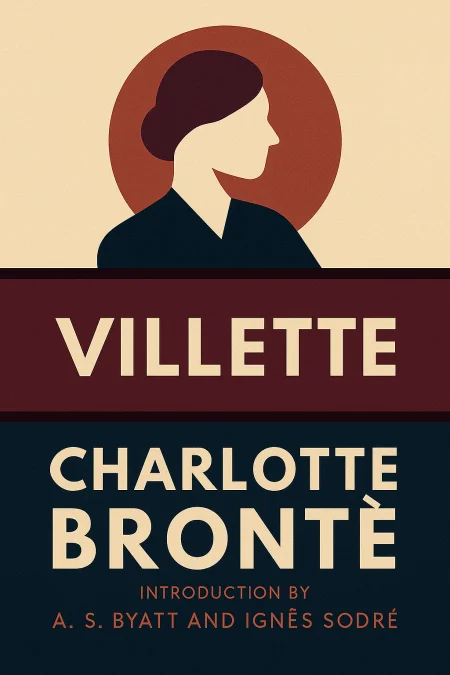
Villette
Love and Independence Abroad
byCharlotte Brontë, Ignes Sodre, A.S. Byatt
Book Edition Details
Summary
In the shadowed corridors of Villette's French boarding school, Lucy Snowe—a woman with a past as fragmented as her own heart—seeks solace from her ghosts. Charlotte Brontë's riveting tale weaves Lucy's quest for identity and belonging with the intensity of forbidden passions and unspoken desires. As Lucy becomes an inadvertent observer of Dr. John and Ginerva Fanshawe's tumultuous entanglement, she faces her own buried emotions. Here, love is both a sanctuary and a tormentor, and in this labyrinth of language and longing, Lucy discovers a resilience she never knew she possessed. Villette is not just a novel; it's an exploration of a woman's consciousness, a masterpiece of emotional depth and literary genius that stands unparalleled in English literature.
Introduction
In the quiet corners of a Belgian boarding school, where shadows dance across worn stone floors and whispered conversations echo through narrow corridors, we encounter one of literature's most compelling portraits of quiet courage. Lucy Snowe emerges from the pages of her story not as a conventional heroine blessed with beauty or fortune, but as a woman whose strength lies in her capacity to endure, observe, and ultimately transform herself through sheer force of will. Her journey from the familiar landscapes of England to the foreign streets of Villette represents more than geographical displacement—it becomes a profound exploration of what it means to forge an authentic life when society offers few maps for the path ahead. What makes Lucy's story so remarkable is not the dramatic sweep of her adventures, but rather the subtle evolution of her inner landscape. She represents a new kind of protagonist—one who finds power not in conquest or romance, but in the patient cultivation of independence and the gradual recognition of her own worth. Through her experiences as an exile, a teacher, and eventually a woman in love, Lucy demonstrates that the most profound transformations often occur not in moments of triumph, but in the quiet spaces between heartbreak and hope. Her story speaks to anyone who has ever felt invisible, displaced, or uncertain of their place in the world, offering the radical suggestion that solitude need not mean loneliness, and that strength can emerge from the very circumstances that seem most likely to defeat us.
From England to Villette: Early Displacement and the Quest for Purpose
Lucy Snowe's early years were marked by the kind of quiet displacement that shapes character in ways more dramatic upheavals cannot. Orphaned and without the safety net of family wealth or connections, she learned early to navigate the world as an observer rather than a participant. Her childhood experiences in the Bretton household provided glimpses of domestic warmth and security, yet even there she remained peripheral—welcomed but never quite belonging, cared for but never claimed. These formative years taught her the art of making herself useful while expecting little in return, a skill that would prove both blessing and burden in the years to come. The death of her guardian and the dissolution of her modest security forced Lucy into the harsh reality of a woman alone in the world. Her brief employment as companion to the invalid Miss Marchmont offered temporary refuge but also a sobering preview of what spinsterhood might hold—a life of devoted service to others' needs while her own dreams withered in silence. When Miss Marchmont's death left her once again without anchor, Lucy faced a choice that would define her future: accept the narrow confines of what English society offered women in her position, or venture into the unknown in search of something more. Her decision to leave England for the Continent represented an act of remarkable courage disguised as desperate necessity. With little money, no connections, and barely functional French, Lucy embarked on a journey that would test every aspect of her character. The crossing to Belgium became symbolic of her larger transition from passive recipient of circumstances to active architect of her own destiny. In choosing exile over familiar limitation, she demonstrated the kind of quiet heroism that would characterize her entire journey—the willingness to embrace uncertainty rather than accept a life half-lived. The early days in Villette brought challenges that might have broken a less determined spirit. Language barriers, cultural differences, and the constant awareness of her foreignness created a daily gauntlet of small humiliations and large uncertainties. Yet these very difficulties began to reveal strengths Lucy had never known she possessed—a capacity for adaptation, a talent for observation, and an inner resilience that would serve as her foundation for everything that followed.
Teaching and Growth: Finding Strength in Professional Independence
The walls of Madame Beck's pensionnat became both sanctuary and testing ground for Lucy's emerging sense of self. Her position as an English teacher thrust her into responsibilities she had never imagined herself capable of handling. The classroom, initially a source of terror with its unruly students and unfamiliar expectations, gradually transformed into her domain—a space where her natural intelligence and hard-won patience could flourish. Each successfully managed lesson, each moment of connection with a struggling student, built her confidence in ways that no amount of encouragement from others could have achieved. Madame Beck herself proved to be an unexpected mentor in the art of quiet authority. Though their relationship remained professionally cordial rather than personally warm, Lucy learned valuable lessons from watching how the headmistress maintained order through careful observation, strategic intervention, and the judicious use of both kindness and firmness. The pensionnat's international character exposed Lucy to perspectives and personalities that broadened her understanding of human nature while teaching her to navigate complex social dynamics with increasing skill. Her interactions with fellow teachers revealed the various strategies women employed to secure their positions in an uncertain world. Some, like Zélie St. Pierre, relied on charm and manipulation; others sought advancement through romantic attachments or family connections. Lucy's path differed markedly from these approaches—she chose to build her reputation on competence, reliability, and genuine care for her students' learning. This decision, while sometimes isolating, established her as a respected member of the school community and provided her with the satisfaction of work well done. The growth Lucy experienced during these years extended far beyond professional competence. Teaching forced her to articulate ideas clearly, to think on her feet, and to command respect from those who might otherwise dismiss her as insignificant. The daily challenges of managing diverse personalities and competing demands developed her emotional intelligence and cultural sensitivity. Most importantly, her success in the classroom proved to herself that she possessed valuable skills and could contribute meaningfully to the world around her, laying the groundwork for the greater independence that would follow.
Love and Choice: Navigating Relationships While Preserving Identity
Lucy's emotional education in Villette proved as transformative as her professional development, though far more painful in its lessons. Her renewed acquaintance with Dr. John Bretton awakened feelings she had thought safely buried beneath layers of resignation and practical necessity. The intensity of her attraction to him, combined with the clear impossibility of its fulfillment, forced her to confront the depth of her own capacity for love and the corresponding potential for heartbreak. Through this experience, she learned the difficult art of loving without expectation, of treasuring connection while accepting limitation. The contrast between her feelings for Dr. Bretton and her later relationship with M. Paul Emanuel revealed the complexity of human affection and compatibility. Where Graham Bretton represented the comfort of familiar affection and social acceptability, M. Paul challenged every assumption Lucy had made about love and partnership. Their relationship developed through intellectual sparring, professional collaboration, and moments of unexpected tenderness that caught them both off guard. With M. Paul, Lucy discovered that true intimacy might require not the surrender of self but the full engagement of two complete individuals. M. Paul's recognition of Lucy's intelligence and capabilities provided her with something she had never experienced before—the validation of being truly seen and valued for her mind as well as her heart. His sometimes harsh but ultimately loving guidance pushed her to develop talents she had kept hidden, to express opinions she had learned to suppress, and to claim space in conversations and situations where she had previously remained silent. Through their debates about education, religion, and human nature, Lucy found her own voice and learned to trust her own judgment. The cultural and religious differences between them added layers of complexity that forced both to examine their fundamental beliefs and assumptions. Lucy's Protestant background and M. Paul's Catholic faith created tensions that went beyond theological disagreement to touch on questions of identity, loyalty, and the possibility of compromise without betrayal of core principles. These challenges ultimately strengthened their bond by proving that love could transcend difference without requiring the erasure of individual conviction.
Self-Possession: The Achievement of Authentic Independence
The establishment of Lucy's own school represented the culmination of her transformation from dependent observer to independent actor in her own life. With M. Paul's financial support and emotional encouragement, she created an institution that reflected her educational philosophy, her understanding of young women's needs, and her vision of what learning could accomplish. The success of this venture validated not only her professional competence but her judgment in matters ranging from curriculum design to staff selection, proving that her years of careful observation and gradual skill-building had prepared her for leadership. Running her own establishment demanded capabilities Lucy had never been required to develop—business acumen, financial planning, and the ability to inspire confidence in parents entrusting their daughters to her care. She discovered within herself a talent for administration and an intuitive understanding of how to create an environment where learning could flourish. The respect she earned from students, parents, and the broader Villette community confirmed her evolution from invisible outsider to valued community member. The three years of M. Paul's absence tested every aspect of Lucy's hard-won independence. While their correspondence provided emotional sustenance and intellectual stimulation, the daily reality of her life required self-reliance and solitary decision-making. She learned to find satisfaction in her work, meaning in her relationships with students and colleagues, and strength in her own company. This period proved that her growth had created genuine transformation rather than mere adaptation to circumstances. Whether M. Paul's return would lead to marriage and a different kind of partnership, or whether fate would require her to continue on her independent path, Lucy had achieved something remarkable—the creation of a meaningful life on her own terms. She had transformed herself from a young woman dependent on others' charity into a respected educator, financially secure and professionally accomplished. Her journey demonstrated that true security comes not from external protection but from the development of one's own capabilities and the courage to act upon one's convictions.
Summary
Lucy Snowe's remarkable journey from displacement to self-possession illuminates a profound truth about human resilience and the possibility of transformation even in the most challenging circumstances. Her story demonstrates that the qualities society often overlooks—quiet intelligence, patient observation, and steady determination—can become the foundation for extraordinary achievement when channeled toward meaningful goals. Through her experiences of exile, professional growth, and complex love, Lucy proves that independence and connection need not be mutually exclusive, and that strength often emerges not in spite of adversity but because of it. Her example offers particular inspiration to those who find themselves operating outside conventional social structures or facing periods of uncertainty and transition. Lucy's path suggests that fulfillment can be discovered in unexpected places and that the patient development of one's talents and character can lead to opportunities that seemed impossible at the outset. Her story speaks to anyone who has ever felt invisible or uncertain of their place in the world, offering the radical proposition that solitude can become a source of power rather than merely a burden to endure, and that authentic independence—built on self-knowledge, competence, and the courage to act on one's convictions—represents one of the most valuable achievements available to the human spirit.
Related Books
Download PDF & EPUB
To save this Black List summary for later, download the free PDF and EPUB. You can print it out, or read offline at your convenience.
By Charlotte Brontë
