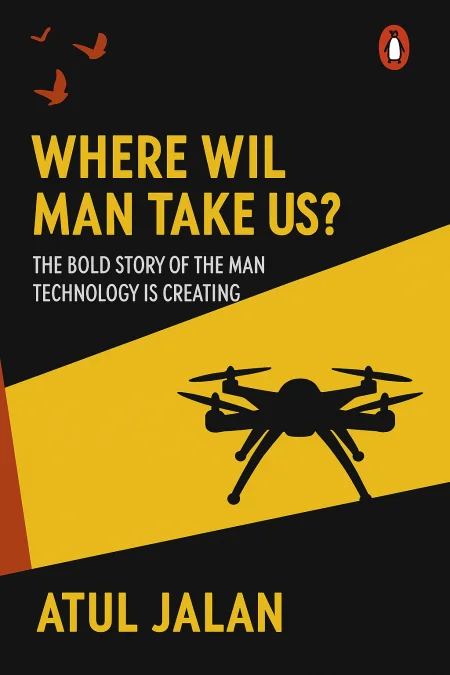
Where Will Man Take Us?
The Bold Story of the Man Technology is Creating
Book Edition Details
Summary
In the not-so-distant tomorrow, the essence of humanity teeters on a digital precipice. Atul Jalan's "Where Will Man Take Us?" unveils a provocative tapestry of the future where nanotech marvels, AI companions, and genetic breakthroughs redefine our existence. Imagine a world where the love of your life might require a nightly recharge, and breakfast begins with a dose of synthetic joy. As we stand at the brink of unprecedented evolution, Jalan poses profound questions about the metamorphosis of society and the ethical labyrinths we must navigate. This thought-provoking exploration challenges us to consider: when technology evolves us beyond recognition, what remains of our humanity?
Introduction
In 1854, a brilliant mathematician was found dead beside a half-eaten apple laced with cyanide. Alan Turing's tragic end marked not just the loss of a visionary mind, but the beginning of a technological revolution that would fundamentally reshape human existence. Today, as we stand at the threshold of artificial intelligence merging with our biology, we witness the culmination of ideas that began in Turing's wartime calculations and laboratory experiments. This sweeping transformation raises profound questions that echo through our daily lives. How did we evolve from mechanical calculators to machines that can beat world champions at games requiring intuition? What happens when our smartphones become extensions of our consciousness, when our genes can be edited like computer code, and when the line between human and artificial intelligence begins to blur? Most crucially, as we gain god-like powers to manipulate matter at the atomic level and potentially achieve immortality, what kind of beings are we becoming? This exploration traces the remarkable journey from the foundational concepts of computation to the emergence of technologies that promise to transcend the very limitations of human biology. It reveals how mathematics, once abstract theory, now patterns our understanding of everything from genetics to the cosmos, while examining the societal upheavals these advances bring to democracy, privacy, employment, and even love itself. For anyone seeking to understand how yesterday's science fiction became today's reality, and what tomorrow might hold for the human species, this journey through the technology revolution offers both wonder and warning about our rapidly approaching future.
The Foundational Era: Computing and AI Emergence (1940s-1990s)
The modern world began not with a bang, but with a dream. In the 1940s, as the world tore itself apart in global warfare, a handful of brilliant minds laid the conceptual foundations for a revolution that would ultimately transform human civilization. Alan Turing's theoretical machines, conceived in the midst of breaking Nazi codes, established the fundamental principles that every computer would follow. His question, "Can machines think?" wasn't merely academic speculation but the opening gambit in humanity's quest to understand intelligence itself. During these formative decades, the boundaries between disciplines collapsed as mathematicians, philosophers, and engineers found themselves wrestling with the same profound questions. What constitutes thought? How does the mind arise from the brain? The early pioneers like Marvin Minsky, who boldly declared humans to be nothing but "meat machines," pushed against the comfortable assumption that consciousness was uniquely biological. Their top-down approach, programming computers with rules governing human behavior, represented humanity's first serious attempt to codify intelligence. Yet progress proved frustratingly slow. The grand promises of the 1950s gave way to the sobering reality of translation programs that turned "the spirit is willing, but the flesh is weak" into "the vodka is good but the meat is rotten." The field entered what many called an AI winter, where expert systems could perform narrow tasks but remained painfully limited compared to even a child's flexible intelligence. The dream of artificial minds seemed to recede even as computing power grew exponentially. This era established crucial precedents that echo through today's technological landscape. The theoretical frameworks developed during this period, from neural networks to machine learning concepts, would lay dormant for decades before resurging with unprecedented power. More importantly, these early pioneers established the philosophical groundwork for questions we still grapple with today: the nature of consciousness, the relationship between mind and machine, and the possibility that intelligence might not be uniquely human after all.
The Digital Convergence: Internet, Data and Algorithmic Society (2000s-2010s)
The twenty-first century's opening decades witnessed an unprecedented convergence of technologies that transformed not just how we communicate, but how we think, love, and govern ourselves. The Internet, once a military communication network, evolved into a vast nervous system connecting billions of minds, while smartphones placed the world's knowledge literally at our fingertips. This period marked the transition from isolated computing to ubiquitous connectivity, fundamentally altering the relationship between humans and information. Social media platforms emerged as the unexpected architects of this new world, creating echo chambers that would reshape democracy itself. Algorithms, initially designed to show us what we wanted to see, inadvertently fractured societies into filter bubbles where opposing viewpoints rarely penetrated. The 2016 election results shocked those trapped within their digital cocoons, revealing how personalized information feeds had created parallel realities. What began as tools for connection became instruments of division, as humans found themselves increasingly living in algorithmic worlds tailored to their preconceptions. Meanwhile, data became the new oil, with tech giants accumulating unprecedented insights into human behavior. Every click, every search, every social interaction fed into vast learning systems that began to predict and influence human choices with startling accuracy. Dating apps revolutionized romance through mathematical compatibility algorithms, while political campaigns treated voters as consumers to be targeted with precision-crafted messages. The quantification of human experience reached new heights as everything from health to happiness became subject to measurement and optimization. This era established the infrastructure for the transformation to come. The massive data lakes accumulated during these decades would become the training grounds for artificial intelligence systems that would soon surpass human capabilities in specific domains. More significantly, society began accepting the idea that algorithms might make better decisions than humans in many domains, from matching romantic partners to recommending entertainment. The stage was set for the next phase, where these technologies would not merely assist human intelligence but begin to augment and potentially replace it entirely.
The Transformation Age: Human-Machine Integration and New Realities (2020s-Future)
We stand at the threshold of the most dramatic transformation in human history, where the boundaries between biology and technology dissolve entirely. Genetic engineering tools like CRISPR now allow us to edit the human genome with the precision of word processing software, while nanotechnology promises to rebuild our bodies molecule by molecule. Artificial intelligence has evolved from narrow task-specific tools to systems that demonstrate creativity, intuition, and problem-solving capabilities that rival or exceed human performance across multiple domains. The implications cascade through every aspect of human existence. Quantum computing threatens to revolutionize our understanding of reality itself, potentially confirming that our universe operates on principles so strange they challenge our most basic assumptions about existence. Advanced AI systems raise profound questions about consciousness, employment, and even love, as humans begin forming emotional bonds with artificial beings that may soon possess qualities indistinguishable from human intelligence. The prospect of digital immortality through consciousness uploading transforms ancient philosophical questions about the nature of self into practical engineering challenges. Simultaneously, these technologies force humanity to confront fundamental questions about identity, purpose, and survival. If machines can perform all human cognitive tasks better than humans, what remains uniquely human? As genetic engineering eliminates disease and extends lifespans indefinitely, how do we find meaning in a post-scarcity world? The convergence of AI, nanotechnology, and biotechnology promises either humanity's greatest triumph or its obsolescence, with the outcome dependent on choices we make in the next few decades. The transformation age represents not just technological advancement but species evolution. We are becoming the first generation consciously directing our own evolutionary path, choosing which traits to enhance and which limitations to transcend. Whether we emerge as enhanced humans, merge with our artificial creations, or find ourselves surpassed by our technological offspring, the human story as we have known it for millennia is entering its final chapter. What comes next will be our choice to make, if we still retain the agency to make it.
Summary
The arc of technological development reveals humanity's relentless drive to transcend its biological limitations through tools that amplify and eventually replace natural capabilities. From Turing's theoretical machines to today's AI systems that demonstrate creativity and intuition, we witness not merely technological progress but the emergence of non-biological intelligence that may represent the next stage of evolution on Earth. This transformation challenges every assumption about human uniqueness, consciousness, and the future of intelligence itself. The historical pattern suggests that we consistently underestimate technology's transformative power while overestimating our ability to control its consequences. Each breakthrough, from the Internet to genetic engineering, has reshaped society in ways its creators never anticipated. Today's convergence of artificial intelligence, nanotechnology, and biotechnology represents not incremental change but a phase transition comparable to the emergence of life itself. The question facing humanity is not whether this transformation will occur, but whether we will guide it wisely or become its unintended casualties. Three principles emerge from this technological odyssey: first, prepare for changes more radical than current imagination suggests, as exponential technologies consistently exceed linear predictions. Second, actively engage with these transformations rather than passively accepting whatever emerges, since the technologies reshaping our world respond to human values and choices embedded in their design. Finally, cultivate wisdom alongside intelligence, for the power to reshape matter, genetics, and consciousness demands ethical frameworks as sophisticated as our technical capabilities. The species that emerges from this transformation will be defined not just by what we can create, but by what we choose to become.
Related Books
Download PDF & EPUB
To save this Black List summary for later, download the free PDF and EPUB. You can print it out, or read offline at your convenience.
By Atul Jalan
