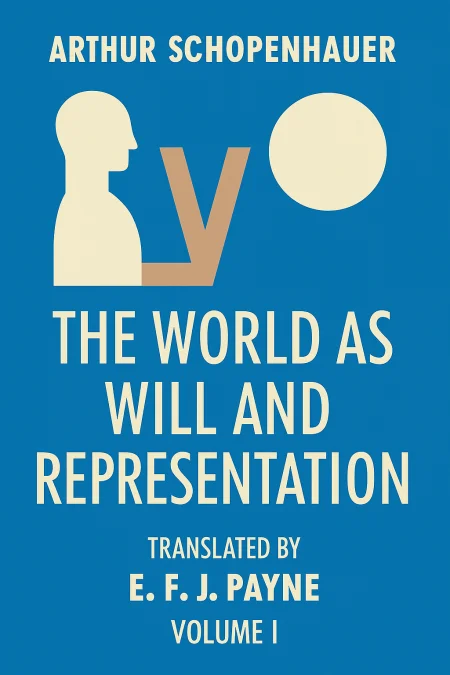
The World as Will and Representation, Volume I
Uncover the Nature of Reality and Human Desire
byArthur Schopenhauer, E.F.J. Payne
Book Edition Details
Summary
In the realm of philosophical exploration, where reality dances on the edge of perception, Arthur Schopenhauer's "The World as Will and Representation" emerges as a profound beacon of thought. A cornerstone of post-Kantian philosophy, this masterpiece strips away the veneer of the visible world to expose the raw, relentless drive of the will beneath. Crafted with intricate precision and visionary depth, Schopenhauer presents a world where the familiar is but an illusion, shaped by the mind's eye, while the true essence pulses with an untamed force beyond our conscious grasp. E. F. J. Payne’s translation breathes new life into this seminal text, correcting past missteps and offering an unfiltered gateway into Schopenhauer's universe, making it an indispensable companion for seekers of philosophical enlightenment.
Introduction
Reality confronts us with a fundamental paradox: the world we experience through our senses appears solid and independent, yet remains forever separated from us by the very act of perception itself. This philosophical investigation challenges the assumption that empirical observation or rational analysis alone can penetrate to the heart of existence. Instead, it proposes a revolutionary approach that recognizes two distinct yet inseparable aspects of reality - the world as it appears to consciousness and the underlying force that drives all manifestation. The method employed here departs radically from traditional philosophical approaches by beginning with immediate, lived experience rather than abstract principles. Through careful analysis of how we know our own bodies both as objects in space and as expressions of inner willing, a unique key emerges for unlocking the mysteries of external phenomena. This investigation reveals how the same fundamental principle that manifests as human desire also appears as gravitational force, chemical affinity, and biological growth, though at different levels of complexity and self-awareness. The systematic exploration proceeds through rigorous examination of perception, aesthetics, ethics, and the ultimate possibilities of human existence. Each stage builds upon previous insights while pointing toward a comprehensive understanding of why existence is characterized by suffering and how genuine liberation might be achieved. The implications extend far beyond theoretical philosophy, offering practical wisdom for those seeking to understand the deepest questions of consciousness, morality, and the meaning of life itself.
The World as Representation: Phenomena and the Principle of Sufficient Reason
All human experience unfolds within the fundamental structure of subject and object, where a knowing consciousness encounters a world of phenomena that exists only in relation to that consciousness. This basic insight reveals that everything we perceive as external reality consists entirely of representations, dependent upon the forms and categories through which the mind organizes sensory data. The apparent independence and objectivity of the physical world dissolves under careful analysis, showing itself to be thoroughly conditioned by the cognitive apparatus that apprehends it. The principle of sufficient reason governs all possible representations, manifesting in distinct forms across different domains of experience. In the realm of concepts and judgments, it operates as logical necessity connecting premises to conclusions. In mathematics, it determines the relationships between spatial figures and temporal sequences. In physical perception, it appears as causality linking phenomena in necessary succession. In human motivation, it connects desires to actions through the mechanism of sufficient motive. Each manifestation follows strict laws that create the orderly structure of experience, yet all remain confined to the sphere of representation rather than revealing the inner nature of things. Space, time, and causality emerge as the fundamental forms through which any possible object must appear to consciousness. These are not properties belonging to things as they exist independently, but rather the necessary conditions under which anything can become an object of knowledge. The understanding operates by immediately grasping causal connections, transforming mere sensations into coherent perceptions of an objective world. Mathematical knowledge demonstrates the a priori nature of spatial and temporal relations, while logical reasoning reveals the formal structures governing conceptual thought. The recognition that the entire phenomenal world consists of representations leads to a crucial philosophical insight: ordinary knowledge, however sophisticated, never penetrates beyond the surface of appearances. We can map the relationships between phenomena with increasing precision and discover universal laws governing their interactions, but the essential nature of what appears through these relationships remains forever hidden from representational knowledge. This limitation points toward the necessity of a different kind of knowing, one that might reveal what lies behind the veil of appearances.
The Will as Thing-in-Itself: The Metaphysical Ground Beyond Kantian Limitations
The breakthrough to metaphysical knowledge occurs through recognition of a unique form of awareness available to every individual: the immediate, non-representational knowledge of one's own willing nature. When we move our bodies or experience desires, we possess direct insight into something that exists outside the forms of space, time, and causality that govern all representations. This willing is not an object among others but the inner reality of what appears externally as bodily action and behavior. The will reveals itself as a blind, irrational force that operates without ultimate purpose or final goal. Unlike everything in the world of representation, where each phenomenon must have sufficient reason for its existence and particular characteristics, the will simply is, requiring no further explanation or justification. This groundless character distinguishes it fundamentally from all representational knowledge, which remains forever bound by the principle of sufficient reason and its demand for causal connections. The identification of will as the thing-in-itself extends far beyond individual human experience to encompass the entire natural world. The same inner nature that we recognize as will in ourselves operates throughout all phenomena, appearing as gravity in falling stones, as chemical affinity in molecular combinations, as growth and reproduction in plants, and as instinct and desire in animals. These forces differ only in their degree of objectification and complexity of manifestation, not in their essential nature as expressions of the universal will. This recognition of will's universal presence explains both the fundamental unity underlying natural phenomena and the ceaseless striving that characterizes all existence. From the attraction between celestial bodies to the most sophisticated human aspirations, the same metaphysical principle drives all change and development. The will's essential unity means that the apparent multiplicity of individual things and separate forces represents different grades of objectification of a single underlying reality, creating the rich diversity of the phenomenal world while maintaining absolute metaphysical simplicity.
Art and Ethics as Paths to Transcendence: Liberation Through Knowledge
Aesthetic experience provides a unique form of liberation from the tyranny of individual willing through the contemplation of eternal Ideas that serve as perfect archetypes for all particular phenomena. When absorbed in genuine artistic beauty, consciousness undergoes a fundamental transformation: the restless pressure of personal desires temporarily ceases, and awareness becomes a pure mirror reflecting the essential forms of existence. This state offers temporary escape from the suffering inherent in willing and provides a foretaste of more permanent liberation. The aesthetic contemplation reveals Platonic Ideas - eternal, unchanging forms that exist outside space and time as perfect patterns for all individual manifestations. In ordinary perception, we see only particular objects serving practical purposes or hindering personal goals. Art, however, presents these universal forms directly, allowing consciousness to grasp the essential nature of phenomena without the distortion introduced by individual interest and desire. The artist, through genius, achieves direct perception of these Ideas and embodies them in sensuous form, making this transcendent vision accessible to others. Ethical behavior emerges from the same fundamental insight that underlies aesthetic experience: the recognition that the apparent boundaries between self and other are illusory constructs of representation rather than metaphysical realities. When the principium individuationis dissolves through genuine knowledge, compassion arises spontaneously as the natural expression of understanding that the same will operates in all beings. This insight leads to justice and loving-kindness not as imposed duties but as inevitable consequences of seeing through the veil of separateness. The progression from aesthetic contemplation to ethical recognition represents different degrees of the same fundamental transformation: the overcoming of individual willing through knowledge. Both paths depend on seeing beyond the world of representation to the underlying reality of will, whether through the timeless vision of Ideas in art or through the recognition of universal suffering in moral experience. These forms of liberation, though temporary, point toward the ultimate possibility of complete transcendence through the total denial of the will-to-live itself.
The Denial of Will-to-Live: Ultimate Salvation from the Suffering of Existence
The highest possibility for human existence lies in the complete denial of the will-to-live, achieved not through abstract reasoning but through immediate insight into the futility of all striving and the suffering inherent in existence itself. This denial represents a fundamental turning of the will against itself, where knowledge becomes so clear and powerful that it acts as a quieter of willing rather than merely providing new motives for action. Such transformation transcends both ordinary morality and aesthetic contemplation, pointing toward absolute liberation from the cycle of desire and suffering. The recognition that drives this ultimate transformation involves seeing through the illusion that satisfaction is possible within the realm of willing. Every fulfilled desire immediately gives birth to new wants, creating an endless cycle of striving that can never achieve permanent peace. Pleasure reveals itself as merely the temporary absence of pain rather than a positive state, while pain and want constitute the positive reality of existence. This insight, when it becomes vivid and complete, naturally leads to the withdrawal from willing itself rather than the mere redirection of desires toward different objects. The denial of will manifests in various forms of ascetic practice and self-renunciation, but its essence lies not in particular external behaviors but in the complete cessation of willing itself. Saints and ascetics throughout history demonstrate this possibility through their voluntary poverty, chastity, and mortification of desires. Their lives serve as empirical proof that the will can indeed turn against itself, achieving a state of inner peace that transcends both pleasure and pain, hope and fear. This ultimate liberation cannot be described positively because it transcends all categories of ordinary experience, which remain bound to the world of willing and representation. From the perspective of those still caught in the web of individual desire, this state appears as nothingness. Yet for those who have achieved it, the entire world of willing, with all its struggles and apparent importance, reveals itself as nothing. This represents the final goal of human existence: the complete transcendence of individuality and the attainment of a peace that surpasses all understanding, pointing beyond existence itself to what can only be called salvation.
Summary
The fundamental insight emerging from this philosophical investigation reveals that reality manifests as the objectification of a single, blind, irrational force that appears both as the world of our representations and as the willing nature we know intimately within ourselves, dissolving the artificial separation between mind and matter while providing a unified account of existence that encompasses everything from physical forces to the highest achievements of human culture. The practical implications extend beyond theoretical understanding to offer genuine possibilities for reducing suffering through aesthetic contemplation, ethical recognition of universal unity, and ultimately the transcendence of willing itself, speaking most directly to those who seek not merely intellectual satisfaction but practical wisdom for navigating the fundamental challenges of conscious existence.
Related Books
Download PDF & EPUB
To save this Black List summary for later, download the free PDF and EPUB. You can print it out, or read offline at your convenience.
By Arthur Schopenhauer
