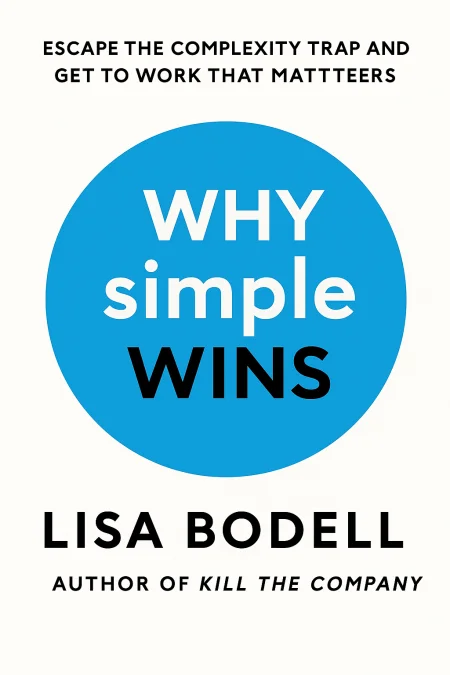
Why Simple Wins
Escape the Complexity Trap and Get to Work that Matters
Book Edition Details
Summary
In a world where complexity stifles creativity, "Why Simple Wins" by Lisa Bodell champions the lost art of simplification as the ultimate business advantage. Instead of drowning in the chaos of emails, redundant meetings, and convoluted processes, Bodell invites us to embrace clarity and purpose. This isn't just a book—it's a manifesto for leaders and teams suffocating under the weight of unproductive work. Through vivid anecdotes and actionable strategies, Bodell dismantles the myth that more is better, revealing how stripping away the superfluous can unleash innovation and engagement. For anyone yearning to cut through the noise and focus on meaningful impact, this is your call to reclaim time and cultivate a culture where simplicity reigns.
Introduction
In today's hyperconnected world, we've created a monster of our own making. Every morning, millions of professionals wake up with ambitious plans to tackle meaningful work, only to find themselves drowning in a sea of unnecessary emails, pointless meetings, and bureaucratic procedures that steal precious hours from their day. The promise of technology was supposed to liberate us, yet we've become slaves to complexity. But there's hope. The most successful organizations and leaders are discovering that in an age of overwhelming complication, simplicity has become the ultimate competitive advantage. By learning to identify, eliminate, and prevent unnecessary complexity, we can reclaim our time, energy, and focus for work that truly matters. The path forward isn't about working harder or adding more tools to our arsenal. It's about the courage to subtract, the wisdom to say no, and the discipline to keep things beautifully simple.
Understanding the Complexity Monster
Complexity isn't just an inconvenience – it's a strategic threat that systematically destroys organizational effectiveness and individual fulfillment. At its core, complexity manifests when processes, communications, and systems become unnecessarily convoluted, requiring more steps, approvals, and mental energy than the actual value they create. Consider the story of Mike McCall, a VP of product management at a global technology company. Despite his expertise and dedication, Mike found himself trapped in what felt like quicksand. His days were consumed by redundant meetings where five minutes of actual decision-making stretched into hour-long sessions. He juggled seventy emails before breakfast and received hundreds more throughout the day, most marked "urgent" despite containing routine information. When his company needed strategic insights to meet revised growth targets, Mike discovered he had zero hours available for the high-level thinking he was hired to provide. Mike's frustration reached a breaking point when a simple request for budget adjustments triggered a cascade of complexity. He spent two hours compiling numbers, calling colleagues across multiple time zones, and navigating approval processes that seemed designed more to create busy work than to generate useful outcomes. The irony wasn't lost on him – the more urgent the business need became, the more organizational complexity prevented him from addressing it effectively. The transformation begins with recognizing that complexity operates like a virus, spreading through organizations via well-intentioned but misguided attempts to improve, control, or optimize. Start by conducting a personal audit of your daily activities. Track how much time you spend on tasks that directly contribute to meaningful outcomes versus time consumed by administrative overhead, redundant communications, and unnecessary processes. Create two columns: "Essential Work" and "Complexity Tax." Most professionals discover that complexity consumes 60-70% of their available time, leaving insufficient bandwidth for the work that actually drives results and satisfaction.
Building Your Simplicity Mindset
True simplification requires more than tactical changes – it demands a fundamental shift in how we think about work, value, and effectiveness. The simplicity mindset rests on four foundational principles: making things as minimal, understandable, repeatable, and accessible as possible. Southwest Airlines exemplifies this mindset in action. While competitors operated fleets of fourteen different aircraft models, Southwest made the bold decision to standardize on a single plane: the Boeing 737. This wasn't just a cost-cutting measure; it was a simplicity strategy that transformed every aspect of their operations. Mechanics needed training on only one aircraft type. Spare parts inventory became streamlined. When weather disrupted schedules, any plane could substitute for another without crew retraining or gate compatibility issues. Ground operations ran smoother because every aircraft had identical parking and service requirements. The results spoke volumes about the power of simplicity. Southwest consistently achieved the industry's "Triple Crown" – best on-time performance, superior baggage handling, and lowest complaint rates. Customers chose Southwest not despite its simplicity, but because of it. The airline's standardization strategy enabled faster turnarounds, more reliable service, and ultimately, better customer experiences. Their success demonstrated that complexity often masquerades as sophistication when simplicity delivers superior results. Building your simplicity mindset starts with asking different questions. Instead of "How can we add value?" ask "What can we remove without losing value?" Replace "How can we improve this?" with "What's the simplest way to achieve our goal?" Begin questioning every process, meeting, and communication channel through the lens of minimal effectiveness. Practice saying no to additions until you've exhausted opportunities for subtraction. Remember that every yes to complexity is an implicit no to something more meaningful. The journey toward simplicity requires courage because it challenges conventional wisdom that equates busyness with productivity and complexity with importance. Embrace the reality that simple solutions often appear deceptively easy, but creating simplicity requires sophisticated thinking and disciplined execution.
The Simplification Toolkit in Action
Effective simplification requires systematic approaches and practical tools that transform good intentions into sustainable results. The most powerful simplification initiatives follow a five-step process: awareness, identification, prioritization, execution, and habit formation. The Cleveland Clinic's business intelligence group demonstrates this toolkit in action. Faced with managing complex reporting systems across one of America's largest healthcare organizations, the team recognized that traditional software development processes were creating more problems than they solved. Instead of disappearing for months to build comprehensive systems, they adopted rapid cycling methodology that emphasized continuous collaboration with end users. The transformation was remarkable. Rather than building elaborate software based on initial requirements that inevitably changed, the team developed solutions in short sprints with constant feedback loops. They discovered that features initially deemed essential became obsolete as real-world usage patterns emerged. By staying closely connected to actual user needs and building only what was truly necessary, they reduced development time by 20-25% while delivering higher-quality solutions that users actually adopted and valued. The key insight was focusing on subtraction rather than addition. The team didn't ask "What else should we build?" but rather "What can we eliminate without losing value?" They streamlined development processes, removed unnecessary features, and simplified user interfaces based on actual behavior rather than theoretical requirements. Start implementing this toolkit by conducting weekly "complexity audits" where you identify the three most time-consuming, low-value activities in your work. Use the "eliminate, outsource, or streamline" framework for each item. Elimination should always be your first choice – completely removing unnecessary tasks creates immediate capacity for meaningful work. When elimination isn't possible, consider outsourcing to someone better positioned to handle the task efficiently. Only when neither elimination nor outsourcing is viable should you invest energy in streamlining existing processes. Create visual dashboards that track your progress in removing complexity. Measure metrics like hours saved, processes eliminated, and capacity redirected toward strategic work. Celebrate simplification victories as enthusiastically as you would celebrate revenue achievements.
Becoming the Chief Simplification Officer
Sustainable simplification requires leadership commitment and organizational culture change that makes simplicity a core operating principle rather than a one-time initiative. Effective leaders embrace their role as chief simplification officers, modeling the behaviors and making the decisions necessary to create space for meaningful work. Steve Strelsin's research at Harvard Business School revealed a striking pattern among high-performing CEOs. While average performers focused primarily on vision-setting, culture-building, and strategy development, industry-leading executives consistently identified their most important role as simplifying the lives and work of their teams. These leaders understood that complexity creates friction that prevents organizations from executing even the best strategies effectively. Tesco CEO Dave Lewis exemplified this leadership approach when he took over the struggling British grocery giant. Facing competition from nimble discount retailers like Aldi and Lidl, Lewis recognized that Tesco's complexity was its primary vulnerability. The company offered twenty-eight different ketchup varieties while Aldi offered one. Customers weren't delighted by choice – they were overwhelmed by it. Lewis made the courageous decision to eliminate 30% of product varieties, reducing offerings from 90,000 items to 65,000. The transformation wasn't immediate, and Lewis faced significant resistance from suppliers, staff, and some customers who complained about losing favorite products. However, the simplification strategy began showing results within the first year. Operations became more efficient, customer decision-making became easier, and the company could focus marketing and inventory resources on products that truly drove business results. Your role as chief simplification officer begins with personal modeling. Eliminate complexity from your own work practices before asking others to do the same. Shorten your emails, reduce meeting times, streamline approval processes you control, and demonstrate that simplification enhances rather than compromises effectiveness. Create a "simplification code of conduct" that establishes clear expectations for how team members approach complexity. Build simplification into strategic planning processes by requiring teams to identify what they'll stop doing before proposing new initiatives. Establish metrics that reward complexity reduction alongside traditional performance indicators. Most importantly, give people permission to challenge unnecessary processes and celebrate those who courageously eliminate work that doesn't add value.
Summary
The choice between complexity and simplicity isn't just about productivity – it's about reclaiming our professional lives and creating space for work that energizes, challenges, and fulfills us. As this exploration has revealed, complexity operates like a silent tax on everything we want to accomplish, consuming resources, energy, and opportunities while delivering diminishing returns. The organizations and individuals who thrive in our hyperconnected age aren't those who master complexity, but those who have the wisdom and courage to eliminate it. Remember Jack Welch's powerful insight: "You can't believe how hard it is for people to be simple, how much they fear being simple. They worry that if they're simple, people will think they're simpleminded. In reality, of course, it's just the reverse. Clear, tough-minded people are the most simple." Your journey toward meaningful work begins with a single, powerful action: identify one unnecessarily complex process in your work today and eliminate it completely. Don't improve it, don't optimize it, don't delegate it – simply remove it and redirect that energy toward something that truly matters. The path to professional fulfillment isn't through doing more things better, but through doing fewer things that matter most.
Related Books
Download PDF & EPUB
To save this Black List summary for later, download the free PDF and EPUB. You can print it out, or read offline at your convenience.
By Lisa Bodell
