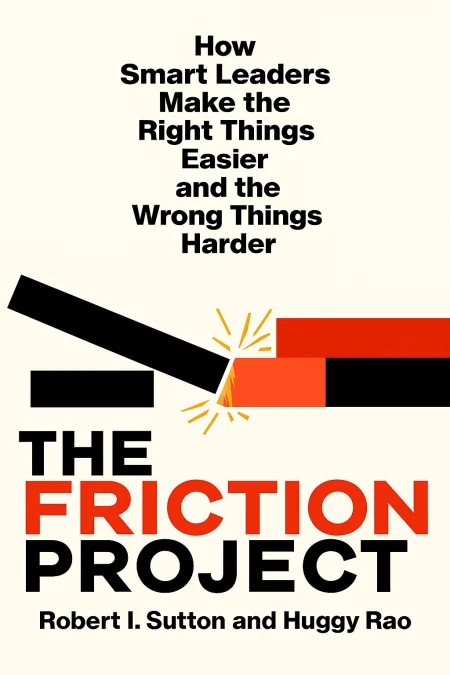
The Friction Project
How Smart Leaders Make the Right Things Easier and the Wrong Things Harder – Without Driving Everyone Crazy
Book Edition Details
Summary
In the dynamic world of modern organizations, friction often stands as both a silent saboteur and an unexpected ally. "The Friction Project," crafted by the insightful duo Robert I. Sutton and Huggy Rao, delves into this paradox with seven years of incisive research. Within these pages, readers are invited to become master "friction fixers," capable of discerning when resistance hinders progress and when it fuels innovation. Sutton and Rao reveal a fascinating blueprint for cultivating a workplace that protects its most vital resources: creativity, health, and enthusiasm. Through engaging case studies and actionable strategies, they unveil how to navigate the complex landscape of organizational dynamics. At its core, this book is a call to embrace the chaos inherent in change, while fostering an environment where civility and compassion drive success. Perfect for leaders eager to transform friction into a force for good, this guide illuminates the path to a more harmonious and effective workplace.
Introduction
Modern organizations face a paradoxical challenge: while technology promises to streamline operations and eliminate inefficiencies, many workplaces have become increasingly frustrating, time-consuming, and dehumanizing. This exploration into organizational friction reveals a counterintuitive truth that challenges conventional wisdom about efficiency and speed. Rather than viewing all obstacles as problems to be eliminated, the key lies in understanding when friction serves a constructive purpose and when it becomes destructive. The analysis presented here adopts a systematic approach to organizational diagnosis, examining how leaders can distinguish between beneficial friction that promotes quality and safety, and harmful friction that wastes time and crushes morale. Through extensive research across diverse industries and organizational contexts, a framework emerges for identifying the root causes of dysfunction and implementing targeted interventions. The methodology combines empirical observation with practical tools, offering readers a structured way to evaluate their own organizational challenges and develop customized solutions that address specific friction points while preserving necessary safeguards and quality controls.
The Core Elements of Friction Fixing
Effective organizational intervention begins with recognizing that friction fixing is fundamentally about stewardship of human time and energy. This perspective shifts focus from abstract efficiency metrics to concrete impacts on individuals navigating organizational systems. The trustee mindset requires leaders to view themselves as guardians of others' most precious resource, making decisions that minimize waste while maximizing meaningful work. The diagnostic process involves systematic evaluation of what should be easy versus what should be difficult within organizational structures. This forensic approach examines eight key dimensions including the appropriateness of actions, available skills and motivation, failure costs, timing pressures, resource capacity, coordination requirements, fairness of burden distribution, and the value of struggle itself. Each dimension provides insight into whether particular processes warrant streamlining or intentional complexity. Implementation follows a hierarchical model of intervention, ranging from immediate symptom relief to fundamental system redesign. At the foundation level, reframing helps people cope with unchangeable frustrations by altering their psychological relationship to obstacles. Navigation provides guidance for traversing complex systems more effectively, while shielding protects core workers from unnecessary interference. The higher levels focus on architectural changes that prevent problems from emerging, whether through localized improvements or comprehensive organizational restructuring. The methodology emphasizes that sustainable change requires both top-down authority and grassroots engagement. Leaders must create conditions for friction fixing while empowering individuals at all levels to identify problems and propose solutions. This distributed approach ensures that improvements address real rather than perceived issues while building organizational capacity for continuous adaptation.
Five Friction Traps and Their Solutions
Power dynamics create the first major source of organizational dysfunction through the insidious effects of privilege and authority on decision-making. Leaders often develop blindness to the burdens their choices impose on others, particularly when they are shielded from experiencing the consequences of organizational inefficiencies. This creates dangerous feedback loops where those with the most influence to fix problems remain unaware of their existence or severity. The human tendency toward addition rather than subtraction represents a second critical trap. Organizations accumulate rules, procedures, meetings, and administrative requirements far faster than they eliminate them. This bias toward complexity stems from individual incentives that reward visible action over less noticeable prevention, combined with the psychological difficulty of recognizing when removing elements might improve performance. Successful intervention requires both systematic auditing of organizational burden and cultural changes that celebrate simplification. Coordination failures plague organizations when different departments, roles, or teams cannot effectively align their efforts. These breakdowns occur partly due to cognitive biases that cause people to focus intensely on their specialized area while neglecting interdependencies. Additionally, organizational structures often reward individual or departmental success without adequately incentivizing collaboration across boundaries. Solutions involve both structural changes and cultural shifts that make cooperation visible and valuable. Communication pollution through jargon, buzzwords, and meaningless language creates barriers to understanding and action. This linguistic confusion takes multiple forms, from unnecessarily complex explanations to completely empty phrases that sound impressive but convey no useful information. The proliferation of specialized terminology can facilitate communication within expert communities while simultaneously excluding others and preventing broader organizational alignment. Effective remedies focus on clarity, translation between specialist domains, and elimination of genuinely meaningless content. The final trap emerges from excessive speed and urgency that prevent thoughtful decision-making and sustainable progress. While rapid response often seems beneficial, premature action frequently creates more problems than it solves, leading to accumulating technical and organizational debt. Organizations need systems that can accurately distinguish between situations requiring immediate action and those benefiting from deliberate consideration, along with mechanisms for slowing down when moving too fast threatens long-term success.
Leading Organizational Change Through Friction Management
Successful friction management requires leaders who understand when to accelerate processes and when to introduce beneficial delays or obstacles. This involves developing sensitivity to organizational rhythms and recognizing that different types of work benefit from different approaches to speed and complexity. Creative endeavors, for instance, require patience and tolerance for iteration, while routine operations benefit from streamlined efficiency. The leadership approach must balance individual needs with collective requirements, recognizing that solutions benefiting some organizational members may create additional burdens for others. Ethical friction management considers these distributional effects and seeks solutions that fairly allocate both benefits and costs. This often involves difficult conversations about whose time is most valuable and which activities deserve priority. Implementation typically requires a portfolio of interventions rather than single solutions. Quick wins that provide immediate relief can build momentum and credibility for larger changes that take longer to implement. However, leaders must resist the temptation to rely solely on superficial fixes that address symptoms while ignoring underlying causes. Sustainable improvement requires both immediate palliative measures and fundamental structural changes. Change processes must account for organizational culture and existing power structures. Interventions that work well in one context may fail completely in another due to different values, histories, or stakeholder relationships. Successful leaders adapt general principles to local conditions while maintaining focus on the core objective of making appropriate activities easier and inappropriate activities more difficult.
Building Sustainable Friction-Fixing Culture
Long-term success requires embedding friction consciousness into organizational DNA rather than relying on periodic improvement initiatives. This cultural transformation involves shifting basic assumptions about efficiency, quality, and human dignity in workplace design. Organizations must develop ongoing capacity to identify emerging friction problems and address them before they become entrenched. Measurement systems play a crucial role in sustaining attention to friction issues. Traditional metrics often fail to capture the full cost of organizational complexity or the benefits of thoughtful simplification. New approaches must account for qualitative impacts on employee experience and long-term organizational health, not just immediate productivity indicators. This requires developing more sophisticated understanding of how organizational design affects human motivation and performance over time. Training and development programs must equip people throughout the organization with friction-fixing skills and perspectives. This involves both technical capabilities for process analysis and improvement, and the interpersonal skills necessary for collaborative problem-solving across organizational boundaries. People need frameworks for evaluating when existing approaches are working well versus when they need modification or replacement. The ultimate goal is creating organizations that continuously evolve toward greater humanity and effectiveness. This requires balancing respect for individual dignity with collective performance requirements. Success involves designing systems that bring out the best in human capabilities while minimizing unnecessary frustration and waste. When done well, friction fixing creates workplaces where people can focus their energy on meaningful challenges rather than navigating artificial obstacles.
Summary
Organizational excellence emerges not from eliminating all resistance and difficulty, but from thoughtfully designing systems that apply the right amount of friction in the right places for the right reasons. The most effective leaders understand that their fundamental responsibility involves serving as trustees of human time and attention, making deliberate choices about what should be easy and what should require effort. This perspective transforms routine management decisions into opportunities for improving both individual experience and collective performance, creating workplaces that honor human dignity while achieving ambitious goals.
Related Books
Download PDF & EPUB
To save this Black List summary for later, download the free PDF and EPUB. You can print it out, or read offline at your convenience.
By Robert I. Sutton
