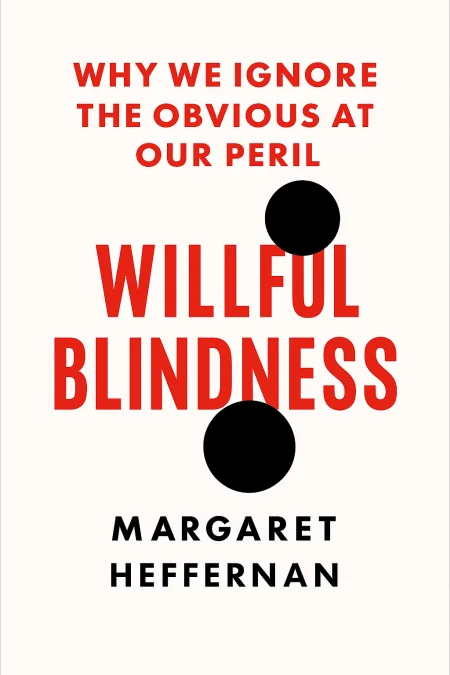
Willful Blindness
Why We Ignore the Obvious at Our Peril
Book Edition Details
Summary
In the dim corners of our consciousness, where comfort meets oblivion, lurks the perilous specter of willful blindness. Margaret Heffernan, an incisive thinker and business maven, peels back the layers of our collective ignorance to reveal why we often choose not to see what's blatantly before us. This isn't about hidden threats but the unsettling truths we shun to dodge discomfort and maintain a fragile peace. Heffernan challenges readers to confront their biases and shatter the cocoon of complacency, weaving through tales of unchecked power and missed opportunities—from boardrooms to battlefields, and beyond. With a deft blend of narrative prowess and sharp analysis, "Willful Blindness" is a clarion call for clarity and courage in facing the truths that shape our lives and societies. This is a must-read for anyone ready to swap ignorance for insight and passive acceptance for active change.
Introduction
Human beings possess an extraordinary capacity to overlook what lies directly before them, particularly when confronting uncomfortable truths threatens their sense of security, identity, or belonging. This phenomenon extends far beyond simple ignorance or lack of information—it represents an active, though often unconscious, choice to remain unseeing. The mechanisms that create this blindness operate through multiple channels: our innate preference for familiar people and ideas, the intoxicating power of love and ideology, the cognitive limitations imposed by fatigue and overload, and the social pressures of obedience and conformity. Understanding these patterns requires examining both the psychological roots of willful blindness and its manifestation in complex social systems. The stakes could not be higher: when individuals, organizations, and entire societies choose blindness over sight, the consequences ripple outward, creating cascading failures that might have been prevented through the simple act of looking. Yet the courage to see clearly, to acknowledge uncomfortable realities, and to act on difficult truths remains one of humanity's most challenging and essential capacities in navigating an increasingly complex world where the costs of collective blindness continue to escalate.
The Psychology of Selective Sight: Love, Ideology and Cognitive Filtering
The foundation of willful blindness lies in fundamental human psychology, beginning with our deep-seated preference for similarity and familiarity. Research demonstrates that people consistently choose partners, friends, and colleagues who mirror their own characteristics—not just in obvious ways like education or background, but in subtle details like height, weight, and even initials. This "positive assortative mating" extends beyond romantic relationships to encompass all forms of social connection, creating echo chambers that reinforce existing beliefs while filtering out challenging perspectives. Love represents perhaps the most powerful form of willful blindness, as the neurochemical processes that bond us to others literally disable critical thinking about our beloved. Brain imaging studies reveal that when people contemplate those they love, the areas responsible for negative emotions and social judgment become inactive. This biological reality explains why parents overlook their children's flaws, why spouses ignore signs of infidelity, and why employees remain loyal to corrupt organizations. Ideology functions similarly, providing organizing principles that give meaning to complex realities while simultaneously blinding adherents to contradictory evidence. When core beliefs are challenged, the brain experiences genuine distress and works actively to eliminate cognitive dissonance. This process explains how intelligent, well-intentioned people can persist in obviously flawed thinking, from medieval physicians clinging to harmful treatments to modern economists defending failed theories. The combination of affinity bias, love blindness, and ideological commitment creates powerful psychological currents that shape what individuals can and cannot see. These aren't character flaws but fundamental features of human cognition, evolved mechanisms that once served survival purposes but now often prevent adaptation to changing circumstances.
Organizational Structures That Systematically Enable Blindness
Within organizational contexts, individual psychological blindness becomes amplified through social dynamics that prioritize harmony over truth-telling. The famous Milgram experiments revealed that ordinary people will inflict apparent harm on others when directed by authority figures, not through malice but through a shift in moral focus. When individuals become part of hierarchical structures, their concern shifts from personal conscience to meeting the expectations of those in power, creating systematic blindness to the human consequences of their actions. Conformity operates through different but equally powerful mechanisms, as demonstrated by experiments where subjects chose obviously wrong answers rather than stand alone against group consensus. Modern neuroscience reveals that conformity actually alters perception—people literally see differently when influenced by group opinion. This perceptual shift reduces cognitive load, making conformity feel effortless and natural, while independence triggers emotional distress in brain regions associated with social pain. Corporate cultures exploit these tendencies by creating environments where belonging depends on adopting shared assumptions and behaviors. The use of specialized jargon, competitive ranking systems, and aggressive social dynamics reinforces group identity while marginalizing dissent. Employees learn to focus intensely on meeting organizational expectations while becoming blind to broader ethical implications of their work. The tragedy of organizational blindness lies in its collective nature—when everyone conforms to the same flawed assumptions, entire institutions can pursue destructive courses of action while each individual participant feels they are simply doing their job well. The division of responsibility across complex hierarchies ensures that no single person feels accountable for outcomes, while the social rewards of belonging make it emotionally costly to break ranks and speak uncomfortable truths.
The Catastrophic Costs of Collective Not-Seeing
Physical and social distance creates perhaps the most insidious form of willful blindness, as decision-makers become literally unable to see the consequences of their choices. Modern organizations span continents and cultures, creating vast gulfs between those who make strategic decisions and those who experience their effects. Technology promises to bridge these gaps but often provides only the illusion of connection while maintaining fundamental separation between different levels of organizational hierarchy. Power itself alters perception, making those who possess it more likely to rely on stereotypes, more optimistic about outcomes, and paradoxically more confident in their judgment even as they become more isolated from ground-level realities. Research shows that powerful individuals process information differently, paying less attention to details that challenge their preconceptions while becoming increasingly abstract in their thinking. The bystander effect demonstrates how social structures can render entire groups blind to emergencies occurring in their midst. When responsibility is diffused across multiple observers, each individual becomes less likely to act, even when witnessing clear harm. This dynamic scales from small groups to entire organizations and societies, creating situations where everyone knows something is wrong but no one feels uniquely responsible for addressing it. Financial crises, environmental disasters, corporate scandals, and institutional abuse all share a common pattern: critical warning signs were visible to many people, but systematic blindness prevented effective action until catastrophe became unavoidable. The complexity of modern systems often serves to obscure rather than illuminate risk, creating opportunities for willful blindness on a massive scale that affects millions of people who had no role in creating the underlying problems.
Breaking Through: Courage, Dissent and Clear Sight
The antidote to willful blindness requires both individual courage and systematic changes to organizational structures that currently reward not-seeing. At the personal level, developing the capacity for clear sight means recognizing and actively countering the psychological forces that promote blindness. This includes seeking out diverse perspectives, questioning comfortable assumptions, and cultivating relationships with people unlike ourselves who can challenge our preconceptions. Effective truth-tellers typically combine several key characteristics: intellectual curiosity that extends beyond their immediate responsibilities, emotional resilience that allows them to tolerate social isolation and professional risk, and moral courage that compels them to act on their observations despite personal costs. They often possess outsider perspectives that free them from the conformity pressures that blind insiders, or they maintain relationships with vulnerable populations that keep them connected to the human costs of institutional failures. Organizations must create genuine incentives for truth-telling while removing the penalties that currently discourage it. This means protecting whistleblowers, rewarding those who raise uncomfortable questions, and designing systems that bring decision-makers into direct contact with the consequences of their choices. Simple changes like rotating assignments, encouraging cross-functional collaboration, and requiring executives to spend time with front-line workers can dramatically improve organizational sight. Perhaps most importantly, societies must cultivate cultural values that prize truth-telling over harmony, courage over compliance, and long-term thinking over short-term comfort. This requires recognizing that some degree of conflict and discomfort is not only inevitable but necessary for healthy functioning. The alternative—the comfortable blindness that seems to make life easier—ultimately leads to far greater suffering when reality finally intrudes on our carefully constructed illusions.
Summary
The human capacity for willful blindness emerges from the intersection of psychological, social, and structural forces that, while serving important functions, can combine to create dangerous patterns of not-seeing. Recognition of these patterns represents the first step toward developing the capacity for clearer sight, but transformation requires both individual courage to confront uncomfortable realities and systematic changes to the institutions that shape our collective vision. The courage to see clearly and the wisdom to design systems that promote rather than discourage truth-telling represent essential capabilities for navigating a world where the consequences of collective blindness increasingly threaten our shared future, making the development of clear sight not merely beneficial but necessary for survival and flourishing.
Related Books
Download PDF & EPUB
To save this Black List summary for later, download the free PDF and EPUB. You can print it out, or read offline at your convenience.
By Margaret Heffernan
