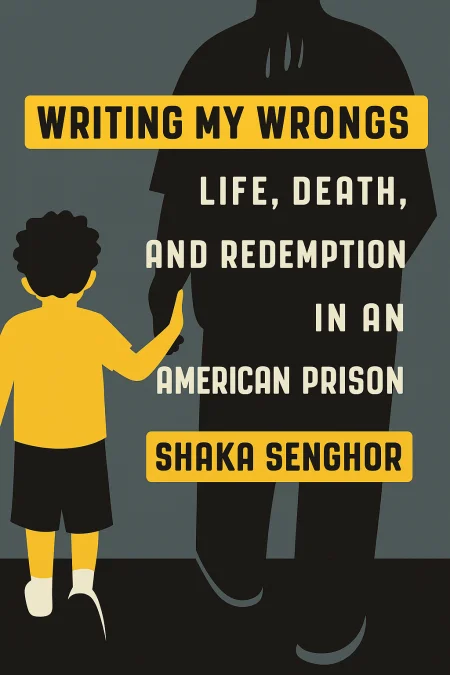
Writing My Wrongs
Life, Death, and Redemption in an American Prison
Book Edition Details
Summary
In the heart of Detroit's turbulent 1980s, Shaka Senghor's life took a harrowing turn from promising student to convicted murderer. "Writing My Wrongs" captures his profound transformation from a young man trapped by circumstance and anger to a beacon of hope and reform. After spending nearly two decades behind bars, seven years of which were in the crushing solitude of confinement, Senghor found salvation in the written word, introspection, and unexpected kindness. This gripping memoir is a testament to the resilience of the human spirit, offering a raw look at the shadows of poverty and violence while challenging the very fabric of our criminal justice system. Senghor's journey of redemption and activism serves as a powerful reminder that our darkest moments don't define us; instead, it's the courage to change that truly matters.
Introduction
In the mirror of a solitary confinement cell, a young man faced the most crucial decision of his life. After years of violence, anger, and desperation, Shaka Senghor stood at the crossroads between destruction and redemption. His story begins in the crack-ravaged streets of 1980s Detroit, where a fourteen-year-old boy abandoned by his family learned to survive through drug dealing and violence. It culminates with a man who transformed nineteen years of imprisonment into a profound journey of self-discovery and healing. Senghor's path was neither straight nor predictable. From a promising child who once dreamed of becoming a doctor, he descended into the darkness of street life, ultimately taking another man's life in a moment of fear and rage. Yet within the concrete walls and steel bars of Michigan's most notorious prisons, something extraordinary happened. Through reading, writing, and painful self-examination, he began to excavate the buried humanity beneath layers of trauma and anger. This transformation story offers profound insights into the nature of redemption, the power of education and self-reflection, and the possibility of change even in the most hopeless circumstances. It reveals how one man's journey from violence to wisdom became a beacon of hope for countless others trapped in cycles of despair and destruction.
The Making of a Street Hustler
Senghor's descent into street life began with a family torn apart by divorce and dysfunction. At eleven, he watched his parents separate, shattering his sense of security and belonging. When his mother later rejected him, telling him to leave if he couldn't follow her rules, fourteen-year-old James White took those words to heart. Cast out into the streets of Detroit, he faced a choice between vulnerability and survival. The transformation was swift and devastating. The boy who once dreamed of becoming a doctor to help heal others became Jay, a drug dealer willing to do whatever it took to survive. He found refuge with Miko, a local dealer who offered him three hundred and fifty dollars a week plus food money to run a crack house twenty-four hours a day. For a homeless teenager, it seemed like salvation. But the streets extracted a terrible price. Young Jay witnessed the devastating effects of crack addiction firsthand, watching adults degrade themselves for small rocks of the drug he sold. He experienced his first taste of violence when two addicts robbed him at gunpoint, leaving him traumatized and angry. The fear and rage from that encounter began to calcify into something harder and more dangerous. By the time he was shot at seventeen, Jay had already lost touch with the gentle child who once wanted to heal people. The bullet wounds in his leg and foot became symbolic of something deeper – the complete death of innocence and the birth of a young man consumed by paranoia, anger, and the desperate need to never again be a victim. The gun he began carrying everywhere would eventually lead him to commit the act that would define the next two decades of his life.
Prison Years and the Path to Violence
The Wayne County Jail introduced Senghor to a world where humanity was stripped away and replaced by the law of the jungle. At nineteen, sentenced to seventeen to forty years for murder, he entered an environment where violence was currency and weakness meant death. The young man who had once been traumatized by street violence quickly adapted to the brutal reality of prison life. In Michigan's notorious prison system, Senghor learned to navigate a complex hierarchy of gangs, racial tensions, and institutional abuse. He joined the Melanic Islamic Palace of the Rising Sun, seeking brotherhood and protection, but also finding himself drawn into the very violence he had hoped to escape. The organization provided him with identity and purpose, yet it also demanded participation in conflicts that kept him trapped in cycles of aggression. As he moved from prison to prison, accumulating thirty-six misconducts over the years, Senghor became exactly what the system expected – a hardened criminal seemingly beyond redemption. He participated in stabbings, assaulted officers, and spent years in solitary confinement. Each act of violence was both a response to immediate threats and a deeper expression of the rage and pain he carried from his childhood trauma. The breaking point came in 1999 at Muskegon Correctional Facility, when a confrontation with an officer over using a bathroom escalated into a brutal assault that left the officer unconscious. As he was dragged away in handcuffs, Senghor saw the contempt in his fellow inmates' eyes and realized he had become the very monster he had once feared. This moment would mark the beginning of his longest journey yet – not through the prison system, but into the deepest recesses of his own soul.
Solitary Confinement and Self-Discovery
Four and a half years in solitary confinement at Oaks Correctional Facility became Senghor's unlikely classroom for transformation. Surrounded by the stench of human despair and the constant chaos of men driven to madness by isolation, he faced a choice: surrender to insanity or fight for his humanity. The cell that was meant to break him ultimately became the crucible where his true self was forged. The turning point came when he stood before a polished steel mirror, tears streaming down his face, and chose forgiveness over rage. He forgave everyone who had hurt him – the childhood bullies, his abusive mother, the man who had shot him, and finally, himself. This moment of radical self-acceptance marked the beginning of an extraordinary journey inward. He began keeping journals, documenting not just the daily horrors around him, but his own thoughts, fears, and gradual awakening. Education became his lifeline. Senghor devoured books on African history, philosophy, spirituality, and psychology, creating curricula for himself and taking self-designed examinations. But it was the letter from his ten-year-old son that completed his transformation. When young Jay wrote, "My mom told me why you're in jail, because of murder! Don't kill dad please that is a sin," the weight of legacy crashed down on Senghor with devastating clarity. In that moment, he realized that his son would grow up seeing him as a murderer unless he fundamentally changed who he was. The shame and responsibility of this recognition broke through the last barriers around his heart. Writing became his tool for excavating decades of buried trauma, helping him understand how childhood abuse and abandonment had created the angry young man capable of taking another's life. Through painful self-examination, he began to separate the hurt child within from the violent man he had become.
Redemption and Return to Community
Senghor's final years in prison were marked by a radical shift from destruction to creation. He began writing novels, mentoring younger inmates, and developing the voice that would eventually reach thousands seeking their own redemption. When he was finally released in 2010 after nineteen years behind bars, he emerged not as the same broken young man who had entered, but as someone fundamentally transformed. The transition to freedom brought its own challenges. The world had changed dramatically during his incarceration – cell phones, the internet, and social media created a landscape he barely recognized. More difficult was learning to navigate adult relationships and responsibilities he had never experienced. His relationship with Ebony, which began while he was still incarcerated, became both an anchor and a testing ground for the man he claimed to have become. His work with at-risk youth revealed the full circle of his journey. Standing before teenagers who reminded him of his former self, Senghor found his true calling. His story of transformation became a powerful tool for reaching young people trapped in the same cycles of violence and despair he had once known. Through speaking engagements, his writing, and mentorship programs, he began to pay forward the grace he had received. The ultimate validation of his transformation came through his partnership with organizations like the MIT Media Lab and #cut50, where his lived experience combined with his hard-won wisdom to address systemic issues of incarceration and violence. The young man who had once terrorized his community became a nationally recognized advocate for criminal justice reform, proving that redemption is not only possible but can become a force for healing entire communities.
Summary
Shaka Senghor's life stands as testament to the profound truth that no human being is beyond redemption, no matter how far they have fallen or how much damage they have caused. His journey from a traumatized child to a violent criminal to a transformative leader illustrates that change is possible when we have the courage to face our deepest wounds and take responsibility for our actions. The most powerful lesson from his story is that the same experiences that break us can, when properly processed and understood, become the foundation for healing not just ourselves but others who walk similar paths. For anyone struggling with their own past mistakes or seeking to understand how cycles of violence and trauma can be broken, Senghor's example offers both hope and a practical roadmap for transformation through education, self-reflection, and service to others.
Related Books
Download PDF & EPUB
To save this Black List summary for later, download the free PDF and EPUB. You can print it out, or read offline at your convenience.
By Shaka Senghor
