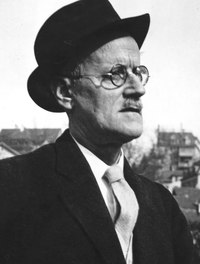
James Joyce
James Augustine Aloysius Joyce, the eminent Irish novelist and a towering figure in the modernist literary movement, left an indelible mark on the landscape of 20th-century fiction. Born into a family that struggled to maintain its middle-class status despite financial hardships, Joyce's early life was steeped in the complexities of Irish identity and Catholicism, elements that would profoundly influence his writing. Educated by Jesuits at Clongowes Wood College and Belvedere College in Dublin, he later attended University College, Dublin, where his literary ambitions began to crystallize. In 1902, he ventured to Paris, immersing himself in the vibrant cultural milieu that would shape his avant-garde narrative style. His return to Dublin in 1904 with Nora Barnacle, who would become his lifelong partner, marked the beginning of a lifelong journey of artistic exploration and expatriation. Joyce's oeuvre is characterized by its innovative narrative techniques and profound exploration of the human psyche. His novel "Ulysses," published in 1922 by Sylvia Beach in Paris due to censorship in Britain and the United States, is heralded as a seminal work of modernist literature. This masterful reimagining of Homer's epic, set against the backdrop of a single day in Dublin, garnered critical acclaim for its stream-of-consciousness technique and richly textured prose. "A Portrait of the Artist as a Young Man," released in 1916, offers a deeply introspective look at the growth of a young artist, echoing Joyce's own quest for identity and self-expression. Meanwhile, his later work, "Finnegans Wake," published in 1939 after years of painstaking labor, pushed the boundaries of linguistic experimentation, though its intricate structure and invented language remain a source of both wonder and bewilderment among readers and critics alike. Joyce's contribution to literature is monumental, marked by his relentless pursuit of narrative innovation and thematic depth. His writing style, characterized by a deft manipulation of language and a fearless embrace of complexity, challenges conventional storytelling norms. Themes of exile, identity, and the labyrinthine nature of consciousness permeate his works, reflecting his acute sensitivity to the human condition. Despite facing personal adversities, including chronic eye problems and the tumult of world wars, Joyce's legacy endures, his works continuing to inspire and provoke scholarly debate. His profound impact on the trajectory of modern fiction cements his status as a pioneering voice whose influence resonates across generations.


by Paul J. Zak
by Rory Vaden
by Robert C. Solomon, Fernando Flores
by Brett Gardner
by Dennis S. Reina
by Julian Baggini
by Larry Downes, Omar Abbosh, Paul Nunes
by Jacqueline Woodson
by Kevin Oakes
by Lindsey Pollak, Kimberly B. Cummings, Kimberly Brown
