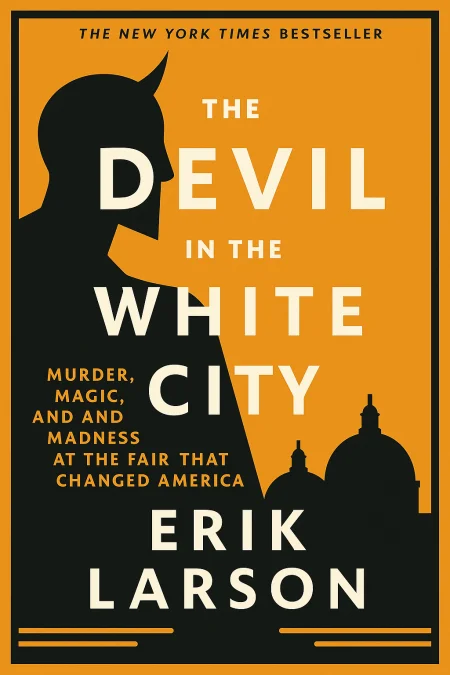
The Devil in the White City
Murder, Magic and Madness at the Fair that Changed America
Book Edition Details
Summary
In the bustling heart of 1893 Chicago, beneath the glimmer of the World's Fair, lurk tales of brilliance and malevolence woven into the city’s very fabric. Erik Larson's 'The Devil in the White City' masterfully chronicles this dichotomy, juxtaposing the monumental achievements of Daniel H. Burnham, the visionary architect of the Fair's majestic "White City," against the chilling exploits of H.H. Holmes, a charismatic doctor concealing a monstrous secret. As Burnham strives against insurmountable odds to bring a dreamscape to life, Holmes crafts a nightmarish hotel designed for murder. Amidst a backdrop of innovation and illusion, Larson's narrative pulsates with the era’s fervor and dread, painting a vivid portrait of a city where dreams and nightmares collide. Through his captivating storytelling, the book unveils an unforgettable tableau of ambition and depravity, ensuring readers are spellbound by both the grandeur and the darkness of a pivotal moment in history.
Introduction
In the final decade of the nineteenth century, America stood at a crossroads between its frontier past and its industrial future, nowhere more dramatically than in the bustling streets of Chicago. Here, two extraordinary men pursued their ambitions with relentless determination, each embodying a different face of the nation's rapid transformation. One sought to create a magnificent testament to human achievement that would announce America's cultural coming of age to the world. The other constructed an elaborate house of horrors, exploiting the very forces of progress and opportunity that drew thousands to the great metropolis. This remarkable convergence reveals three profound questions that defined America's emergence as a modern power. How does unchecked ambition shape both creation and destruction in rapidly growing societies? What happens when technological innovation and urban development outpace the moral and social frameworks needed to protect the vulnerable? And why do periods of greatest human achievement often coincide with the emergence of unprecedented forms of evil? This narrative will captivate readers fascinated by the intersection of true crime and American history, urban development enthusiasts intrigued by the birth of modern cities, and anyone seeking to understand how individual human drama reflects broader social transformation. It offers a unique window into the moment when America stepped onto the world stage, carrying both its most inspiring dreams and its darkest shadows.
Vision and Planning: Building America's Cultural Triumph (1890-1891)
The battle for America's cultural soul began in earnest when Chicago stunned the Eastern establishment by winning the right to host the World's Columbian Exposition in 1890. This victory represented far more than civic pride; it symbolized the democratic West's challenge to established authority and the nation's determination to prove itself worthy of global respect. The young city, still bearing scars from the Great Fire of 1871, faced the seemingly impossible task of creating something magnificent enough to rival the greatest achievements of European civilization in just over two years. Daniel Burnham emerged as the master architect of this audacious dream, a man whose early failures at Harvard and Yale had forged an iron determination to achieve greatness through sheer force of will. Partnering with the brilliant John Root, Burnham assembled an unprecedented collaboration of America's finest architects, including Charles McKim, Richard Morris Hunt, and Louis Sullivan. When Root died suddenly in January 1891, Burnham faced the crushing responsibility of completing their shared vision alone, transforming personal grief into professional resolve that would drive the project forward against all obstacles. The deeper forces at work extended far beyond individual ambition or civic rivalry. America in the 1890s was experiencing the most rapid industrialization and urban growth in human history, creating both magnificent opportunities and profound social tensions. The fair represented the nation's urgent need to demonstrate that democratic ideals could produce beauty and culture equal to any European monarchy. The planners understood they were not merely constructing buildings but crafting a new American identity that would define the nation's place in the modern world. The scale and complexity of the undertaking revealed the emerging power of American engineering and organizational capability. Thousands of workers would labor through brutal Chicago winters, employing revolutionary techniques in steel construction, electrical systems, and landscape architecture that would reshape urban development worldwide. This massive project established the template for modern project management while demonstrating America's growing industrial might, setting the stage for the nation's emergence as the dominant global power of the twentieth century.
Construction and Crime: Dreams and Nightmares Rise Together (1891-1892)
As construction began in earnest at Jackson Park, the fair faced a cascade of seemingly insurmountable obstacles that tested every aspect of Burnham's leadership and vision. Severe weather repeatedly destroyed partially completed structures, labor disputes threatened to halt progress entirely, and financial shortfalls created constant uncertainty about the project's viability. The death of John Root had removed the artistic genius behind many of the fair's most innovative designs, leaving Burnham to shoulder both administrative and creative responsibilities that would have overwhelmed lesser men. Meanwhile, just miles from the fairgrounds, Dr. H.H. Holmes was pursuing his own architectural project with equally methodical precision. His three-story building at 63rd and Wallace Streets appeared to casual observers as a hotel designed to accommodate fair visitors, but Holmes had conceived it as something far more sinister. Working with a rotating crew of contractors whom he systematically cheated and dismissed to prevent anyone from understanding the complete design, Holmes created an elaborate death trap complete with soundproof rooms, gas pipes controlled from his office, secret passages, and a basement equipped with acid vats and cremation facilities. The contrast between these parallel construction projects illuminated the fundamental duality of American ambition during this transformative period. At Jackson Park, thousands of workers labored openly under Burnham's demanding but protective oversight, creating buildings of unprecedented beauty and scale through collaborative effort and shared purpose. Holmes worked in shadows and deception, exploiting the same urban anonymity and rapid social change that made Chicago attractive to ambitious young people, turning the city's promise of opportunity into a predator's hunting ground. Both projects reflected the broader transformation of American society as traditional rural communities gave way to anonymous urban centers. The fair represented humanity's highest aspirations for progress, technology, and cultural achievement, while Holmes's Murder Castle embodied the darker consequences of social fragmentation and the breakdown of traditional protective networks. The same forces that enabled unprecedented human cooperation and creativity also created vulnerabilities that evil could exploit with devastating efficiency.
Glory and Shadow: The Fair Opens Amid Hidden Horrors (1893)
On May 1, 1893, President Grover Cleveland pressed a golden telegraph key to officially open the World's Columbian Exposition, unveiling a spectacle that exceeded even its creators' grandest visions. The White City that emerged from the shores of Lake Michigan presented visitors with a realm of neoclassical palaces, electric lights, and technological marvels that seemed to herald humanity's bright future. The Court of Honor, with its grand basin and towering Statue of the Republic, created what many described as the most beautiful artificial environment ever created by human hands. Yet the fair's triumph unfolded against a backdrop of economic crisis and social tension that revealed the fragile foundations beneath America's gilded prosperity. The Panic of 1893 had plunged the nation into severe depression, making the exposition's admission fees prohibitive for many Americans and threatening its financial viability. Burnham and his team worked frantically to complete unfinished attractions, most notably George Ferris's revolutionary wheel, which opened in June to become the fair's most popular feature and a symbol of American engineering prowess. During these same months, Holmes's hotel operated at peak efficiency, its guest registry filled with young women drawn to Chicago by the fair's promise of employment and adventure. His advertisements promised comfortable accommodations for single women at reasonable rates, while his personal charm convinced many victims they had found not just lodging but protection in the dangerous city. The same transportation networks that brought millions of visitors to the exposition also delivered a steady stream of potential victims to Holmes's carefully constructed trap. The juxtaposition of unprecedented triumph and hidden terror reflected deeper contradictions in American society at the dawn of the modern age. The fair celebrated human achievement and democratic ideals, attracting visitors from around the world who marveled at American innovation and cultural sophistication. Yet Holmes's systematic predation revealed how the same forces that enabled such progress could be perverted to evil purposes, exploiting the mobility, anonymity, and opportunity that defined modern urban life. This duality would define not only the fair's complex legacy but America's ongoing struggle to balance individual freedom with collective security in an increasingly complex and interconnected world.
Reckoning and Revelation: Exposing Evil After Triumph (1894-1896)
The World's Columbian Exposition closed on October 30, 1893, just days after the shocking assassination of Chicago's beloved mayor Carter Harrison, casting a shadow over what should have been a purely triumphant conclusion. The fair had ultimately succeeded beyond all expectations, attracting over 27 million visitors and definitively proving that America could create something genuinely magnificent on the world stage. Yet the economic depression that had threatened the exposition's success deepened into one of the worst financial panics in American history, leaving thousands of former fair workers unemployed and desperate. Holmes, sensing that increased scrutiny from creditors and suspicious relatives of missing persons made Chicago too dangerous, fled to pursue new schemes in Fort Worth and Philadelphia. His downfall began with a relatively simple insurance fraud involving his longtime associate Benjamin Pitezel, whom Holmes murdered and then claimed had died accidentally to collect a substantial policy. The investigation that followed gradually revealed the full scope of Holmes's crimes, leading Philadelphia detective Frank Geyer on a horrific journey across the Midwest, uncovering evidence of murders in Chicago, Indianapolis, Toronto, and other cities. The discovery of Holmes's systematic killing spree shocked a nation that had believed such calculated evil was impossible in civilized society. His trial in Philadelphia became a media sensation, with newspapers struggling to comprehend how one man could have murdered so many people with such methodical precision. Holmes himself seemed almost proud of his notoriety, giving interviews and even writing a memoir in which he attempted to justify his actions while maintaining his innocence of specific charges, revealing the same manipulative charm that had enabled his crimes. The deeper reckoning extended far beyond Holmes's individual evil to fundamental questions about American society and the price of rapid modernization. How had a serial killer operated for years in the nation's second-largest city without detection? What did Holmes's success reveal about the vulnerabilities created by urban anonymity, social mobility, and the breakdown of traditional community oversight? The case forced Americans to confront uncomfortable truths about the dark side of progress and the urgent need for better systems to protect society's most vulnerable members, establishing patterns of concern about urban crime and social fragmentation that would persist throughout the twentieth century.
Summary
The parallel stories of Daniel Burnham and H.H. Holmes reveal the fundamental duality that has characterized American civilization since the Gilded Age: the same forces that enable extraordinary human achievement also create unprecedented opportunities for exploitation and evil. Their intertwined narratives demonstrate how rapid technological and social change can simultaneously elevate the human spirit and provide cover for its darkest impulses, a pattern that continues to define our modern world with striking relevance. The historical lessons from 1893 Chicago offer three crucial insights for navigating contemporary challenges. First, we must recognize that technological innovation and social progress alone cannot guarantee moral advancement, requiring constant vigilance and robust institutional safeguards to prevent the exploitation of vulnerable populations. Second, the importance of maintaining community connection and social oversight becomes paramount in preventing individuals from operating beyond accountability, particularly relevant in our increasingly anonymous digital age. Finally, the story reminds us that our greatest collective achievements typically emerge from collaborative effort guided by shared ethical vision, while our most devastating failures often result from unchecked individual ambition divorced from moral constraint. The legacy of the White City and its shadows teaches us that building a better world requires more than architectural blueprints, technological innovation, or economic growth. It demands a sustained commitment to creating social systems that protect the vulnerable while enabling the ambitious, fostering environments where human creativity and progress can flourish without providing cover for predation and cruelty. In our own era of rapid urbanization, technological disruption, and social transformation, these lessons offer essential guidance for ensuring that our pursuit of progress serves to elevate rather than endanger the human condition.
Related Books
Download PDF & EPUB
To save this Black List summary for later, download the free PDF and EPUB. You can print it out, or read offline at your convenience.
By Erik Larson
