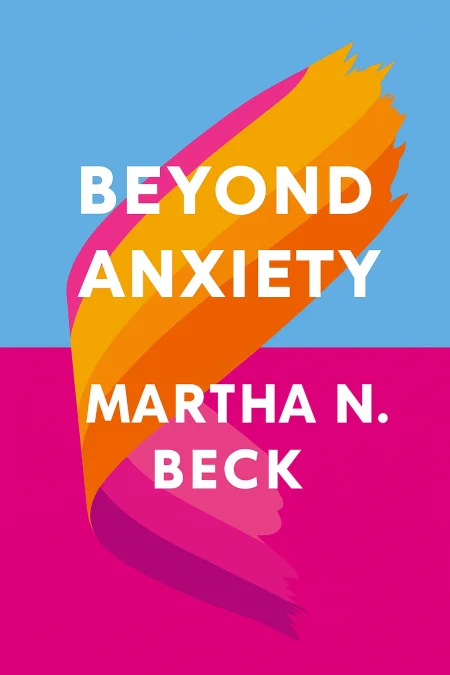
Beyond Anxiety
Curiosity, Creativity, and Finding Your Life's Purpose
Book Edition Details
Summary
Amidst a world gripped by the relentless tide of anxiety, Martha Beck extends a lifeline not in the form of escape, but through a creative renaissance. "Beyond Anxiety" challenges the conventional narrative by suggesting that peace and joy aren't destinations at the end of a mental maze but are born from within when we dare to tap into our innate creativity. Beck's insights, woven from the threads of neuroscience and sociology, unravel the "anxiety spiral" and guide readers towards a transformative "creativity spiral." This journey invites you to rewire your mind, catalyzing innovation and fostering profound connections. Beck reimagines anxiety not as an adversary but as a catalyst for personal revolution, lighting the path to a life where curiosity reigns over fear.
Introduction
Picture Martha, a successful life coach, sitting in her cozy South African cottage as a leopard's guttural call pierces the evening stillness. For a split second, her body floods with adrenaline, every nerve alert to potential danger. But within moments, as she spots the magnificent creature padding past her screen door, something remarkable happens. Instead of spiraling into panic, she feels a surge of champagne-like exhilaration coursing through her veins. This isn't the grinding torture of chronic worry that once plagued her daily existence, but the sharp, clean gift of healthy fear that quickly transforms into wonder. This moment captures the essence of a profound transformation available to each of us. In our hyperconnected, perpetually anxious world, we've forgotten the difference between the life-saving alarm of genuine fear and the soul-crushing weight of persistent anxiety. We've been conditioned to believe that constant worry keeps us safe, that staying terrified motivates peak performance, that anxiety is simply the price of modern success. But what if everything we've been taught about managing our fears is not just wrong, but actively harmful? The journey from anxiety to creativity isn't about eliminating all discomfort from our lives. It's about learning to distinguish between the leopard at the door and the imaginary monsters in our minds. It's about discovering that our most anxious moments often contain the seeds of our greatest creative breakthroughs, and that the same brain that can trap us in spirals of worry possesses an almost magical capacity for innovation, connection, and joy. This transformation doesn't require years of therapy or radical life changes. It begins with understanding how our magnificent minds actually work, and then gently coaxing them toward their natural state of curious, creative engagement with the world.
The Leopard at the Door: Understanding Our Anxious Mind
When Jennifer woke in her South African cottage to find a leopard devouring an impala just feet from her bed, her sleep-addled brain crafted an instant theory and survival strategy. Convinced that her leopard-print pajamas marked her as a territorial rival, she wrapped herself in a beige blanket and spent the night posing as a termite mound. By morning, she was laughing at her own absurd logic, but in that terrifying moment, her response felt completely rational. This story illustrates the fundamental machinery of human anxiety. Unlike other animals that experience fear only in the presence of actual danger, we humans possess the dubious gift of imagination combined with language. When our ancient alarm system detects a threat, our sophisticated brains don't just react, they create elaborate stories to justify our fear and devise complex strategies to regain control. Jennifer's left hemisphere, faced with a leopard, instantly generated both an explanation for why she should be terrified and a plan for staying safe. The problem isn't that we have this alarm system, it's that we can't turn it off. Our storytelling minds feed fearful scenarios back to our emotional centers as if they were actually happening, creating what engineers call an unregulated feedback cycle. Each scary thought generates more fear, which generates scarier thoughts, which generates even more fear. We call this the anxiety spiral, and it's the reason we can lie awake at night, completely safe, becoming more and more terrified of things that exist only in our imagination. Understanding this mechanism is the first step toward freedom. Our anxiety isn't a character flaw or a sign of weakness, it's simply a case of mistaken identity. We've confused the voice of our primitive alarm system with the voice of wisdom, the urgent whisper of our survival instincts with the calm guidance of our deeper knowing. Once we learn to recognize anxiety for what it truly is, a frightened creature doing its best to protect us, we can begin to offer it the gentle care it needs to finally relax.
Griffin's Lesson: When Protection Meets Play and Purpose
Frieda lived in constant terror, her severe allergies making every breath a potential death sentence. Her service dog Griffin, trained to detect dangerous chemicals, kept her alive but couldn't calm her perpetual anxiety. During a workshop, as Frieda trembled with fear despite being completely safe, she mentioned something curious about Griffin's behavior. Sometimes when he chased squirrels, she got the strange feeling he was trying to show her something, as if his playful pursuit was part of his job. When the coaches suggested that maybe Griffin was trying to teach Frieda that even though danger exists everywhere, so do squirrels, joy, play, and silliness, something shifted. For the first time in their conversation, Frieda genuinely laughed. And Griffin, the perfectly disciplined service dog, completely lost his composure. He leaped into everyone's lap, wagging his entire body, covering them with kisses and pure joy, as if shouting "YES! You finally got it!" This moment captures the essence of what happens when we learn to build what we might call a "sanity quilt" of life. Instead of organizing our days around avoiding danger and meeting obligations, we begin to structure our time around the things that make us say "Oh, wow, that's cool!" Like a quilter working with beloved fabric scraps, we start gathering our genuine interests into a "ragbag of curiosities," then gradually stitching them together into a life that actually fits who we are. The process requires us to distinguish between what pushes us and what pulls us, between the activities that drain our energy and those that mysteriously restore it. Society teaches us to build our lives from predetermined patterns, like successful entrepreneur or perfect parent, using materials we don't particularly enjoy. But sanity quilting works differently. We start with whatever genuinely fascinates us, no matter how impractical it seems, and build outward from there. The result may look strange to others, but it keeps us warm in a way that conventional success never could.
Wag Dodge's Fire: Creative Genius Under Pressure
When veteran firefighter Wag Dodge found himself and his crew trapped by a wildfire racing toward them at seven hundred feet per minute, he did something unprecedented. Unable to outrun the flames, Dodge stopped, lit a match, and set fire to the grass around him. As his panicked crew ran past, he threw himself down in the smoldering circle and waited for the inferno to pass over him. Thirteen firefighters died that day. Dodge survived, protected by his instant innovation of creating a firebreak where none had existed before. This moment illustrates the highest expression of human creativity, what we might call freeing the magician within. Dodge's brain, working faster than conscious thought, combined all his years of firefighting experience with the immediate crisis to generate a completely novel solution. This wasn't logical analysis or careful planning, it was the mysterious process by which our right hemisphere takes everything we know and recombines it in ways we never imagined possible. This same capacity for breakthrough insight lives within each of us, waiting to be awakened through sustained engagement with our deepest interests. When we commit ourselves fully to exploring something we love, pushing against the edges of our current abilities, we create the conditions for what psychologists call the Eureka effect. These moments of sudden understanding don't come from trying harder with our analytical minds, they emerge from the patient cultivation of expertise combined with a willingness to let go of control. The path to mastery isn't about perfecting a skill for external rewards, it's about falling so deeply in love with the process of learning that we lose ourselves in it completely. Like the crocheting woman who found the same transcendent insights through her craft that others discover through psychedelics, we can use any genuine passion as a doorway to the magical thinking that solves problems we didn't even know we had. The key is not to force the magic, but to create the conditions where it can naturally emerge.
Beyond Fear: Building Your Authentic Life Ecosystem
During a month-long experiment in right-brain living, Martha discovered something that both thrilled and terrified her. Starting each day with drawing, she found herself disappearing into a wordless world of color and form, losing all sense of time, forgetting to drink her morning coffee. Her logical left hemisphere grew increasingly concerned as Art Toad, as she called this creative part of herself, seized control of her life with the reckless abandon of Mr. Toad's wild ride. "Washerwoman, indeed!" Art Toad seemed to shout. "I am the Toad who always escapes!" This creative takeover revealed a profound truth about human nature. We are not primarily logical beings who occasionally dabble in creativity, we are fundamentally creative beings who have been trained to suppress our natural inventiveness in favor of analytical thinking. The same neural networks that trap us in anxiety spirals can, when properly engaged, launch us into creativity spirals that pull us toward exploration, connection, and joy rather than control, isolation, and fear. The shift from anxiety to creativity begins with curiosity, that magical moment when we encounter something unfamiliar and, instead of immediately categorizing it as dangerous, pause long enough to wonder "What's that?" This simple question opens a doorway between the fearful and inventive sides of our brains. Like the Olympic water polo team that learned to shift out of frustration by simply saying "Hmm," we can train ourselves to meet uncertainty with interest rather than alarm. The creative spiral works as a mirror image of the anxiety spiral. Where anxiety makes us want to control and predict, creativity makes us want to explore and discover. Where anxiety narrows our world until we're afraid of everything, creativity expands our world until we're fascinated by everything. This isn't just about making art or solving puzzles, it's about approaching our entire lives as a creative project, stitching together the things that genuinely captivate us into an existence that feels both meaningful and joyful.
Summary
The journey from anxiety to creativity reveals a fundamental truth about human nature: we are not broken beings who need to be fixed, but magnificent creatures who have temporarily forgotten how to fly. Like Frieda's service dog Griffin, who never lost sight of the squirrels even while vigilantly protecting his human from danger, we can learn to hold both awareness of real threats and appreciation for life's countless delights. The transformation begins with understanding that anxiety and creativity are two sides of the same coin, both powered by our brain's response to the unfamiliar. When we meet uncertainty with fear, we spiral into smaller and smaller worlds of control and prediction. When we meet it with curiosity, we spiral into larger and larger worlds of exploration and connection. The choice, moment by moment, is ours to make. Perhaps most importantly, this isn't about eliminating all discomfort from our lives or pretending that real dangers don't exist. It's about learning to distinguish between the leopard at the door and the monsters in our minds, between the genuine challenges that require our attention and the imaginary threats that steal our joy. When we can make this distinction clearly, we free ourselves to engage with life as the creative adventure it was always meant to be, building our days from the materials that truly nourish our souls rather than the expectations that merely satisfy our fears.
Related Books
Download PDF & EPUB
To save this Black List summary for later, download the free PDF and EPUB. You can print it out, or read offline at your convenience.
By Martha N. Beck
