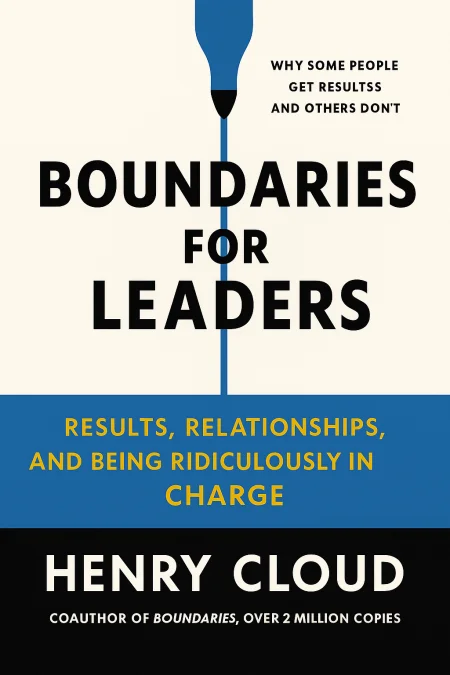
Boundaries for Leaders
Take Charge of Your Business, Your Team, and Your Life
Book Edition Details
Summary
At the crossroads of leadership and neuroscience lies a transformative guide that challenges the status quo of managerial success. Dr. Henry Cloud, celebrated for his insights into human behavior, crafts a blueprint in "Boundaries for Leaders" that redefines how effective leadership is achieved. By harnessing the power of mental frameworks, Cloud illuminates the path to creating environments where the brain's potential is fully realized. Leaders are entrusted with the pivotal task of setting 'boundaries'—not as constraints but as dynamic structures that empower teams and catalyze innovation. Dive into seven pivotal principles that anchor focus, nurture emotional climates, and unleash unprecedented performance. From shaping thought patterns to steering away from negativity, this essential read charges leaders with the exhilarating responsibility of being 'ridiculously in charge.' Through real-world examples, Cloud equips aspiring visionaries to forge cultures of high performance and sustainable success.
Introduction
In the relentless pursuit of business success, leaders often find themselves trapped in a paradox. They possess brilliant strategies, hire talented individuals, and invest heavily in cutting-edge resources, yet their organizations consistently underperform. The missing ingredient isn't more intelligence or better planning—it's the invisible architecture that determines whether human potential flourishes or withers: leadership boundaries. This exploration delves into a revolutionary framework that positions leaders as architects of cognitive environments. By understanding how the human brain functions under different conditions, leaders can create organizational cultures where attention sharpens, creativity soars, and performance transcends ordinary limitations. The theoretical foundation rests on neuroscientific insights about executive functions, emotional regulation, and the psychological conditions that either unleash or constrain human capability. The central questions this framework addresses include: How do leadership behaviors literally change brain chemistry and cognitive performance? What environmental conditions must exist for teams to function as unified, high-performing units? How can leaders harness the power of optimism and control to overcome learned helplessness? What systematic approach transforms individual contributors into cohesive teams that achieve extraordinary results?
Executive Functions: Leading So Brains Can Work
The neuroscientific revolution has revealed that leadership effectiveness hinges on understanding three fundamental executive functions of the human brain: attention, inhibition, and working memory. This theoretical framework positions leaders as cognitive architects who must create conditions for optimal brain performance rather than merely issuing directives and hoping for compliance. Attention represents the brain's capacity to focus on relevant information while filtering out distractions. Leaders who master this function help their teams identify what truly matters, cutting through the noise of competing priorities. Inhibition involves the ability to suppress irrelevant or counterproductive impulses and behaviors. Effective leaders create boundaries that prevent toxic patterns from taking root while encouraging constructive actions. Working memory enables individuals to retain and access relevant information for decision-making and future action, creating continuity and coherence in complex endeavors. The interaction between these three functions creates a multiplier effect. When teams can focus intensely, avoid destructive patterns, and maintain awareness of critical information, they unlock higher-order capabilities: strategic thinking, creative problem-solving, adaptive planning, and sustained execution. Consider the difference between a daily team meeting that merely reports status versus one that systematically addresses what deserves attention, what should be eliminated, and what knowledge must remain active. The latter transforms routine gatherings into cognitive enhancement sessions that literally rewire organizational intelligence. Leaders who understand this framework don't just manage people—they optimize the conditions for human brains to perform at their peak capacity.
Emotional Climate and Connection for Peak Performance
The emotional architecture of organizations operates as a hidden operating system that either amplifies or diminishes cognitive performance. This framework reveals how leaders can engineer emotional climates that unleash human potential rather than trigger defensive responses that shut down higher-order thinking. When individuals perceive threat or experience chronic stress, their brains shift resources away from creative and strategic thinking toward basic survival responses. The amygdala hijacks the prefrontal cortex, creating what neuroscientists call the fight-or-flight response. In organizational contexts, this manifests as defensiveness, risk aversion, decreased collaboration, and diminished innovation. Conversely, when people feel psychologically safe and emotionally supported, their brains can access full cognitive capacity. Connection serves as both a buffer against stress and an amplifier of performance. Research demonstrates that individuals in supportive relationships show dramatically reduced stress hormone levels and enhanced problem-solving capabilities. The framework distinguishes between toxic fear—fear of the leader or relational consequences—and constructive concern about real-world outcomes. Effective leaders eliminate the former while cultivating the latter through reality-based accountability that focuses on results rather than personal judgment. They master the delicate balance of being "hard on issues, soft on people," creating environments where individuals feel secure enough to take risks, share vulnerabilities, and invest their full creative energy. This emotional foundation becomes the bedrock upon which all other organizational capabilities are built.
Control and Optimistic Thinking for Results
The psychological concept of learned helplessness provides crucial insights into why talented teams sometimes perform below their potential and how leaders can reverse these patterns. This framework demonstrates how the perception of control directly impacts brain chemistry, decision-making quality, and sustained performance. Learned helplessness develops when individuals repeatedly encounter situations where their actions seem to have no impact on outcomes. This creates a cognitive shift characterized by three destructive patterns: personalization of failures, pervasive negative interpretations, and permanent pessimistic projections about the future. Once established, these thought patterns become self-fulfilling prophecies that undermine initiative and creative problem-solving even when circumstances change. The antidote involves systematically redirecting attention toward factors within one's sphere of influence. The Control Divide exercise illustrates this principle powerfully. Leaders help their teams create two columns: factors beyond their control and factors within their control that can influence desired outcomes. By limiting worry time for the first column while investing energy exclusively in the second, teams experience what neuroscientists call "optimistic control"—the energizing combination of realistic assessment and focused action. This approach transforms victims into agents, shifting brain chemistry from stress hormones that impair thinking to dopamine that enhances motivation and creativity. Organizations that master this framework don't just survive difficult circumstances—they use challenges as catalysts for innovation and growth, consistently outperforming competitors who remain trapped in helpless thinking patterns.
Building High-Performance Teams Through Trust and Self-Leadership
The transformation from a collection of talented individuals into a genuinely high-performing team requires both structural elements and relational foundation. This framework reveals how trust functions as the catalyst that enables teams to transcend individual capabilities and achieve collective excellence. Trust in organizational contexts comprises five essential elements: connection through mutual understanding, aligned motivation and intent, demonstrated character and credibility, proven capacity and competence, and established track record of performance. These elements interact systemically—weakness in any area undermines the entire foundation. Teams that invest deliberately in building trust across all dimensions create psychological safety that enables radical honesty, creative risk-taking, and genuine collaboration. They develop shared operating values that guide behavior and shared objectives that transcend individual agendas. The process of building high-performance teams mirrors athletic team development. Just as championship sports teams analyze both victories and defeats to identify patterns that lead to success or failure, business teams must examine their collaborative processes with equal rigor. They establish behavioral covenants that define how they will work together, create accountability systems that measure not just outcomes but the behaviors that drive outcomes, and implement observing structures that enable continuous improvement. The most sophisticated teams develop their own language and rituals that reinforce their values and strengthen their bonds. Self-leadership completes this framework by recognizing that leaders must model the behaviors they expect from others, maintaining personal boundaries around thinking patterns, energy management, and continuous learning that prevent them from becoming the limiting factor in their team's development.
Summary
The most profound insight this framework offers is that leadership effectiveness is ultimately determined not by charisma or strategic brilliance, but by the leader's ability to create conditions where human brains can function optimally. Organizations are essentially cognitive ecosystems, and leaders serve as ecosystem designers who determine whether collective intelligence flourishes or withers. This neuroscience-based approach to leadership represents a paradigm shift from command-and-control models toward what might be called "cognitive leadership"—the systematic cultivation of environments that unleash human potential. As our understanding of brain science continues to evolve, leaders who master these principles will possess an increasingly significant competitive advantage, building organizations that not only achieve superior results but also become magnets for top talent who crave the opportunity to perform at their highest level. The implications extend far beyond business success to encompass the fundamental question of how we can create human systems that honor both individual flourishing and collective achievement.
Related Books
Download PDF & EPUB
To save this Black List summary for later, download the free PDF and EPUB. You can print it out, or read offline at your convenience.
By Henry Cloud
