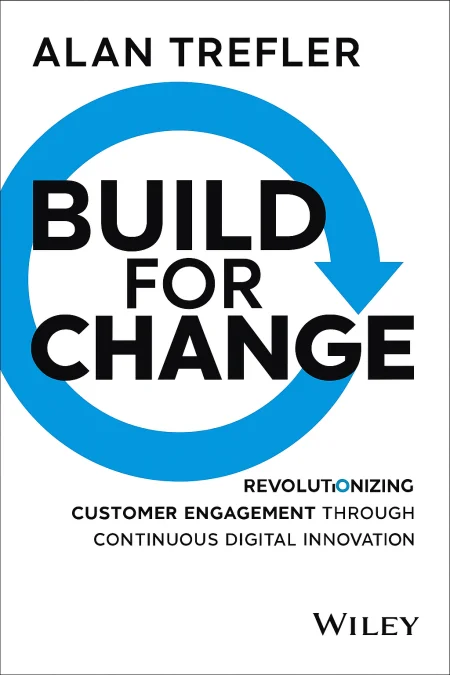
Build For Change
Revolutionizing Customer Engagement through Continuous Digital Innovation
Book Edition Details
Summary
In a business landscape poised on the brink of revolution, "Build For Change" stands as your beacon to a prosperous future. Alan Trefler, the visionary CEO of Pegasystems, unravels the seismic shift driven by a new generation of consumers who are rewriting the rules of engagement. As traditional marketing crumbles, companies face a stark choice: adapt or face obsolescence. Trefler illuminates how embracing innovation and customer-centric strategies can transform impending chaos into unrivaled opportunity. With insightful guidance, he reveals how businesses can navigate the complexities of digital evolution, transforming customer interactions into sustainable success. Are you ready to harness the power of change and thrive in this dynamic era? Your company’s survival might just depend on it.
Introduction
The modern business landscape faces an unprecedented existential crisis, one that threatens to obliterate companies that have dominated markets for decades. The emergence of digitally native consumers represents far more than a simple demographic shift—it constitutes a fundamental rewiring of the customer-business relationship that demands nothing short of revolutionary organizational transformation. Traditional approaches to customer management, built on transactional thinking and inside-out processes, are not merely inadequate; they are actively destructive when deployed against customers who possess unprecedented power, connectivity, and expectations. The challenge extends beyond surface-level adaptations like social media presence or mobile apps. It requires dismantling entrenched organizational structures, abandoning legacy technology approaches, and reconstructing the very foundation of how businesses understand and respond to customer intent. The stakes could not be higher: companies that fail to master this transformation face not gradual decline, but rapid extinction at the hands of customers who have evolved from passive recipients to active judges of corporate worthiness. This analysis traces the anatomy of this customer revolution, dissecting both the forces driving it and the systematic changes required for organizational survival.
The Coming Customerpocalypse: Why Traditional Customer Management is Failing
The fundamental premise driving modern business failure lies in a catastrophic misalignment between organizational assumptions and customer reality. Traditional customer relationship management operates from the flawed belief that businesses can control, predict, and direct customer behavior through systematic data collection and process optimization. This assumption crumbles when confronted with digitally empowered consumers who reject the very notion of being managed or controlled. Generation C, defined by their content creation and connectivity, established the foundation for this power shift. These customers expect seamless experiences across all touchpoints and possess the tools to broadcast their dissatisfaction instantly to vast networks. Their successor, Generation D, represents an even more formidable challenge. The "D" stands for discover, devour, and demonize—behaviors that fundamentally alter the risk-reward equation for business interactions. These customers don't simply switch providers when dissatisfied; they actively work to destroy companies they perceive as inauthentic or manipulative. The magnitude of this threat becomes clear when examining corporate casualties. Circuit City, Nokia, and Borders all possessed extensive customer data and sophisticated management systems, yet failed catastrophically because they misunderstood the nature of evolving customer expectations. These companies focused on optimizing their internal processes rather than delivering experiences that customers actually valued. The lesson is stark: customer data without genuine customer understanding creates a dangerous illusion of control that blinds organizations to their own obsolescence. Success requires abandoning the fantasy of customer management in favor of authentic customer engagement built on mutual value creation.
From Data Overload to Customer Intelligence: Combining Memory, Intent and Process
Data accumulation has become the dominant obsession of modern business, yet this fixation often produces outcomes directly contrary to improved customer relationships. The fundamental flaw lies in treating data as an end rather than a means, leading to the accumulation of vast information repositories that overwhelm decision-makers while providing little actionable insight. This data-centric approach fails because it captures only the past—the memory of previous interactions—while offering no guidance for future behavior or customer desires. True customer intelligence emerges only when memory combines with intent, creating a dynamic understanding that transcends static data analysis. Intent operates bidirectionally, encompassing both customer motivations and business objectives, and transforms reactive data interpretation into proactive engagement strategy. This synthesis enables organizations to move beyond correlation-based observations toward causal understanding of customer behavior patterns. The scientific method provides the critical framework for achieving this transformation. Rather than drowning in endless data collection, organizations must learn to form testable hypotheses about customer behavior and validate these assumptions through controlled experimentation. This approach reveals the difference between correlation and causation, enabling companies like Farmers Insurance to reduce quote turnaround time from two weeks to fifteen minutes by understanding the true drivers of customer satisfaction. The practical manifestation of this intelligence appears in concepts like next-best-action, where systems combine historical data with real-time contextual information to suggest optimal customer interactions. When paired with adaptive learning mechanisms, these systems continuously refine their understanding based on actual outcomes rather than assumptions. The result is a dynamic, evolving intelligence that grows more accurate over time rather than becoming increasingly obsolete like traditional data warehouses.
Technology Transformation: Breaking Down Business-IT Barriers for Customer Centricity
The traditional relationship between business and IT functions represents one of the most destructive forces undermining organizational agility and customer responsiveness. This dysfunction stems from fundamental misalignments in language, objectives, and accountability structures that create artificial barriers between customer needs and technological solutions. The conventional development process—characterized by lengthy requirements gathering, complex technical translations, and rigid deployment schedules—produces systems that are obsolete before they launch. The root cause lies in the persistent use of machine-oriented programming languages and methodologies that require specialized translation between business intent and system implementation. This translation process inevitably introduces errors, delays, and misunderstandings that compound over time. Organizations trapped in this cycle produce zombie systems that resist change, manual workarounds that bypass automation, and rogue implementations that operate outside organizational control. Liberation from this dysfunction requires fundamental shifts in both technology approach and organizational structure. The democratization of technology means empowering business users to directly specify system behavior using business language rather than technical code. Modern computing power makes this possible through systems that can generate executable code from business-friendly specifications, eliminating the need for traditional programming intermediaries. Thinking in layers provides the architectural framework for this transformation. Rather than creating monolithic systems that must be rebuilt for each variation in customer, product, or jurisdiction, layered approaches identify commonalities and differences across multiple dimensions. This enables organizations to build adaptive systems that can accommodate new requirements through configuration rather than reconstruction. When business users can directly modify system behavior to meet changing customer needs, the organization gains the agility necessary to compete in rapidly evolving markets.
Organizational Liberation: Building Agile Systems for Generation D and Beyond
Organizational transformation extends far beyond technology changes to encompass fundamental shifts in structure, culture, and leadership philosophy. Traditional hierarchical arrangements that separate business functions from technical implementation create insurmountable barriers to customer-centric operations. Breaking down these silos requires more than reorganization—it demands the creation of hybrid vigor through cross-pollination of skills and perspectives. The emergence of new executive roles reflects this transformation imperative. Chief Process Officers focus on horizontal integration across organizational silos, ensuring that customer experiences remain consistent regardless of internal departmental boundaries. Chief Customer Officers provide dedicated advocacy for customer perspectives in strategic decisions, while transformed CFO functions embrace iterative investment approaches rather than traditional waterfall capital allocation. The redefinition of customer service represents perhaps the most critical organizational shift. Traditional service models operate from transactional assumptions, activating only when customers initiate contact for specific problems. Customer-centric organizations replace this reactive approach with engagement strategies that build ongoing relationships based on continuous value creation. This requires different hiring criteria, training programs, and performance metrics that reward relationship building over transaction processing. The ultimate organizational liberation occurs when companies recognize that they must become software companies to survive. In an increasingly digital world, customer interactions are mediated primarily through software systems that embody organizational values, processes, and capabilities. Companies that delegate this critical function to external providers or treat it as a commodity inevitably lose the ability to differentiate their customer experiences. Success requires taking direct control of the software layer that defines customer relationships, ensuring that it reflects authentic organizational DNA rather than generic industry templates.
Summary
The customer revolution represents an existential inflection point that separates surviving organizations from those destined for obsolescence. The solution lies not in incremental improvements to existing approaches, but in fundamental transformation of how organizations understand, engage with, and deliver value to increasingly empowered customers. Companies must abandon the illusion of customer control in favor of authentic relationship building based on mutual value creation, supported by technology systems that adapt dynamically to changing customer needs and organizational capabilities.
Related Books
Download PDF & EPUB
To save this Black List summary for later, download the free PDF and EPUB. You can print it out, or read offline at your convenience.
By Alan Trefler
