
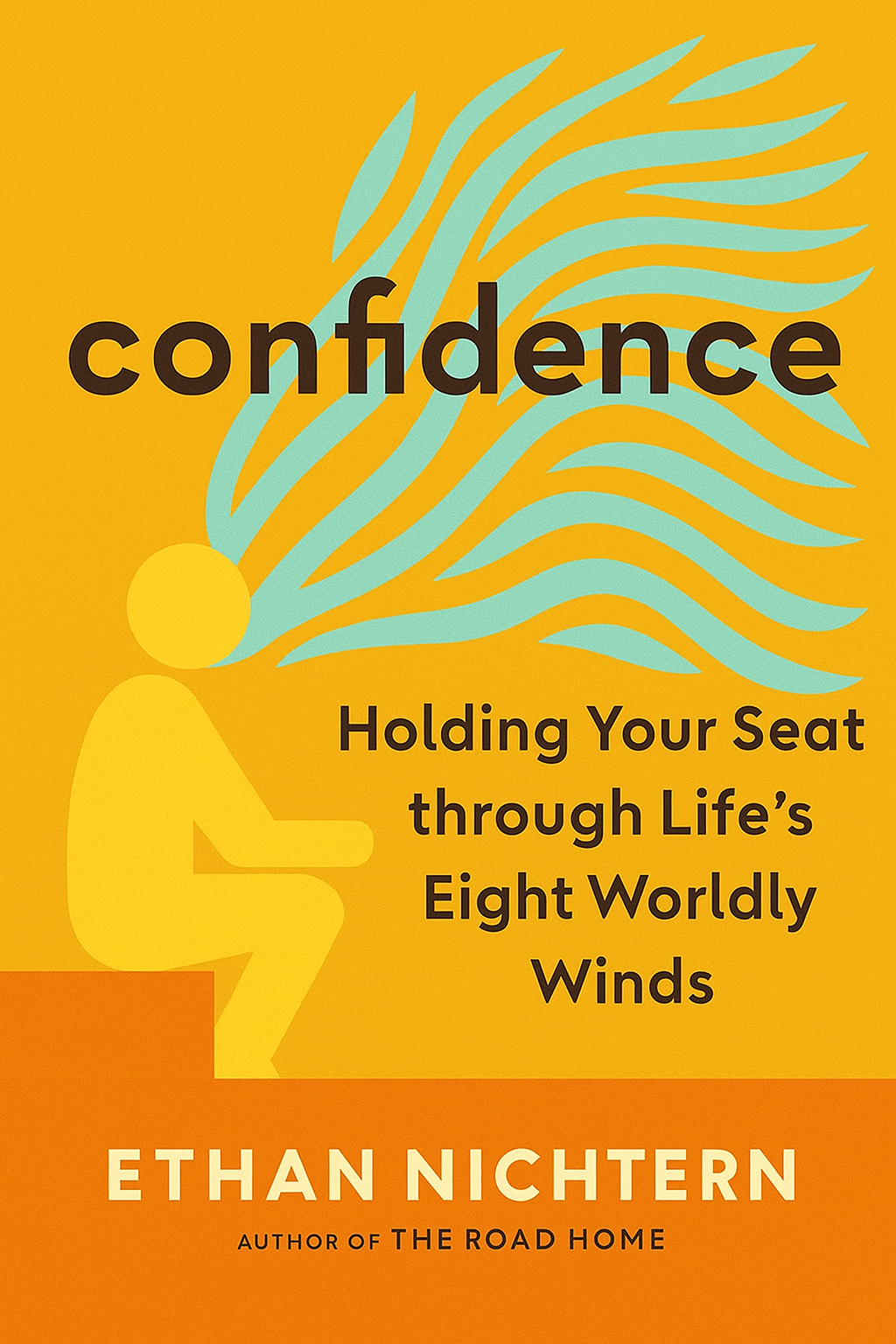
Confidence
Holding Your Seat through Life's Eight Worldly Winds
Book Edition Details
Summary
Amid the cacophony of modern life, where change is the only constant and division seems to deepen by the day, Ethan Nichtern offers a beacon of insight with "Confidence." This transformative guide is not just about surviving the tumult; it's about thriving through it by harnessing the timeless wisdom of Buddhist philosophy. Nichtern masterfully unpacks the Eight Worldly Winds—those fickle forces of praise, blame, pleasure, pain, fame, insignificance, success, and failure—to reveal their profound impact on our inner landscape and relationships. Through this lens, readers are invited to explore the delicate dance of identity, power, and ethics. Accompanied by practical meditation exercises, "Confidence" empowers you to tap into your inherent wisdom, fostering a deep-seated assurance amidst the chaos. This isn't merely a book; it's a path to discovering the steadfast core within you, unshaken by the storm.
Introduction
Picture yourself sitting in meditation, feeling centered and grounded, when suddenly your phone buzzes with news that threatens to knock you completely off balance. Maybe it's praise that makes you uncomfortable, criticism that stings, or news of someone else's success that triggers unexpected envy. In that moment, you face a choice: let these "worldly winds" blow you around like a leaf in a storm, or learn to hold your seat with dignity and grace. This ancient wisdom about the eight worldly winds—four pairs of experiences that can either inflate or deflate our sense of self—remains startlingly relevant in our hyperconnected age. We live in a time when a single social media notification can send us spiraling into anxiety, when comparison has become a constant companion, and when our sense of worth seems to fluctuate with every external validation or rejection. Through the lens of Buddhist psychology combined with modern insights about vulnerability and resilience, we discover that true confidence isn't about becoming immune to these winds, but about learning to dance with them. This journey reveals how mindfulness, compassion, and authentic self-awareness can transform our relationship with success and failure, praise and blame, pleasure and pain. Rather than seeking to transcend our humanity, we learn to embrace it fully, finding strength in vulnerability and wisdom in our shared struggles.
Running the Gauntlet of Hope and Fear
On election night 2008, crowds danced in the streets as Barack Obama became president, embodying a nation's hope for change. The iconic poster with its bold declaration of "HOPE" had become a rallying cry for millions. Yet by the 2010 midterm elections, many of those same hopeful volunteers had disappeared, disillusioned that the complex work of democracy required sustained engagement rather than a single moment of triumph. When hope crashed into the reality of incremental change, the deflation was palpable. This cycle reveals something profound about human nature: we constantly swing between the extremes of hope and fear, attachment and aversion, reaching toward what we want and pushing away what we don't. The Buddha identified these as the fundamental forces that knock us off balance—not just major life events, but the countless daily moments when we grasp for pleasure and recoil from discomfort. Hope without awareness becomes a mirage, promising that this next achievement or experience will finally provide lasting security. Fear without mindfulness becomes a prison, causing us to defend against experiences that might actually hold valuable lessons. But when we learn to recognize these forces with clear awareness, something remarkable happens: we can hold our seat in the midst of uncertainty, neither chasing the next high nor running from the inevitable lows. The path forward isn't about eliminating hope and fear—that would be inhuman. Instead, it's about developing the capacity to remain present and responsive rather than reactive when these powerful energies move through us, transforming the very winds that once knocked us down into sources of wisdom and strength.
The Power of Compassion and Interdependence
When Kevin Durant won the NBA's Most Valuable Player award, he delivered a twenty-six-minute acceptance speech that initially seemed tedious in its thoroughness. He meticulously thanked every teammate, every staff member, every person who had contributed to his success. But then he turned to his mother, Wanda, who had single-parented four children through poverty, and through tears declared, "You're the real MVP." In that moment, individual achievement transformed into a recognition of interdependence. This shift from "I did this" to "we made this possible" represents a fundamental reorientation that lies at the heart of genuine confidence. The mythology of the self-made individual—the idea that success is purely personal achievement—creates a brittle kind of confidence that requires constant defense. When we believe we accomplished everything alone, we also bear the full weight of every failure, creating a fragile sense of self that swings wildly between grandiosity and inadequacy. Compassion practice begins with extending the same understanding to ourselves that we might offer a good friend, recognizing our struggles without harsh judgment. This self-compassion then naturally expands to include others, as we begin to see how our wellbeing is intimately connected to the wellbeing of those around us. Rather than viewing compassion as weakness or self-sacrifice, we discover it as a source of power—the power that comes from accurate perception of how things actually work. The three components of compassion—empathy, care, and agency—work together to create what might be called "interdependent confidence." When we truly understand that our success depends on others and contributes to others, our sense of self becomes both more humble and more empowered. We're not carrying the impossible burden of complete self-reliance, nor are we helplessly dependent on external validation.
Awareness as the Space That Holds Everything
After experiencing several grand mal seizures, the author found himself in an ambulance, slowly returning to consciousness with no memory of what his body had done during the postictal state. Despite decades of meditation practice, his brain's electrical storm had reduced him to pure instinct—biting an EMT, hiding under bedcovers, failing to recognize his own daughter. This humbling experience revealed both the limits and the power of awareness in ways that no peaceful meditation session ever could. The shame of awakening—that moment when we realize we've been unconscious or reactive—is something every meditator knows intimately. We return from distraction during meditation and feel embarrassed about how far we've wandered. We recognize a pattern of behavior and cringe at how long it took us to see it. Yet these moments of recognition, however uncomfortable, represent the dawn of genuine awareness rather than spiritual failure. Awareness itself can't be found or grasped because it's not a thing—it's the space in which all our experiences arise and dissolve. Like trying to see your own eyeball, the mind can't observe awareness directly, but it can learn to recognize and rest in this knowing quality of consciousness. This recognition brings profound relief: awareness is larger than any emotion, more stable than any circumstance, more patient than any distraction. The practice of "leaning back" into awareness rather than leaning forward to chase experiences creates a different relationship with whatever arises in consciousness. Instead of being caught up in the content of our thoughts and emotions, we learn to rest in the context—the spacious, luminous quality of mind itself that can accommodate any visitor with curiosity and warmth.
Windhorse: Harnessing Life's Energy with Vulnerable Courage
The ancient concept of windhorse offers a radically different approach to the forces that usually knock us off balance. Instead of defending against the eight worldly winds or trying to transcend them, we learn to harness their energy like a skilled rider working with a powerful horse. The wind represents all the energetic forces of life—fear, excitement, disappointment, joy—while the horse represents our capacity to use these energies skillfully rather than being overwhelmed by them. This practice involves joining what the tradition calls heaven and earth: the visionary, creative aspect of our nature with the practical, grounded reality of daily life. Heaven without earth becomes grandiose escapism—all vision with no follow-through. Earth without heaven becomes grinding drudgery—all work with no inspiration. But when we learn to unite these qualities, something magical happens: the most mundane tasks become sacred, and our highest aspirations become grounded in reality. The meditation practice of rousing windhorse takes only a few minutes but creates a profound shift in how we meet whatever comes next. By consciously taking our seat, connecting with both earth and sky, and awakening the heart center, we remember that we have everything we need to show up with both tenderness and strength. This isn't about feeling invincible or perfected, but about trusting our basic capacity to work with whatever life presents. Perhaps most importantly, windhorse reveals that confidence isn't about having eliminated vulnerability or uncertainty—it's about being willing to remain open-hearted in their presence. The warrior's path isn't about building armor but about developing the courage to stay soft and responsive even in difficult circumstances, using every experience as fuel for greater wisdom and compassion.
Summary
True confidence emerges not from conquering the forces that challenge us, but from learning to dance with them skillfully. The eight worldly winds—pleasure and pain, praise and blame, success and failure, recognition and obscurity—will never stop blowing through our lives, but they need not knock us off our seats. Through mindfulness, we can recognize these forces with clarity rather than reactivity. Through compassion, we can see our struggles as part of the universal human experience rather than personal failures. Through connection with lineage, we remember that we're part of something larger than our individual concerns. And through the cultivation of awareness, we discover a space within ourselves that's vast enough to hold any experience with grace. This approach to confidence doesn't promise a life free from difficulty or uncertainty, but rather the development of an unshakeable trust in our ability to work with whatever arises. It's confidence rooted not in perfection but in resilience, not in invulnerability but in the courage to remain open. When we learn to hold our seat with both strength and tenderness, we discover that the very experiences we once feared become sources of wisdom, and the winds that once knocked us down become the energy that carries us forward on the path of awakening.
Related Books
Download PDF & EPUB
To save this Black List summary for later, download the free PDF and EPUB. You can print it out, or read offline at your convenience.
By Ethan Nichtern
