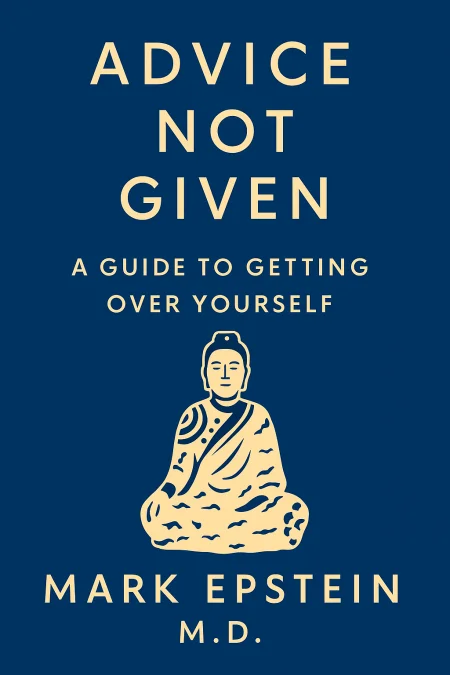
Advice Not Given
A Guide to Getting Over Yourself
Book Edition Details
Summary
A masterful interplay of Eastern wisdom and Western psychology, "Advice Not Given" by Dr. Mark Epstein offers a profound exploration of the ego's complex role in our lives. Imagine a world where the relentless chase for self-improvement is not only questioned but transformed into a journey of self-awareness and liberation. Epstein, both a seasoned psychiatrist and a devoted Buddhist, dismantles the ego's deceptive grip on our well-being with insight and empathy. He illuminates the Eightfold Path—not as a mystical relic, but as a practical guide for navigating modern life’s psychological labyrinths. Blending personal anecdotes with therapeutic insights, Epstein crafts a tapestry where mindfulness becomes a tool of gentle rebellion against ego-driven suffering. For those seeking genuine growth, this book is not just advice—it’s a call to a deeper understanding of the self, inviting readers to reshape their lives with compassion and clarity.
Introduction
Modern therapeutic practice stands at a fascinating intersection where ancient Buddhist psychology meets contemporary Western psychoanalysis. This convergence emerges from a shared recognition that human suffering often stems from our relationship with our own ego—that persistent inner voice demanding attention, validation, and control over circumstances beyond our grasp. While Western therapy has traditionally focused on strengthening the ego to navigate life's challenges, Buddhist wisdom offers a complementary approach: learning to observe and gradually release the ego's grip on our experience. The therapeutic potential of this integration becomes evident when we consider how both traditions address the fundamental human predicament of self-imposed limitation. Buddhist mindfulness practices reveal the impermanent nature of thoughts and emotions, while psychodynamic therapy uncovers the unconscious patterns that keep us trapped in repetitive cycles of suffering. Together, they offer a more complete framework for psychological healing—one that neither strengthens nor eliminates the ego, but rather transforms our relationship to it through conscious awareness and skillful intervention. This synthesis challenges conventional assumptions about what constitutes effective mental health treatment. Rather than choosing between Eastern meditation or Western analysis, we discover how the Buddha's Eightfold Path can serve as a sophisticated psychological framework, offering practical tools for therapists and patients alike to navigate the complex terrain of human consciousness with greater wisdom and compassion.
The Integration Framework: Buddhism and Psychotherapy as Complementary Approaches
The integration of Buddhist psychology with Western psychotherapy represents more than mere theoretical synthesis—it emerges from practical necessity. Each tradition addresses different aspects of psychological suffering with distinct methodologies that prove remarkably complementary. Western therapy excels at uncovering the historical roots of emotional patterns, helping individuals understand how childhood experiences shape adult relationships and self-perception. Buddhist meditation, conversely, teaches direct observation of mental processes as they arise in present-moment awareness, revealing how thoughts and emotions function independent of their content or origins. This complementary relationship becomes evident in clinical practice when patients discover that insight alone rarely produces lasting change. Understanding why we behave in certain ways provides crucial context, but transformation requires the capacity to observe these patterns as they unfold in real-time. Buddhist mindfulness training develops this observational muscle, creating space between stimulus and response that allows for conscious choice rather than automatic reaction. The integration also addresses a fundamental limitation in each approach when practiced in isolation. Meditation without psychological understanding can become spiritual bypassing—using peaceful states to avoid confronting difficult emotions rather than processing them. Therapy without contemplative awareness often remains trapped in analytical loops, endlessly discussing problems without developing the capacity to witness them with equanimity. Most significantly, both traditions recognize that the observing awareness itself—what Buddhism calls "witness consciousness" and therapy terms "the observing ego"—remains unchanged by the psychological content it observes. This stable center of awareness becomes the foundation for healing, providing refuge from the storm of thoughts and emotions while maintaining compassionate engagement with human experience.
Core Arguments: The Eightfold Path as Therapeutic Tool for Ego Transformation
The Buddha's Eightfold Path functions as a comprehensive psychological intervention system designed to transform humanity's fundamental relationship with selfhood. Rather than viewing the ego as either enemy or ally, this ancient framework treats it as a natural mental function that requires conscious refinement rather than elimination or reinforcement. Each aspect of the path addresses specific ways that unconscious ego-driven behavior creates unnecessary suffering while providing practical alternatives. The therapeutic genius of this system lies in its recognition that ego-transformation cannot be achieved through direct assault or naive acceptance. Instead, it employs what might be called "strategic indirection"—approaching ego-patterns obliquely through ethical behavior, mental training, and wisdom cultivation. Right Speech, for instance, includes not only external communication but the internal dialogue that shapes self-concept. Right Action extends beyond moral behavior to encompass the quality of presence we bring to daily activities. This systematic approach proves particularly valuable for addressing what Western psychology terms "characterological issues"—deeply embedded personality patterns that resist conventional therapeutic intervention. Where traditional therapy might spend years uncovering the childhood origins of defensive behaviors, the Eightfold Path provides immediate tools for recognizing these patterns as they manifest and gradually weakening their compulsive quality through mindful observation and ethical restraint. The path's effectiveness stems from its understanding that ego-transformation occurs not through peak experiences or dramatic insights, but through consistent practice in ordinary circumstances. Each moment of choosing awareness over reactivity, compassion over self-protection, or presence over mental elaboration gradually shifts the balance of power from unconscious conditioning toward conscious responsiveness. This process honors both the ego's protective function and the human capacity for growth beyond narrow self-interest.
Clinical Applications: Right View, Speech, and Action in Therapeutic Practice
The initial components of the Eightfold Path translate directly into therapeutic interventions that address fundamental aspects of psychological suffering. Right View establishes the foundational understanding that emotional pain often stems not from external circumstances but from our relationship to impermanence and uncertainty. This perspective shift proves particularly valuable for clients struggling with anxiety, depression, or grief, as it normalizes difficult experiences while reducing the additional suffering created by resistance to natural human responses. Right Speech extends beyond communication skills to encompass the internal narrative that shapes self-experience. Many clients discover that changing their relationship to the inner critic produces more rapid improvement than attempting to eliminate negative self-talk entirely. This approach acknowledges that self-critical thoughts may continue arising while developing the capacity to recognize them as mental events rather than objective truths. The therapeutic focus shifts from content modification to relationship transformation. Right Action in clinical contexts emphasizes the quality of presence brought to daily activities rather than mere behavioral compliance. Clients learn to distinguish between actions arising from conscious choice versus unconscious compulsion, developing sensitivity to the internal states that precede destructive behaviors. This awareness creates natural pause points where alternative responses become possible without forcing artificial changes. The integration of these principles requires sophisticated clinical judgment about when to apply Buddhist concepts versus traditional therapeutic interventions. Some clients benefit from direct mindfulness instruction, while others need extensive psychological excavation before contemplative approaches become accessible. The art lies in recognizing which aspects of the path address each individual's particular form of suffering while maintaining therapeutic alliance and avoiding spiritual bypassing of necessary emotional processing.
Advanced Practice: Right Effort, Mindfulness, and Concentration in Mental Health
The latter components of the Eightfold Path address the refined mental training necessary for sustainable psychological transformation. Right Effort reveals the crucial distinction between striving and sustainable practice, teaching clients how to work with psychological patterns without creating additional tension through excessive trying. This principle proves essential for individuals whose perfectionism or achievement-orientation actually reinforces the ego-patterns they seek to transcend. Right Mindfulness in therapeutic contexts goes beyond stress-reduction techniques to cultivate investigative awareness that can examine mental processes without being overwhelmed by them. This capacity proves invaluable for clients with trauma histories, anxiety disorders, or emotional dysregulation, as it provides a stable platform from which to explore difficult internal territory safely. The key insight involves recognizing awareness itself as inherently peaceful, regardless of the content being observed. Right Concentration develops the mental stability necessary for sustained self-observation and emotional regulation. Unlike the popular conception of meditation as mental blankness, therapeutic concentration involves collecting scattered attention to examine psychological patterns with greater clarity and persistence. This focused awareness reveals subtle aspects of ego-functioning that remain invisible during ordinary consciousness, such as the mechanisms by which thoughts generate emotional states or how attention itself can be directed consciously. The clinical application of these advanced practices requires careful titration based on individual capacity and psychological stability. Some clients develop concentration naturally through therapy's sustained attention to inner experience, while others benefit from formal meditation instruction. The therapeutic relationship itself becomes a laboratory for practicing mindful awareness, as clients learn to observe their reactions to the therapist while maintaining connection and authentic communication. This integration of contemplative awareness with interpersonal engagement represents the fullest expression of the path's psychological potential.
Summary
The synthesis of Buddhist wisdom and Western therapeutic practice offers a sophisticated framework for addressing the fundamental human predicament of ego-driven suffering through conscious awareness and skillful intervention. This integration transcends the limitations of either approach practiced in isolation, providing both the psychological understanding necessary to contextualize emotional patterns and the contemplative tools required to transform our relationship to these patterns as they arise in present-moment awareness. The resulting therapeutic methodology honors the protective function of ego-structures while developing the capacity for conscious choice that allows genuine psychological freedom to emerge naturally through sustained practice and skillful guidance.
Related Books
Download PDF & EPUB
To save this Black List summary for later, download the free PDF and EPUB. You can print it out, or read offline at your convenience.
By Mark Epstein
