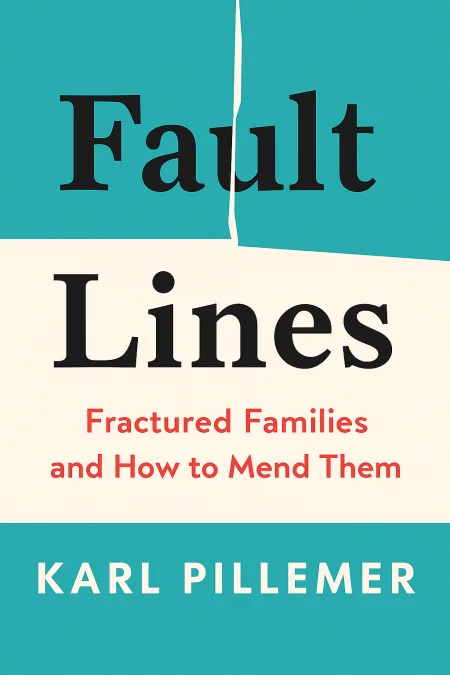
Fault Lines
Fractured Families and How to Mend Them
Book Edition Details
Summary
In a world where family ties often unravel in silence, "Fault Lines" emerges as a beacon of hope and understanding. With empathy and insight, Karl Pillemer delves into the quiet epidemic of family estrangement, a poignant reality for over 65 million Americans. This groundbreaking work draws from the rich tapestry of the Cornell Reconciliation Project, blending firsthand stories of reconciliation with cutting-edge social science research. Pillemer paints a vivid portrait of fractured relationships and the paths to healing, answering profound questions about the nature of familial rifts and the steps to bridge them. By weaving together dramatic narratives and practical advice, this book offers a lifeline to those seeking to mend their broken bonds, making it an essential guide for anyone touched by the pain of separation and yearning for renewal.
Introduction
The silence had stretched for three years when Maria finally picked up the phone to call her daughter. Her finger trembled over the contact name she had stared at countless times before, always pulling back at the last moment. The argument that had torn them apart seemed so small now, yet the chasm it created felt impossibly wide. What she didn't know was that across the country, millions of other parents, children, and siblings were living with similar wounds, carrying the weight of broken family bonds in quiet desperation. Family estrangement has become one of our most hidden epidemics, affecting over 67 million Americans who navigate daily life with the ache of severed family connections. These fractures don't discriminate by wealth, education, or background—they cut across all demographics, leaving behind a trail of confusion, guilt, and profound loss. Unlike other forms of grief, estrangement offers no closure, no community support, no clear path forward. It exists in a gray zone where hope and despair dance together, where the person you've lost is still alive but unreachable. Yet within this landscape of broken relationships lies extraordinary hope. Through extensive research and hundreds of intimate interviews, we discover that even the deepest family rifts can heal. The families who find their way back to each other share common wisdom about forgiveness, boundaries, and the courage to see beyond past hurts. Their stories reveal that reconciliation isn't about returning to what was, but about creating something entirely new—relationships built on understanding rather than obligation, respect rather than control, and love that allows space for growth and change.
The Hidden Epidemic: Understanding Family Estrangement
When David's son stopped returning his calls, David assumed it was temporary. Young adults get busy, he reasoned. They need space to establish their independence. But weeks turned into months, and months into years, until David realized he was living with a reality he had never imagined possible: his own child had deliberately chosen to remove him from his life. The silence wasn't accidental or temporary—it was intentional and seemingly permanent. David's experience reflects a startling truth that researchers have only recently begun to quantify. National surveys reveal that over one-quarter of American adults are currently estranged from a family member, making family cutoffs far more common than divorce, unemployment, or most major life crises we openly discuss. These numbers shatter the myth that estrangement only happens in obviously dysfunctional families or represents some kind of personal failure. The demographics of estrangement tell a surprising story. It affects families across all racial, economic, and educational lines with remarkable consistency. Whether you live in a mansion or a mobile home, whether you have advanced degrees or never finished high school, the risk remains essentially the same. The universality of this experience suggests that estrangement isn't about individual pathology but about fundamental challenges in how families navigate change, difference, and the complex dynamics of love and control. What makes estrangement particularly devastating is the shame and secrecy that surround it. People who would openly discuss their divorce, job loss, or health problems will go to extraordinary lengths to hide their family rifts. This silence creates a vicious cycle where the isolated feel uniquely damaged, convinced that their situation represents some special kind of failure. The hidden nature of the epidemic means that millions of people are suffering alone with a problem that is actually remarkably common, carrying shame for an experience that touches families everywhere.
Volcanic Events and Their Lasting Impact
The argument started over something so trivial that Jennifer can barely remember the specific trigger. She and her mother were discussing holiday plans when suddenly voices were raised, old grievances surfaced, and before either woman fully understood what was happening, her mother had screamed, "If that's how you feel, then don't bother coming home at all!" The words hung in the air like smoke after an explosion, and in that moment, both women knew that something fundamental had shifted between them forever. This is what researchers call a "volcanic event"—a single incident that appears to cause an estrangement but actually represents the eruption of long-simmering tensions beneath the surface. Like geological volcanoes, these relationship explosions don't happen without warning. The pressure has been building through years of small conflicts, unaddressed resentments, and incompatible expectations about how the relationship should work. The holiday argument wasn't really about logistics; it was about control, respect, and two women's different visions of their connection. Jennifer had been feeling suffocated by her mother's constant involvement in her decisions, while her mother experienced Jennifer's independence as rejection and ingratitude. Neither woman understood the other's perspective, and their inability to communicate these deeper needs meant that every conversation became a potential minefield. The volcanic event provided a clear before-and-after moment, a specific point in time when everything changed, making it easier to remember and harder to forgive than the gradual erosion that preceded it. Understanding volcanic events is crucial because they often become the focal point that keeps families stuck in estrangement. Both parties replay the incident endlessly, each convinced that the other person's behavior was unforgivable, neither able to see past the explosion to address the underlying instability that made it inevitable. The power of these moments lies not in their objective severity but in their symbolic weight, crystallizing everything that has been wrong in the relationship into one unforgettable scene of pain and betrayal.
The Road to Reconciliation: Practical Wisdom
After twelve years of silence, Robert found himself writing a letter to his estranged brother. The catalyst wasn't forgiveness or sudden compassion, but his teenage daughter's simple question: "Why don't I have any cousins?" The question forced Robert to confront the cost of carrying old wounds, not just for himself but for the next generation who were inheriting a fractured family legacy they had no part in creating. The letter was brief and carefully worded. Robert didn't apologize for the past or demand explanations for old hurts. Instead, he focused on the present: his desire to try again, his willingness to start fresh, and his hope that they could build something different than what they'd had before. His brother's response came three weeks later, equally cautious but open to the possibility of reconnection. Their first phone call was awkward and tentative, but it was a beginning. The reconciliation process unfolded slowly over many months. They established ground rules about topics to avoid, agreed on the frequency and nature of their contact, and most importantly, they both accepted that their relationship would never be what it had been before. This wasn't a failure; it was an evolution. They were creating something that honored both their need for connection and their individual growth, something that acknowledged the hurt while refusing to be defined by it. Robert's story illustrates the most important principle of successful reconciliation: it must be undertaken for your own well-being, not out of obligation or guilt. The families who successfully bridge long-term estrangements share common strategies that can guide others on similar journeys. They learn to let go of the need to be right about the past, focusing instead on building a different future together. They set clear boundaries about acceptable behavior while remaining flexible about what their renewed relationship might look like. Most importantly, they approach reconciliation as a process rather than an event, understanding that rebuilding trust and connection takes time, patience, and consistent effort from both parties.
Summary
The landscape of family estrangement reveals both our deepest vulnerabilities and our greatest capacity for healing. Through countless stories of separation and reunion, we discover that the fractures in our families are rarely about the dramatic moments that seem to break us apart, but about the accumulated weight of unspoken expectations, unhealed wounds, and the fundamental challenge of loving imperfect people imperfectly. The shame and isolation that typically accompany family rifts only deepen the wound, creating barriers to healing that can persist for decades. Yet within this difficult terrain lies profound hope. The families who successfully bridge their divides offer a roadmap for others, demonstrating that reconciliation is possible even after years of silence and hurt. Their wisdom centers on three key insights: reconciliation must be undertaken for one's own well-being rather than out of obligation, the past cannot be changed but the future can be consciously created together, and healing happens through consistent small actions rather than dramatic gestures. The journey requires courage to let go of the relationship you wanted in order to embrace the relationship that's actually possible. For those standing at the edge of their own family chasm, the message is clear: you are not alone in your pain, your situation is not hopeless, and the choice to reach across the divide can transform not only your relationship with your estranged family member, but your relationship with yourself and your understanding of what it means to be part of a family in all its imperfect, complicated, and ultimately redemptive complexity. The courage to choose connection over being right, understanding over judgment, and hope over despair becomes a radical act of faith in the possibility of healing that extends far beyond our own family circles.
Related Books
Download PDF & EPUB
To save this Black List summary for later, download the free PDF and EPUB. You can print it out, or read offline at your convenience.
By Karl Pillemer
