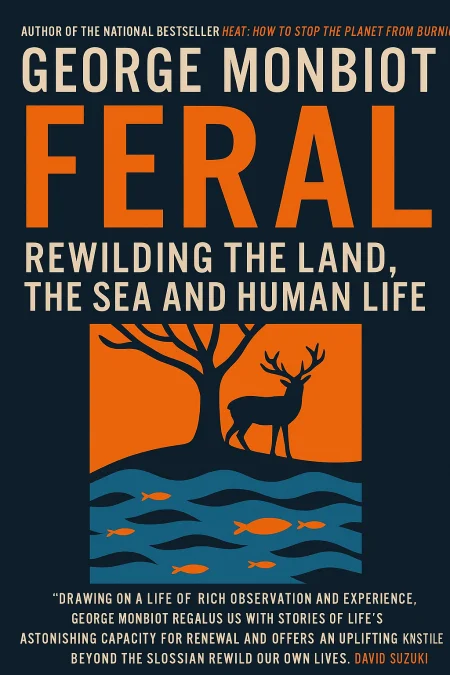
Feral
Rewilding the Land, Sea and Human Life
Book Edition Details
Summary
George Monbiot's "Feral" ignites a symphony of nature's splendor and untamed vigor, challenging us to rethink our connection with the wild. Through the pages, Monbiot becomes a modern-day explorer, tracing the contours of forgotten landscapes where nature still commands its ancient power. He encounters dreamers and doers who labor to bring back lost forests and once-dominant species like wolves and lynx, revealing a profound truth: rewilding isn't just about healing the Earth, but rejuvenating the human spirit. Monbiot's narrative is a clarion call for a vibrant future, a vision where ecological harmony breathes life back into barren lands and our own souls. Here lies a manifesto that dares us to envisage a world rich with the cacophony of life, a world where wilderness offers not just escape, but a vital path to rediscovery.
Introduction
Picture yourself walking through the Scottish Highlands, where the silence is broken only by wind across empty moorland. Yet just three centuries ago, these same hills echoed with the howls of wolves and the crash of ancient forests. This haunting transformation reveals one of Europe's most dramatic yet forgotten ecological collapses. Britain, once among the continent's wildest landscapes, has become one of its most nature-depleted nations through centuries of systematic deforestation, species extinction, and landscape simplification. This exploration uncovers the shocking scale of what we've lost and the revolutionary science of how we might get it back. Through rewilding, damaged ecosystems can recover with startling speed when natural processes are allowed to operate freely. From the return of beavers engineering new wetlands to the possibility of wolves once again shaping forest ecosystems, we're witnessing the early stages of an ecological renaissance that could transform our relationship with the natural world. This story will captivate anyone curious about Britain's hidden environmental history, the cutting-edge science of ecosystem restoration, or the practical challenges of bringing wilderness back to a crowded island. It speaks to those who sense something vital is missing from our sanitized landscapes and wonder whether we might reclaim a wilder, more vibrant future.
The Great Emptying: Millennia of Systematic Ecological Destruction
Between 10,000 and 4,000 years ago, Britain underwent one of history's most complete landscape transformations. Archaeological evidence reveals a land that would seem fantastical today: straight-tusked elephants browsed through ancient forests, cave lions stalked through woodlands covering nearly the entire landmass, and massive aurochs with six-foot horn spans thundered across clearings. This wasn't the distant past but a functioning ecosystem where megafauna shaped every aspect of the environment. The systematic elimination of these giants began with improving human hunting techniques during the Mesolithic period. Each extinction sent cascading effects through the ecosystem, removing the very architects that had maintained the landscape for millennia. These weren't simply animals living in forests; they were the forests' creators, their feeding, trampling, and wallowing maintaining complex mosaics of woodland, glade, and grassland that supported extraordinary biodiversity. The arrival of Neolithic farmers around 6,000 years ago accelerated this transformation from coexistence to domination. What began as small clearings for crops evolved into systematic deforestation as each generation pushed deeper into the wildwood. The introduction of sheep, animals that had never existed in Britain's evolutionary history, proved particularly devastating since native vegetation had evolved no defenses against their persistent grazing. By medieval times, the great temperate rainforests that once covered over 70 percent of the uplands had been reduced to scattered fragments. Pollen cores from Welsh bogs tell this story with scientific precision, documenting the replacement of diverse forest ecosystems with the bare hills we now mistake for natural wilderness. This represents perhaps the most successful example of environmental destruction in European history, so complete that we've forgotten what we lost and now actively work to preserve the ecological wasteland that remains.
Agricultural Hegemony and Conservation's Fatal Mistakes (1700s-Present)
The 20th century transformed ecological destruction from an unintended consequence into deliberate, subsidized policy. The Common Agricultural Policy, established in the 1960s, created perverse incentives that actively rewarded environmental damage. Farmers received payments not for producing food, but simply for preventing natural vegetation from returning to their land. This system turned conservation upside down, paying landowners to maintain ecological deserts where diverse ecosystems might otherwise recover. The scale of this subsidized destruction was staggering. Sheep numbers in Wales tripled between 1950 and 1999, transforming even the most marginal hillsides into closely-cropped grassland. The infamous "fifty trees rule" exemplified the madness: any pasture containing more than fifty trees per hectare became ineligible for subsidies. Ancient hedgerows were destroyed, veteran trees felled, and the last fragments of scrubland cleared to meet bureaucratic definitions of agricultural productivity. Perhaps most tragically, conservation organizations fell into the same trap, mistaking the products of ecological destruction for nature itself. The bare, sheep-grazed hills that resulted from centuries of overgrazing were designated as natural habitats worthy of protection. Conservation groups found themselves using cattle and sheep to maintain landscapes in permanent states of degradation, spending millions to prevent the natural regeneration that might restore these damaged ecosystems. The environmental costs mounted relentlessly. Farmland bird populations crashed by 60 percent between 1970 and 2010. Rivers became polluted with agricultural runoff, their clarity lost to sediment from overgrazed hillsides. Yet the subsidy system continued rewarding these practices, creating a self-perpetuating cycle of ecological degradation funded by taxpayers who believed they were supporting environmental stewardship. This agricultural hegemony didn't just destroy habitats; it fundamentally altered how people understood their relationship with the natural world, setting the stage for conservation policies as destructive as the farming practices they claimed to counteract.
Europe's Wildlife Renaissance: Rewilding Success Stories
While Britain remained trapped in its agricultural paradigm, continental Europe began experiencing an extraordinary ecological renaissance. Starting in the 1950s and accelerating after 1990, species reduced to tiny remnant populations began expanding across the continent. Wolves, once confined to remote corners of Spain and Eastern Europe, now roam through Germany, France, and Scandinavia. Bears multiplied from a few hundred to over 25,000 across Europe, while lynx populations tripled since 1970. This recovery wasn't the result of expensive reintroduction programs but the natural consequence of changing attitudes and land use patterns. As rural populations migrated to cities and marginal farmland was abandoned, large carnivores simply followed their prey back into recovering habitats. The European Union's Habitats Directive provided legal protection, while growing public enthusiasm for wildlife tourism created economic incentives for conservation. The scale of transformation was breathtaking. Beavers, reduced to fewer than 1,200 individuals in 1900, now number over 700,000 following 161 separate reintroduction projects. European bison, extinct in the wild after World War I, graze once again in forests from Poland to Spain. Even golden jackals are expanding northward into territories they may not have occupied since the Iron Age. This rewilding is happening not in remote wilderness but in landscapes far more densely populated than much of Britain. Most remarkably, this recovery occurred with minimal conflict and widespread public support. Compensation schemes address livestock losses, while wildlife tourism generates far more income than traditional land uses. In the Scottish Highlands, a single pair of reintroduced sea eagles brings £5 million annually to the local economy, compared to £1.6 million generated by deer stalking across an entire county. The European experience demonstrates that coexistence between humans and large predators is not only possible but economically beneficial, challenging British assumptions about the incompatibility of wildlife and modern life.
Britain's Rewilding Future: Restoring Natural Abundance
Britain stands at the threshold of its own ecological renaissance, though progress remains frustratingly slow compared to continental Europe. Small-scale rewilding projects are already demonstrating the remarkable speed with which damaged ecosystems can recover when given the chance. In Welsh hills, areas protected from sheep grazing have transformed from barren grassland to thriving woodland within two decades, supporting returning populations of birds, mammals, and insects absent for generations. The reintroduction of beavers offers a glimpse of what's possible when keystone species return. These ecosystem engineers don't simply occupy habitats but actively create them, building dams that slow water flow, reduce flooding, and support dozens of other species. Their return after 400 years of absence has met with surprising public enthusiasm, despite initial resistance from some landowners. Early results suggest they could provide natural flood management worth millions while creating havens for wildlife. More ambitious proposals envision lynx returning to Scottish forests and even wolves to the Highlands. Scientific assessments suggest both species could thrive in Britain's remaining wild areas, where deer populations have exploded in the absence of natural predators. Lynx, posing virtually no threat to humans and minimal risk to livestock, could be reintroduced relatively easily. Wolves present greater challenges but offer correspondingly greater ecological benefits, potentially transforming vast Highland areas from deer-grazed wastelands back into functioning ecosystems. The obstacles to rewilding in Britain are primarily cultural rather than ecological. Unlike continental Europe, where land ownership is more dispersed and public access rights stronger, Britain's concentrated ownership pattern gives a small number of individuals disproportionate power over ecological restoration. Yet public opinion polls consistently show strong support for species reintroduction, suggesting democratic pressure may eventually overcome aristocratic resistance. The question isn't whether Britain will join Europe's rewilding revolution, but when and how quickly it will embrace the restoration of its natural heritage.
Summary
The story of Britain's ecological transformation reveals a fundamental tension between human control and natural processes that continues shaping our environmental relationships today. Over millennia, the systematic elimination of forests, predators, and ecological complexity created landscapes that appear natural but are actually among Earth's most heavily modified. This process of simplification, driven by agricultural expansion and sustained by cultural attitudes viewing wild nature as threatening or wasteful, represents one of history's most complete environmental transformations. Yet the European rewilding renaissance demonstrates this trajectory isn't irreversible. When given space and protection, natural systems display extraordinary capacity for recovery, often exceeding scientific predictions for speed and scope of restoration. The return of wolves to Germany, beavers to Britain, and forests to abandoned farmland shows that coexistence between humans and wild nature is not only possible but mutually beneficial. These successes challenge us to reimagine what's possible in our own landscapes and communities. The path forward requires both ecological restoration and cultural transformation. We must reform subsidy systems rewarding ecological destruction, create large protected areas where natural processes can operate freely, and reintroduce missing species to restore ecological complexity. Most importantly, we must develop a new relationship with wildness that embraces uncertainty, complexity, and the thrilling possibility of encountering the unexpected in our own backyards. The choice between ecological impoverishment and natural abundance remains ours to make, but the window for action is rapidly closing.
Related Books
Download PDF & EPUB
To save this Black List summary for later, download the free PDF and EPUB. You can print it out, or read offline at your convenience.
By George Monbiot
