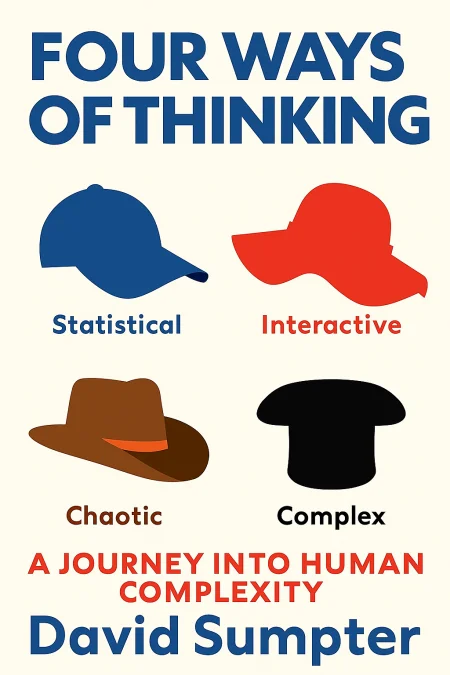
Four Ways of Thinking
A Journey Into Human Complexity
Book Edition Details
Summary
Ever wonder if your thoughts shape your reality? Acclaimed mathematician David Sumpter invites you to question the very fabric of your thinking in "Four Ways of Thinking." This isn't just a book—it's a mind-expanding odyssey through four transformative lenses: statistical, interactive, chaotic, and complex. Sumpter combines his profound expertise with vibrant storytelling, unveiling how these diverse approaches can refine your decision-making, fortify your relationships, and elevate your everyday experiences. With humor and a dash of number crunching, he weaves personal anecdotes with the awe-inspiring tales of pioneering scientists who revolutionized the world. Prepare to embark on a journey where math meets the marvel of life, and discover how adjusting your perspective can indeed change your world.
Introduction
Why do some people seem to navigate life's challenges with remarkable clarity while others feel perpetually overwhelmed by complexity? The answer lies not in intelligence or luck, but in how we structure our thinking. Throughout history, mathematicians and scientists have developed powerful frameworks that cut through chaos and uncertainty, revealing patterns that transform confusion into understanding. This mathematical approach to thinking offers four distinct yet interconnected ways of processing complexity: statistical analysis for understanding populations and probabilities, interactive modeling for grasping dynamic relationships, chaotic thinking for embracing uncertainty and unpredictability, and complex thinking for navigating irreducible complexity. These four approaches, when mastered, provide a comprehensive toolkit for making sense of everything from personal relationships to global phenomena. Rather than viewing mathematics as abstract formulas, we can harness these thinking patterns as practical wisdom for everyday decision-making, problem-solving, and understanding the intricate systems that surround us.
Statistical Thinking: Finding Truth in Numbers
Statistical thinking represents the foundation of evidence-based reasoning, teaching us to distinguish between meaningful patterns and random noise. At its core, this approach involves collecting data, analyzing distributions, and drawing reliable conclusions about populations based on samples. The power of statistical thinking lies in its ability to reveal truths that individual experiences might obscure, providing objective frameworks for understanding complex phenomena. The methodology of statistical thinking operates through several key components. First, we learn to recognize and calculate measures of central tendency like means and medians, understanding when each provides the most accurate representation of our data. We then explore variability and distribution patterns, learning to identify normal curves, long-tailed distributions, and other shapes that reveal underlying structures. Correlation analysis helps us understand relationships between variables, while significance testing allows us to distinguish genuine patterns from coincidental occurrences. Consider how statistical thinking transforms our understanding of personal health decisions. Rather than relying on anecdotal evidence or media headlines, we can examine large-scale longitudinal studies to understand the real impact of lifestyle choices. When research shows that adopting four healthy behaviors can add twelve years to life expectancy, we're seeing statistical thinking in action. Similarly, understanding that happiness studies reveal correlation but not necessarily causation helps us approach self-improvement with appropriate skepticism and nuance. Statistical thinking empowers us to make informed decisions by seeing beyond individual cases to broader patterns, while simultaneously recognizing the limitations of what numbers can tell us about our unique, personal experiences.
Interactive Thinking: Understanding Dynamic Systems
Interactive thinking shifts our focus from static analysis to dynamic relationships, revealing how individual components create emergent behaviors through their connections and feedback loops. This approach recognizes that many of life's most important phenomena arise not from isolated elements but from the complex interplay between multiple actors, whether they're predators and prey, individuals in relationships, or ideas spreading through communities. The framework of interactive thinking operates through several interconnected mechanisms. We begin by identifying the key players or components in any system, then map the rules governing their interactions. These interactions often follow patterns similar to chemical reactions, where one state transforms into another through contact and influence. Feedback loops, both positive and negative, amplify or dampen changes throughout the system. Tipping points emerge when small changes in interaction patterns lead to dramatically different outcomes, while periodic cycles reveal the natural rhythms that emerge from sustained interactions. Interactive thinking illuminates countless aspects of human experience. In relationships, we can understand how communication patterns create either constructive dialogue or destructive argument cycles. Instead of focusing on who started a disagreement, interactive thinking reveals how both parties' response patterns either escalate or de-escalate conflict. Social trends, from fashion movements to political polarization, become comprehensible as interactive processes where individual choices aggregate into collective phenomena. By understanding these interaction patterns, we gain the ability to intervene strategically, changing our own behavior in ways that positively influence entire systems.
Chaotic Thinking: Embracing Uncertainty and Randomness
Chaotic thinking acknowledges the fundamental unpredictability inherent in complex systems, teaching us when to embrace uncertainty rather than fight it. Unlike randomness, which lacks pattern entirely, chaos emerges from deterministic systems that are extraordinarily sensitive to initial conditions. This sensitivity means that tiny differences can compound into dramatically different outcomes, making long-term prediction impossible even when we understand the underlying rules. The principles of chaotic thinking revolve around several key insights. Sensitive dependence on initial conditions means that small changes early in any process can have enormous consequences later. This butterfly effect applies not just to weather systems but to personal decisions, market dynamics, and social movements. Chaotic systems typically exhibit both positive feedback, which amplifies small changes, and regulatory mechanisms that prevent infinite growth. The interplay between these forces creates complex, unpredictable dynamics that resist our attempts at control. Chaotic thinking proves invaluable in managing personal challenges and decision-making. When we recognize that our attempts to rigidly control outcomes often create more chaos, we learn to distinguish between situations requiring careful planning and those benefiting from flexibility. Understanding entropy teaches us that complexity naturally increases over time, helping us approach setbacks with equanimity rather than self-blame. In relationships, chaotic thinking helps us recognize that some turbulence is natural and that our attempts to eliminate all uncertainty might actually create more instability. This framework encourages us to develop resilience and adaptability rather than pursuing the impossible goal of complete predictability.
Complex Thinking: Navigating Irreducible Complexity
Complex thinking addresses the profound reality that some phenomena cannot be reduced to simpler explanations without losing their essential nature. Drawing from Kolmogorov complexity theory, this approach recognizes that a system is only as complex as its shortest possible description. When no shorter description exists, we encounter irreducible complexity that must be understood on its own terms rather than broken down into component parts. The architecture of complex thinking operates through multiple dimensions simultaneously. We learn to recognize emergent properties that arise from interactions but cannot be predicted from individual components alone. Pattern recognition becomes crucial, as we seek the shortest accurate descriptions of complex phenomena while acknowledging that some patterns resist simplification. This thinking mode embraces multiscale analysis, recognizing that complexity often spans multiple levels of organization, from individual behaviors to group dynamics to societal structures. Complex thinking proves essential for understanding human nature and social systems. When we recognize that each person represents billions of neural connections and life experiences, we develop appropriate humility about our ability to fully understand others or even ourselves. This perspective transforms how we approach relationships, moving away from simple categorizations toward appreciation of genuine uniqueness. In organizational contexts, complex thinking helps us design systems that account for human unpredictability while creating conditions for positive emergence. Rather than seeking to control complex systems, this approach teaches us to influence conditions and allow beneficial patterns to develop naturally, recognizing that the most profound aspects of human experience often resist reduction to simple formulas.
Summary
The journey through these four ways of thinking reveals that mathematical frameworks, far from being abstract academic concepts, provide practical wisdom for navigating life's complexity with greater clarity and effectiveness. By integrating statistical analysis for evidence-based decisions, interactive modeling for understanding relationships, chaotic thinking for embracing uncertainty, and complex thinking for honoring irreducible complexity, we develop a comprehensive approach to both personal growth and social understanding. This mathematical lens ultimately teaches us that while we cannot control or fully comprehend all aspects of existence, we can develop more sophisticated and effective ways of thinking that lead to better decisions, deeper relationships, and greater resilience in an inherently complex world.
Related Books
Download PDF & EPUB
To save this Black List summary for later, download the free PDF and EPUB. You can print it out, or read offline at your convenience.
By David Sumpter
