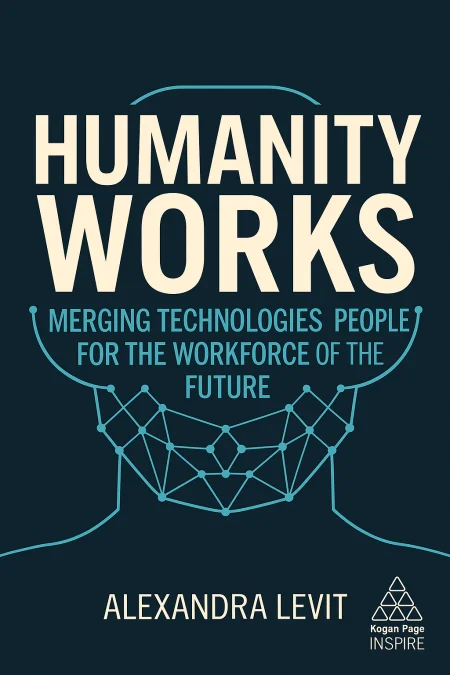
Humanity Works
Merging Technologies and People for the Workforce of the Future
Book Edition Details
Summary
In a world where the relentless march of technology feels unstoppable, "Humanity Works" by Alexandra Levit stands as a beacon of hope for organizations seeking to thrive in the future. As workplaces evolve, the challenge is not just to survive but to leverage the irreplaceable human elements of creativity, judgment, and empathy. Levit, an acclaimed futurist, reveals how the dance between human talent and machine efficiency can create agile, innovative environments. Drawing from insightful case studies of industry giants like Nestle and The Washington Post, she crafts a narrative that's both a guide and a call to action. This book is your key to unlocking the potential of your workforce, ensuring that humanity isn't just preserved but celebrated in the face of technological upheaval.
Introduction
Picture walking into an office where robots handle routine tasks while humans focus on creativity and complex problem-solving. This isn't science fiction—it's the workplace reality rapidly approaching us. As artificial intelligence reshapes industries and automation transforms how we work, a fundamental question emerges: what will happen to human workers? The answer is far more optimistic than many fear. Rather than replacing humans entirely, technology is creating new opportunities for uniquely human skills to flourish. The future workplace will be a collaborative ecosystem where humans and machines work together, each contributing their distinct strengths. This transformation brings exciting possibilities for more meaningful work, flexible arrangements, and career paths that adapt to individual needs. Understanding how to navigate this changing landscape will determine not just professional success, but how we can harness technology to create more fulfilling and productive working lives for everyone.
Technological Transformation and Human Value in the Digital Age
The rise of artificial intelligence and automation has sparked widespread concern about job displacement, but the reality is more nuanced and encouraging than headlines suggest. While machines excel at processing vast amounts of data and performing repetitive tasks with perfect consistency, they struggle with the complex, creative, and interpersonal challenges that define much of meaningful work. Think of a doctor using AI to analyze medical scans—the technology can spot patterns and anomalies with incredible precision, but the doctor provides the human judgment, empathy, and communication skills needed to treat the whole person. This human-machine partnership represents a fundamental shift in how we think about work. Rather than competing with technology, successful professionals are learning to collaborate with it. Machines handle the computational heavy lifting, freeing humans to focus on what they do best: creative problem-solving, building relationships, making nuanced judgments, and adapting to unexpected situations. A marketing professional might use AI to analyze customer data and identify trends, but still needs human insight to craft compelling campaigns that resonate emotionally with audiences. The key to thriving in this technological transformation lies in developing distinctly human capabilities that complement rather than compete with machines. These include emotional intelligence, creative thinking, complex communication, and the ability to work effectively in teams. Companies are discovering that the most valuable employees aren't those who can outperform computers at computational tasks, but those who can leverage technology to enhance their uniquely human contributions. This shift also demands continuous learning and adaptability. The most successful workers are those who embrace technology as a powerful tool while continuously developing skills that remain uniquely human. They understand that their value lies not in what they know, but in how they think, connect, and create solutions to complex problems that require human insight and judgment.
Evolving Work Structures and the Rise of Flexible Employment
The traditional 9-to-5 office job is rapidly becoming an artifact of the industrial age, replaced by flexible work arrangements that reflect both technological capabilities and changing employee expectations. Remote work, once considered a perk for a privileged few, has become mainstream as digital tools enable seamless collaboration across distances and time zones. This transformation extends beyond simple location flexibility to encompass entirely new ways of organizing work, from project-based teams that form and dissolve as needed to hybrid schedules that blend in-person and virtual collaboration. Co-working spaces represent another fundamental shift in how we think about workplace structure. These shared environments bring together professionals from different companies and industries, fostering the kind of cross-pollination of ideas that was once limited to chance encounters at conferences. They reflect a broader trend toward community-based work arrangements where networking, learning, and collaboration happen organically rather than through formal corporate hierarchies. The gig economy exemplifies the most dramatic departure from traditional employment models. Independent contractors, freelancers, and project-based workers now constitute a significant portion of the workforce, offering both employers and workers new forms of flexibility. Companies can access specialized skills on demand without long-term commitments, while individuals can pursue multiple interests, control their schedules, and build diverse skill sets across different projects and industries. These evolving structures are supported by technologies that make distributed work not just possible but often more efficient than traditional arrangements. Virtual reality meetings, cloud-based collaboration tools, and AI-powered project management systems enable teams to work together effectively regardless of physical location. The result is a work environment that prioritizes results over presence, creativity over conformity, and adaptability over rigid adherence to outdated organizational structures.
Leadership Evolution and Organizational Culture in 2030
The command-and-control leadership style that dominated the industrial era is giving way to more collaborative, transparent, and adaptable approaches that reflect both technological capabilities and generational shifts in workplace expectations. Tomorrow's leaders will need to inspire and guide rather than simply direct, fostering environments where innovation flourishes and diverse teams can contribute their best work regardless of their physical location or traditional hierarchical position. Organizational cultures are becoming increasingly purpose-driven, with companies that clearly articulate their mission and values attracting and retaining the most talented workers. This shift reflects a broader trend where professionals, particularly younger generations, seek meaningful work that aligns with their personal values rather than simply pursuing traditional markers of success like salary and status. Leaders must learn to communicate not just what needs to be done, but why it matters and how each person's contribution fits into the larger purpose. The rise of data-driven decision-making is transforming how leaders understand and respond to their teams' needs. Advanced analytics can provide insights into employee engagement, productivity patterns, and potential areas of concern, enabling leaders to address issues proactively rather than reactively. However, the most effective leaders balance this technological insight with human intuition and emotional intelligence, understanding that behind every data point is a person with individual needs, motivations, and circumstances. Perhaps most significantly, leadership itself is becoming more distributed and collaborative. Rather than concentrating all decision-making authority at the top of traditional hierarchies, successful organizations are empowering team members at all levels to take ownership of their work and contribute to strategic thinking. This requires leaders who are comfortable with ambiguity, skilled at facilitating rather than controlling, and able to create psychological safety that encourages risk-taking and innovation.
Summary
The future of work is not a story of human replacement, but of human elevation through thoughtful integration with advancing technology. The most profound insight emerging from this transformation is that our uniquely human capabilities—creativity, empathy, complex reasoning, and adaptability—become more valuable, not less, in an increasingly automated world. Success in tomorrow's workplace will belong to those who can harness technology to amplify their human potential while continuously developing skills that complement rather than compete with machines. How might you begin preparing today for a work environment that values human creativity and connection above routine task completion? What steps could organizations take now to build cultures that truly leverage both human insight and technological capability? For readers interested in understanding how technological advancement can enhance rather than diminish human potential, this exploration offers a roadmap for navigating change with optimism and strategic purpose.
Related Books
Download PDF & EPUB
To save this Black List summary for later, download the free PDF and EPUB. You can print it out, or read offline at your convenience.
By Alexandra Levit
