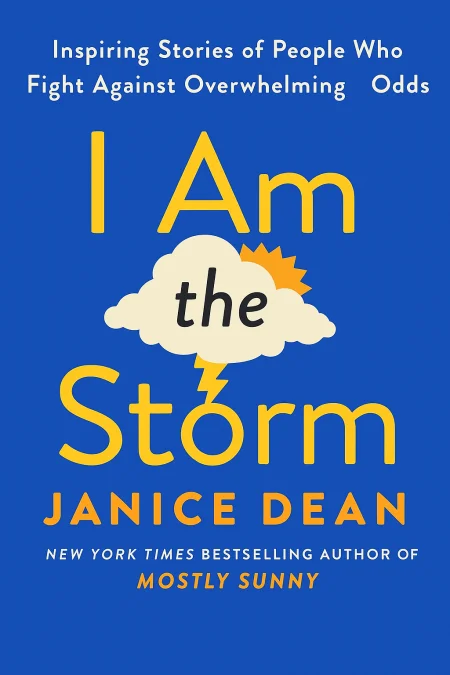
I Am the Storm
Inspiring Stories of People Who Fight Against Overwhelming Odds
Book Edition Details
Summary
Battling against the odds and rising as beacons of hope, the everyday heroes in Janice Dean's "I Am the Storm" redefine courage. With tales that cut to the heart, Dean captures the indomitable spirit of ordinary individuals who refuse to yield in the face of towering challenges. Discover the raw tenacity of a Californian chef defying government edicts to support his community, the unyielding resolve of a college hockey team toppling Soviet giants, and a grieving mother waging war on the opioid crisis. These narratives, brimming with resilience, spotlight the power of standing firm against life's fiercest gales. Dean's work is an emotional tapestry that invites readers to find strength and perseverance amidst adversity, underscoring the profound impact of unwavering courage.
Introduction
What drives an individual to stand against insurmountable odds when retreat seems the only rational choice? This exploration delves into the profound human capacity for courage when faced with seemingly impossible challenges. Through carefully documented stories of ordinary people confronting extraordinary adversities, a compelling argument emerges about the nature of moral courage and its transformative power in society. The analysis employs a narrative-driven approach, weaving together personal testimonies, historical context, and psychological insights to demonstrate how individual acts of defiance can create ripple effects far beyond their immediate circumstances. Each story serves as both evidence and argument, illustrating how the decision to fight rather than flee often stems not from calculated heroism, but from an fundamental recognition of what is right. These accounts reveal a consistent pattern: the moment when someone realizes they possess the power to act becomes a catalyst for broader change. The examination moves systematically through different spheres of human experience, from personal tragedy to institutional corruption, showing how courage manifests across diverse contexts while maintaining essential characteristics that transcend individual circumstances.
Finding Voice in Tragedy: Personal Loss as Catalyst for Action
The transformation of grief into advocacy represents one of humanity's most profound responses to injustice. When personal tragedy intersects with systemic failure, the resulting emotional force often propels individuals beyond their comfort zones and into public battles they never anticipated fighting. This dynamic reveals how loss can become a powerful catalyst for social change when channeled through determined action. The psychological mechanism underlying this transformation involves a shift from internal processing of pain to external expression of purpose. Tragedy strips away many of the social conventions and personal hesitations that typically constrain public action. Survivors find themselves uniquely positioned to speak truths that others cannot or will not articulate, carrying both the moral authority of lived experience and the emotional urgency that compels attention. Personal loss creates a particular form of expertise that cannot be acquired through academic study or professional training. Those who have navigated the specific challenges of systemic failures possess insights into the human cost of institutional decisions. Their advocacy carries authenticity that resonates with both policymakers and the public, often proving more persuasive than statistical analyses or expert testimonies. The transition from private grief to public voice requires tremendous courage, as it involves revealing vulnerability while simultaneously demanding accountability from powerful entities. This vulnerability, however, becomes a source of strength, creating connections with others who have experienced similar losses and building coalitions capable of sustained pressure for change.
David vs. Goliath: Ordinary People Confronting Powerful Systems
The archetypal confrontation between individual citizens and entrenched power structures reveals fundamental truths about how change occurs in democratic societies. These battles demonstrate that institutional power, despite its apparent invincibility, contains inherent vulnerabilities that determined individuals can exploit through strategic action and moral clarity. Successful challenges to powerful systems typically begin with a clear articulation of injustice that resonates beyond the immediate participants. The individual's role becomes symbolic, representing broader concerns that many share but few dare to voice. This symbolic power transforms personal grievances into collective causes, mobilizing resources and support that would be impossible for any single person to generate alone. The asymmetry between individual challengers and institutional opponents creates both obstacles and opportunities. While institutions possess superior resources, legal teams, and political connections, they also suffer from bureaucratic inertia, public accountability pressures, and the need to maintain legitimacy. Individuals, conversely, can move quickly, speak authentically, and adapt tactics without complex approval processes. The most effective individual challenges to powerful systems combine moral clarity with strategic thinking. They identify pressure points where public attention can create maximum discomfort for institutions, forcing responses that reveal either genuine reform or defensive behaviors that further undermine credibility. Success often comes not from single victories but from sustained campaigns that gradually shift public perception and political dynamics.
The Ripple Effect: How Individual Courage Inspires Collective Change
Individual acts of courage create expanding circles of influence that extend far beyond their immediate contexts. This ripple effect operates through multiple mechanisms: direct inspiration, permission-giving for others to act, and the creation of new social narratives that redefine what is possible for ordinary citizens to accomplish. The inspirational power of individual courage stems from its demonstration that action is possible even when odds seem impossible. Witnesses to courageous acts undergo a psychological shift, recognizing that if one person can stand against overwhelming opposition, perhaps they too possess similar capacities. This recognition often lies dormant until activated by compelling examples of ordinary people choosing extraordinary action. Permission-giving represents a crucial social function of visible courage. Many people harbor concerns about injustices they witness but doubt their right or ability to speak out. When someone similar to themselves takes public action, it legitimizes their own potential involvement and provides models for how such action might proceed. This dynamic explains why individual acts of courage often precipitate waves of similar actions across different contexts. The creation of new social narratives through individual courage challenges prevailing assumptions about power, possibility, and responsibility. These stories become part of collective memory, providing resources for future generations facing similar challenges. They demonstrate that alternatives to passive acceptance exist and that individual agency can produce meaningful change, even when confronting seemingly immovable obstacles.
Weathering the Storm: Resilience and Hope in Dark Times
The capacity to maintain hope and continue fighting despite repeated setbacks reveals essential truths about human resilience and the psychological foundations of sustained resistance. This resilience emerges not from naive optimism but from a clear-eyed recognition of both the magnitude of challenges and the genuine possibilities for progress through persistent effort. Effective resilience in the face of overwhelming odds requires the development of multiple sources of meaning and motivation. Those who sustain long-term fights against powerful opposition typically draw strength from combinations of personal conviction, community support, spiritual or philosophical frameworks, and tangible evidence of incremental progress. This diversification prevents any single setback from undermining overall commitment. The maintenance of hope during extended struggles often depends on redefining victory to include process victories alongside outcome victories. Progress may be measured not only by achieving specific goals but by raising awareness, building networks of support, changing conversations, and creating precedents for future action. This broader definition of success provides sustainable motivation even when ultimate objectives remain elusive. Community formation around shared struggles provides crucial support systems that sustain individual resilience. These communities offer practical assistance, emotional support, strategic advice, and shared burden-bearing that makes overwhelming challenges manageable. They also preserve institutional memory and accumulated wisdom that can guide future efforts even when original leaders can no longer continue.
Summary
The evidence presented demonstrates that individual courage, when exercised with moral clarity and strategic wisdom, possesses transformative power that extends far beyond immediate circumstances, creating conditions for broader social change through the multiplication of inspired action and the gradual shift of collective consciousness toward greater justice and accountability. These stories illuminate not merely the heroism of exceptional individuals, but the latent capacity for courage that exists within ordinary people when confronted with clear moral choices and equipped with examples of possibility.
Related Books
Download PDF & EPUB
To save this Black List summary for later, download the free PDF and EPUB. You can print it out, or read offline at your convenience.
By Janice Dean
