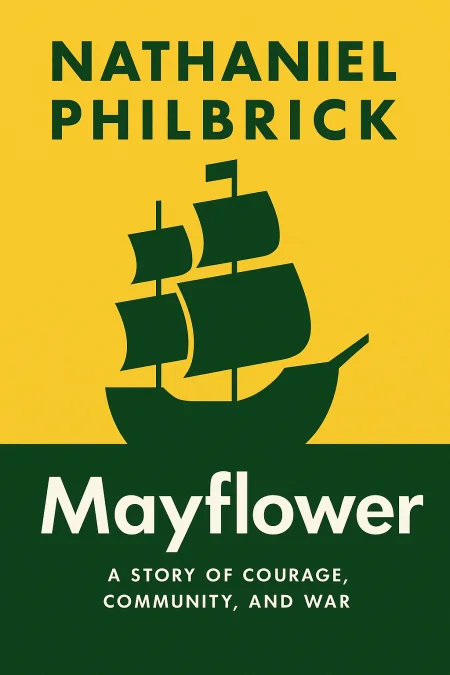
Mayflower
A Story of Courage, Community, and War
Book Edition Details
Summary
In the shadows of American folklore lies a tale far more profound than the celebrated First Thanksgiving. Nathaniel Philbrick's "Mayflower" takes you beyond the textbook pages to unravel the relentless saga of survival, diplomacy, and conflict that spanned fifty-five tumultuous years. With a masterful touch, Philbrick paints an unflinching portrait of the Pilgrims' audacious 1620 journey and the ensuing clash of cultures that would forge a nation. From tentative alliances with Indigenous peoples to the fires of devastating warfare, every page echoes with the echoes of choices made long ago. As past and present intertwine, this narrative invites readers to reflect on the enduring legacies that continue to shape the American spirit.
Introduction
Picture a small band of English religious separatists, barely surviving their first brutal winter in the New World, suddenly encountering a towering Native American warrior who greets them with the astonishing words "Welcome, Englishmen!" This extraordinary moment in 1621 marked the beginning of one of the most complex and ultimately tragic relationships in American history—a fifty-five-year dance of cooperation, manipulation, and mutual dependence that would end in devastating warfare. This story challenges everything we think we know about early America. Far from the simple tale of Pilgrims and Indians sharing a peaceful Thanksgiving, we discover a sophisticated web of diplomacy, cultural exchange, and political maneuvering that would make modern international relations seem straightforward by comparison. We witness how Massasoit, the Pokanoket sachem, brilliantly leveraged his alliance with vulnerable English settlers to rebuild his plague-devastated people's power, while the Pilgrims transformed from desperate refugees into confident colonizers willing to use brutal violence to maintain their position. This narrative speaks to anyone seeking to understand how cultures collide and adapt, how alliances form and fracture, and how the seeds of future conflicts are often planted in the very relationships that ensure present survival. It reveals the human complexity behind America's founding myths and offers sobering lessons about the long-term consequences of short-term survival strategies.
Desperate Beginnings and Strategic Alliance (1620-1640)
The Mayflower's arrival at Cape Cod in November 1620 was hardly the triumphant landing of legend. After sixty-five days at sea, the 102 passengers were sick, starving, and facing the onset of a brutal New England winter. Their intended destination had been the Hudson River, but dangerous shoals and contrary winds forced them to anchor in what is now Provincetown Harbor. Before setting foot on land, they faced their first crisis of governance—some passengers threatened mutiny, declaring they would "use their own liberty" once ashore since their patent didn't technically cover this northern territory. The solution was the Mayflower Compact, a remarkable document that established civil government based on consent rather than divine right or corporate charter. This wasn't democracy as we know it, but it was revolutionary for its time—a group of people three thousand miles from authority creating their own legitimate government through mutual agreement. The compact represented both pragmatic necessity and radical innovation, establishing a precedent that would echo through American history. The transformation from hostility to alliance began with Samoset's bold walk into Plymouth in March 1621, followed by the arrival of Squanto, whose remarkable life story made him uniquely qualified to serve as cultural bridge between two worlds. But the real architect of peace was Massasoit, the Pokanoket sachem who made perhaps the most consequential decision in early American history when he chose to ally with the struggling English settlement. His calculation was brilliant and desperate—his people had been devastated by plague, reduced from thousands to hundreds, and were now vassals to their traditional enemies, the Narragansetts. This period of accommodation saw remarkable cultural exchange that demonstrated genuine possibilities for coexistence. The English learned to grow corn using Native techniques, adopted Indian foods like succotash and johnnycakes, and even used wampum as currency. The Natives eagerly embraced European tools, weapons, and trade goods, integrating them into their traditional ways of life. Yet beneath this surface cooperation lay deeper tensions about land ownership, cultural practices, and political authority that would eventually prove irreconcilable as circumstances changed and new generations took power.
Demographic Shifts and Growing Cultural Tensions (1640-1675)
The arrival of the Great Migration in the 1630s fundamentally altered the balance of power in New England. Suddenly, Plymouth was no longer an isolated outpost but part of a rapidly expanding English presence that included Boston, Connecticut, and dozens of new towns. The Pequot War of 1637 introduced a new level of violence to Indian-English relations, with Massachusetts Bay's systematic destruction of a Pequot village shocking even Native allies with its brutality. As one Narragansett observer protested, European warfare was "too furious, and slays too many men." For the Pokanokets, these changes brought both opportunities and mounting pressures. Massasoit skillfully leveraged his English alliance to expand his influence, but his people increasingly found themselves surrounded by English settlements and dependent on a colonial economy that offered them diminishing returns. The fur trade that had initially enriched both sides was collapsing as beaver populations crashed, while English livestock constantly invaded Native cornfields, creating endless friction over property rights and compensation. The death of the founding generation marked a crucial turning point. When Massasoit died around 1661, his son Alexander inherited a much more constrained world than his father had known. The new generation of English leaders, led by men like Josiah Winslow, lacked their parents' sense of debt to the Natives and were more inclined to treat Indian sachems as subordinates rather than allies. When Alexander was summoned to Plymouth court in 1662 and died shortly after his confrontation with English authorities, many Pokanokets became convinced that the English had poisoned him. Alexander's younger brother Philip inherited not just leadership of the Pokanokets but also a legacy of grievance and suspicion. Unlike his father Massasoit, who had dealt with English leaders who remembered their dependence on Native aid, Philip faced a generation of colonists who saw Indians primarily as obstacles to their expansion. The stage was set for a tragic collision between Philip's determination to preserve Pokanoket independence and English assumptions about their right to dominate the land their parents had entered as desperate refugees.
King Philip's War and Colonial Transformation (1675-1676)
The war that erupted in June 1675 was not inevitable, but it was the logical outcome of fifty-five years of mounting tensions and mutual misunderstanding. Philip had spent over a decade trying to navigate between accommodation and resistance, selling land to survive economically while watching his people's territory shrink and their traditional ways of life disappear. The immediate trigger was the execution of three Pokanokets for murdering John Sassamon, a Christian Indian who may have warned Plymouth authorities of Philip's war preparations. What began as a localized conflict quickly spread across New England as decades of accumulated grievances exploded into violence. Philip's strategic genius lay not in military tactics but in his ability to forge a pan-Indian alliance that transcended traditional tribal boundaries. For the first time, Natives from different tribes united against the common threat of English expansion, creating a coalition that nearly succeeded in driving the colonists back to the sea. The Narragansetts, traditional enemies of the Pokanokets, joined after English forces attacked their winter stronghold in the devastating Great Swamp Fight. The war's brutality shocked both sides and revealed how completely the careful protocols of earlier decades had collapsed. English towns were burned and abandoned, with refugees fleeing eastward as the frontier collapsed. Native communities were shattered as families were torn between loyalty to Philip and accommodation with the English. The conflict became a civil war within both societies, with Christian Indians fighting alongside colonists while some English traders continued dealing with Philip's forces even as their own communities burned. The human cost was staggering—in proportion to population, King Philip's War was the deadliest conflict in American history, killing one in sixteen English colonists and perhaps three in four Native Americans in southern New England. Philip himself was killed in August 1676, shot down in a swamp near Mount Hope by a Christian Indian fighting with English forces. His head was displayed on a spike in Plymouth for decades, a grim monument to the failure of accommodation. The war's end marked more than military victory—it represented the final collapse of the bicultural world that Massasoit and the Pilgrims had created together.
Legacy of Violence and America's Racial Divide
The aftermath of King Philip's War established patterns that would define American expansion for the next two centuries. The Pokanokets ceased to exist as an independent people, their survivors sold into slavery or scattered among other tribes. The English emerged victorious but traumatized, their sense of security permanently shattered and their relationship with Native peoples reduced to one of domination rather than cooperation. The systematic enslavement of captured Native peoples, including Philip's own wife and nine-year-old son, demonstrated how thoroughly the colonists had abandoned any pretense of treating Indigenous peoples as equals. The war's conclusion brought not just military defeat but systematic cultural destruction for New England's Native peoples. Hundreds were sold into slavery in the Caribbean, while others fled to French Canada or Iroquois territory. Those who remained found themselves confined to small reservations or scattered among English towns as laborers and servants. The rich political traditions of sachems like Massasoit and Philip were replaced by English-appointed overseers, and the complex kinship networks that had sustained Indigenous communities for millennia were shattered beyond repair. Perhaps most tragically, the war destroyed what had been a unique experiment in intercultural cooperation that might have offered a different model for American development. The early Plymouth Colony had demonstrated that English and Native peoples could create shared institutions, adopt each other's technologies, and build communities that transcended racial boundaries. The choice to abandon this experiment in favor of racial dominance would echo through American history in the treatment of African Americans, Mexican Americans, Asian immigrants, and countless other groups who found themselves on the wrong side of the color line that King Philip's War helped establish. The conflict also revealed how quickly intercultural cooperation could collapse when people chose to see difference as threat rather than opportunity. Captain Benjamin Church, the war's most successful English commander, embodied a new American type: a frontiersman who adopted Native tactics and employed Native allies while remaining fundamentally committed to English dominance. His methods of total warfare, cultural adaptation, and racial hierarchy would become the template for American expansion across the continent, creating cycles of violence that could have been broken with different choices at crucial moments.
Summary
The story from Mayflower to King Philip's War reveals the central paradox of early American history: the very alliances that enabled survival contained the seeds of future destruction. Massasoit's decision to aid the Pilgrims saved both peoples in the short term but created a dynamic of dependence and cultural change that ultimately proved unsustainable. The English learned to survive in America with Native help, then used that knowledge to dispossess their former allies. The Natives gained temporary security through English alliance, but at the cost of their long-term independence and cultural integrity. This pattern of initial cooperation followed by domination and dispossession would repeat itself across the American continent as European settlement expanded westward. Each new frontier would see similar cycles of mutual dependence, cultural exchange, mounting tension, and eventual violent resolution. The tragedy was not that conflict was inevitable, but that both sides repeatedly chose short-term advantage over long-term coexistence, creating cycles of violence that could have been broken with different choices at crucial moments. For modern readers, this history offers sobering lessons about the challenges of cross-cultural cooperation and the long-term consequences of decisions made under pressure. It reminds us that today's allies can become tomorrow's enemies when fundamental interests diverge, that cultural exchange alone cannot overcome structural inequalities, and that the failure to address underlying tensions often leads to explosive conflicts that destroy everyone involved. Most importantly, it suggests that sustainable relationships between different peoples require not just mutual respect but genuine power-sharing and a willingness to sacrifice immediate advantages for long-term stability.
Related Books
Download PDF & EPUB
To save this Black List summary for later, download the free PDF and EPUB. You can print it out, or read offline at your convenience.

By Nathaniel Philbrick
