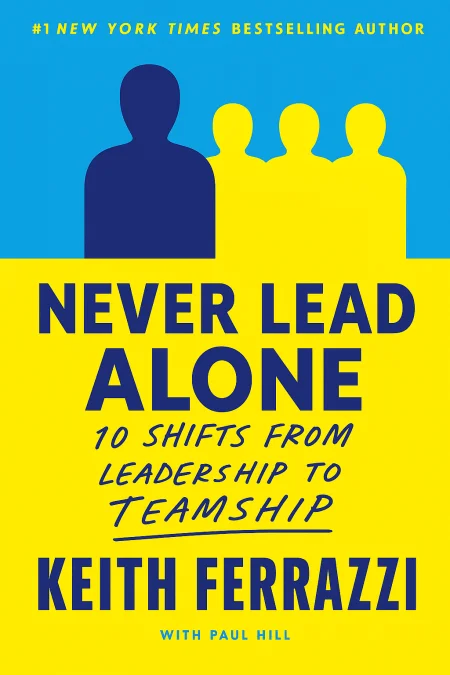
Never Lead Alone
10 Shifts from Leadership to Teamship
Book Edition Details
Summary
In an era where the synergy of collaboration eclipses the lone genius, "Never Lead Alone" redefines the blueprint for success. Keith Ferrazzi, renowned architect of thriving teams, unveils the transformative power of "teamship"—a revolutionary concept that places collective ingenuity above singular leadership. Drawing from his vast experience with giants like Mastercard and trailblazers like MongoDB, Ferrazzi reveals ten paradigm shifts that propel teams from stagnation to innovation. This book is a clarion call to embrace dynamic interdependence and ignite a culture where diverse minds coalesce to drive exponential growth. Experience firsthand how teams can evolve into engines of creativity and resilience, capturing the bold essence of shared brilliance in a complex world.
Introduction
Why do some teams consistently outperform while others struggle despite having talented individuals? The traditional model of heroic leadership, where success hinges on a single leader's vision and directive, has reached its limits in today's volatile, interconnected business environment. The answer lies not in finding better leaders, but in fundamentally reimagining how teams operate through what can be termed "teamship" - a systematic approach that distributes leadership responsibilities across team members while fostering co-elevation behaviors. This paradigm represents a convergence of behavioral psychology, organizational design, and collaborative technology, rooted in decades of research with high-performing teams across industries. The framework addresses three critical questions that define modern organizational effectiveness: How can teams move beyond traditional hierarchical constraints to unlock collective intelligence? What specific practices enable peer-to-peer accountability without sacrificing speed or clarity? How do successful teams integrate human collaboration with emerging technologies to achieve breakthrough results? The synthesis of these elements creates a replicable system for transforming any group of individuals into a cohesive, self-directing, and continuously improving team.
From Hub-and-Spoke Leadership to Co-Elevation
The hub-and-spoke model positions leaders as central nodes through which all information and decisions must flow, creating bottlenecks that limit organizational agility and individual growth. Co-elevation represents a fundamental shift toward distributed leadership, where team members actively commit to both achieving shared missions and lifting each other's performance simultaneously. This framework operates on three interconnected levels: commitment architecture, behavioral agreements, and outcome accountability. The commitment architecture establishes that every team member holds dual responsibility - delivering on their individual contributions while actively supporting colleagues' success. Behavioral agreements define how team members interact, share information, challenge ideas, and provide feedback in service of collective goals. Outcome accountability ensures that success metrics reflect both individual achievement and team elevation, creating alignment between personal advancement and group performance. Consider how venture capital teams traditionally operate versus those practicing co-elevation. In conventional structures, individual partners compete for deal flow and recognition, often withholding information that could benefit colleagues. Co-elevating teams create systematic knowledge sharing, collaborative due diligence processes, and joint accountability for portfolio performance. When one partner identifies a promising opportunity, they actively involve others who bring complementary expertise, resulting in better investment decisions and stronger portfolio company support. The transformation from individual competition to collective intelligence multiplies both personal success and team outcomes.
Building Trust Through Candor and Purposeful Bonds
Trust in high-performing teams operates across three distinct dimensions: professional trust based on competence and reliability, structural trust that acknowledges different roles and perspectives, and personal trust rooted in genuine care and understanding. Each dimension requires specific practices and intentional cultivation to create the psychological safety necessary for breakthrough performance. Professional trust develops through consistent demonstration of expertise, follow-through on commitments, and transparent communication about capabilities and limitations. Team members build this foundation by regularly sharing their work processes, admitting knowledge gaps, and actively seeking input to improve outcomes. Structural trust emerges when people understand and respect different functional perspectives, recognizing that marketing, engineering, finance, and operations teams naturally view challenges through different lenses that enhance rather than threaten collective solutions. Personal trust, perhaps most critical yet often neglected in workplace settings, grows through purposeful bonding that reveals individual motivations, challenges, and aspirations. Teams practicing this approach create structured opportunities for members to share personal stories, discuss struggles, and celebrate achievements beyond work accomplishments. Manufacturing teams that implement these practices report dramatic improvements in cross-functional collaboration, with engineers and production workers developing genuine concern for each other's success rather than viewing interactions as zero-sum negotiations. The result transforms workplace dynamics from transactional exchanges to invested partnerships where team members actively protect and advance each other's interests.
Elevating Collaboration with Agile and AI Tools
Modern collaboration transcends traditional meeting-based interactions through what can be understood as a comprehensive collaboration stack - layered approaches that optimize different types of teamwork for specific outcomes. This framework recognizes that synchronous meetings represent just one collaboration mode, often not the most effective for complex problem-solving or inclusive participation. The collaboration stack encompasses four primary modes, each serving distinct purposes and requiring different facilitation approaches. Asynchronous collaboration allows team members to contribute thoughtfully over time, particularly valuable for complex analysis, creative ideation, and inclusive input gathering from introverted team members or global participants across time zones. Remote synchronous work enables real-time interaction without physical presence, ideal for rapid decision-making and dynamic problem-solving. Hybrid collaboration combines in-person and remote participants, requiring careful orchestration to ensure equal participation. In-person collaboration remains optimal for relationship building, conflict resolution, and high-stakes negotiations where emotional nuance matters significantly. Artificial intelligence integration amplifies each collaboration mode by providing analytical support, facilitating information synthesis, and enabling broader perspective inclusion through simulated expert viewpoints. Teams using AI effectively report being able to stress-test ideas against diverse scenarios, access specialized knowledge without hiring additional experts, and maintain comprehensive documentation of decisions and reasoning processes. Manufacturing companies implementing these approaches have reduced product development cycles from months to weeks while improving design quality through more comprehensive testing and iteration before physical prototyping begins.
Creating Peer Development and Sustainable Alignment
Sustainable high performance requires teams to simultaneously pursue ambitious objectives while developing individual capabilities and maintaining collective resilience. This creates an integrated system where personal growth, team effectiveness, and organizational results reinforce each other through deliberate design rather than hoping development happens organically. Peer development operates through structured feedback exchanges where team members actively coach each other across four distinct areas: idea refinement, performance accountability, skill enhancement, and working style optimization. Unlike traditional hierarchical feedback that flows downward from managers, peer development creates multidirectional learning where insights come from those closest to the actual work. Team members become invested in each other's growth because individual improvement directly enhances collective capabilities and shared outcomes. The alignment component ensures that all development efforts and performance improvements serve clearly defined organizational objectives while allowing for individual expression and growth paths. Teams maintain this balance through regular collaborative problem-solving sessions where members collectively analyze challenges, generate solutions, and commit to specific actions that advance both personal learning goals and team objectives. Technology companies implementing these practices report significantly higher retention rates, faster skill development, and more innovative solutions as team members feel simultaneously supported in their individual growth and connected to meaningful collective purposes.
Summary
The essence of transformational teamship lies in recognizing that sustainable high performance emerges not from exceptional individuals but from exceptional systems that enable ordinary people to achieve extraordinary results together. This approach transforms traditional leadership from a position of authority into a distributed capability where every team member shares responsibility for collective success, individual development, and continuous adaptation to changing circumstances. The framework provides organizations with practical tools for unlocking the latent potential within their existing teams while preparing them for the increasingly complex and collaborative demands of modern business environments.
Related Books
Download PDF & EPUB
To save this Black List summary for later, download the free PDF and EPUB. You can print it out, or read offline at your convenience.
By Keith Ferrazzi
