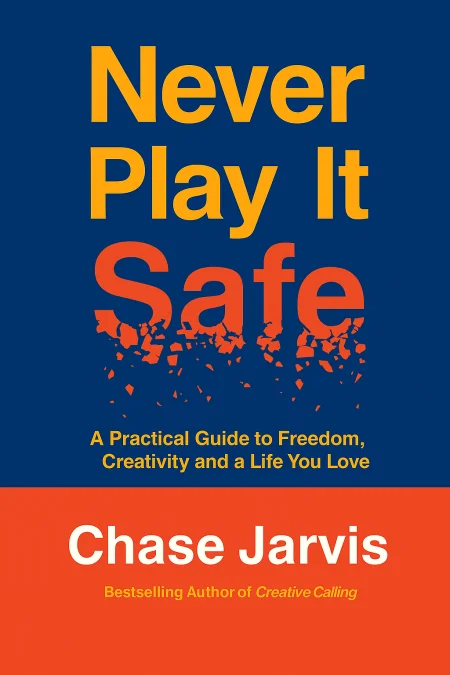
Never Play It Safe
A Practical Guide to Freedom, Creativity, and a Life You Love
Book Edition Details
Summary
Chase Jarvis dares you to dance on the edge of life's safety net in "Never Play It Safe," a manifesto for those yearning to break free from the shackles of fear. This isn’t just a guide; it's an invitation to reclaim your authentic self by trusting your instincts and embracing risk as a catalyst for creativity. Jarvis weaves tales of luminaries and everyday heroes who have crafted extraordinary lives from ordinary beginnings, offering seven transformative tools: attention, time, intuition, constraints, play, failure, and practice. With his keen insights and a narrative that pulsates with possibility, this book is your call to action—an electrifying reminder that your life is the grandest canvas you'll ever work on. Ready to take the leap? Your most vibrant self awaits.
Introduction
Deep down, you know you weren't meant to live in a box defined by someone else. That voice inside you whispers of bigger possibilities, of dreams you've pushed aside because they seemed too risky or impractical. Yet here you are, feeling the pull between the safety of conformity and the magnetic draw of your authentic self. The truth is, the very thing we've been taught to seek—safety—is actually the greatest risk of all. It's the risk of living only a fraction of your potential, of reaching your final days with the haunting question: "What if I had been brave enough to try?" The world needs what you have to offer, but first, you need to remember that you already possess everything required to build a life that lights you up from the inside out.
Master Your Inner Tools: Attention, Time, and Intuition
Your attention is your superpower, yet most people give it away freely to whatever demands it loudest. Consider Viktor Frankl, who survived the Nazi concentration camps by deliberately focusing his attention on treating suicidal patients and maintaining his sense of purpose, even in humanity's darkest hour. While others succumbed to despair, Frankl chose where to direct his mental energy, proving that even in the most extreme circumstances, we retain the freedom to choose our response. Frankl's story reveals a profound truth: what you pay attention to literally becomes your experience of life. When you scatter your focus across endless distractions, you scatter your power. But when you learn to direct your attention with intention, you reclaim control over your inner world. This isn't about positive thinking—it's about recognizing that your experience of reality is shaped by where you consistently place your focus. Time, too, is far more malleable than we've been taught. Those moments when you're completely absorbed in meaningful work, when hours pass like minutes, reveal time's true nature. You're not managing time—you're surfing it, catching waves of presence and flow. The secret lies in understanding that time expands when you're fully engaged with what matters most to you. Start by protecting your first 90 minutes of each day for your most important work, treating this time as sacred and non-negotiable. Then practice bringing your full attention to whatever task is before you, whether it's a creative project or washing dishes. Notice how this simple shift transforms both the quality of your work and your experience of time itself.
Transform Obstacles into Opportunities: Constraints and Play
What if the very limitations you've been fighting against are actually your greatest creative assets? Constraints force innovation in ways that unlimited resources never could. Chris Ballew of the Presidents of the United States of America discovered this when he started breaking guitar strings regularly. Instead of seeing this as a problem, he began experimenting with removing strings entirely, ultimately creating the unique two-string sound that would make his band famous and sell millions of records. Ballew's breakthrough came from embracing what seemed like a limitation. The constraint of fewer strings didn't restrict his creativity—it focused it, forcing him to find new ways to create music that no one had heard before. This is the paradox of constraints: they don't limit possibility, they concentrate it into something powerful and original. The same principle applies to your life. That tight budget might force you to be more resourceful and creative than you've ever been. The small apartment might teach you the beauty of simplicity. The demanding schedule might help you discover what truly matters most. Every constraint contains the seeds of breakthrough if you're willing to see it differently. Identify one limitation in your life that frustrates you most. Instead of fighting it, spend a week exploring how this constraint might actually be redirecting you toward a better solution. Ask yourself: "How might this limitation be protecting me from something worse, or pointing me toward something better?" Often, our biggest breakthroughs come not from removing obstacles, but from dancing with them creatively.
Embrace Failure as Your Greatest Teacher
Melissa Arnot Reid lay crying in her tent at 17,590 feet above sea level, not from the harsh conditions of Mount Everest base camp, but from overhearing fellow climbers question why she was attempting to summit without oxygen again after previous failures. She had already failed multiple times at this seemingly impossible feat, and the mountaineering community was losing faith in her abilities. But instead of quitting, she made a crucial decision: she stopped seeking others' approval and moved to a quieter part of the mountain where she could focus entirely on her goal. That shift in perspective changed everything. Reid went on to become the first American woman to summit Everest without oxygen, but only after five attempts. Her story reveals that failure isn't the opposite of success—it's the raw material from which success is built. Each failed attempt taught her something essential about the mountain, about her own capabilities, and about the mental game required for such an extraordinary achievement. The key insight from Reid's journey is that failure only becomes truly damaging when we let it define our identity rather than inform our strategy. She learned to replace "I'm afraid to fail" with "I'm afraid to live," recognizing that avoiding failure means avoiding the very experiences that make life meaningful. Every setback became data, every disappointment became wisdom, every "no" became redirection toward a better approach. When you face your next failure, resist the urge to either dismiss it quickly or dwell on it endlessly. Instead, conduct a brief but honest debrief: What worked? What didn't? What would you do differently? Then make one small adjustment and try again quickly. The faster you can move from failure to learning to action, the more resilient and capable you become.
Build Your Practice: From Vision to Reality
Stephen Curry didn't become the greatest shooter in basketball history through talent alone—he became legendary through the quality of his practice. Every shot he takes in practice is executed with the same precision and intentionality he brings to game-winning moments. His coaches note that he approaches each practice session with a clear purpose, constantly seeking ways to refine not just his shooting technique, but his very approach to practice itself. This isn't just about logging hours—it's about falling in love with the process of getting better. Curry's mastery reveals the three pillars that separate world-class performers from everyone else: relentless focus on fundamentals, genuine love for the process, and complete alignment between identity and action. He doesn't just practice shooting—he practices being the kind of person who never misses when it matters most. This identity-driven approach transforms practice from obligation into expression. The same principle applies to building any life you love. You must first envision the future version of yourself living that dream, then reverse-engineer the daily practices that person would naturally embody. If you want to be a successful entrepreneur, start thinking and acting like one today. If you want to be a published author, establish the daily writing practice that authors maintain. Your actions become votes for the kind of person you're becoming. Choose one area of your life where you want to see transformation. Write down three specific practices that the future version of yourself would do daily. Start with just five minutes a day of one practice, focusing more on consistency than intensity. Remember, you're not just building a skill—you're building an identity. Every time you show up, you're proving to yourself that you're the kind of person who follows through on their dreams.
Summary
The path to creative freedom isn't about avoiding risks—it's about developing the inner tools to navigate them with confidence and grace. As Viktor Frankl discovered in humanity's darkest hour, "Everything can be taken from a man but one thing: the last of the human freedoms—to choose one's attitude in any given set of circumstances, to choose one's own way." This choice, this fundamental freedom to respond rather than react, to create rather than conform, lives within you right now. Every constraint can become a catalyst, every failure can become fuel, every moment of attention can become a building block for the life you truly want. The world needs your unique contribution, but first you must be brave enough to stop playing it safe and start playing by your own rules. Your next chapter begins the moment you decide that your dreams are worth the risk of pursuing them.
Related Books
Download PDF & EPUB
To save this Black List summary for later, download the free PDF and EPUB. You can print it out, or read offline at your convenience.
By Chase Jarvis
