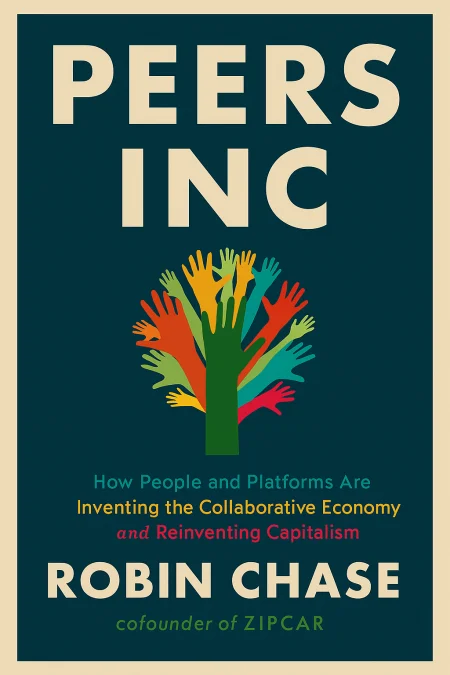
Peers Inc
How People and Platforms Are Inventing the Collaborative Economy and Reinventing Capitalism
Book Edition Details
Summary
What happens when the revolutionary spirit of the digital age collides with age-old corporate giants? In "Peers Inc," Robin Chase, the visionary mind behind Zipcar, unveils a transformative blueprint for the future of business. At its heart is a daring collaboration between nimble individuals and powerful institutions—a fusion that sparks innovation and reshapes capitalism as we know it. This compelling narrative reveals how such partnerships harness unused resources, accelerate growth, and tackle global challenges like climate change. Chase's insights paint a vivid picture of a new economic landscape, where the synergy between "Peers" and "Inc" not only invigorates industries but also paves the way for sustainable abundance. A must-read for anyone eager to glimpse the future's potential and embrace the power of shared success.
Introduction
Picture this: It's a rainy September morning in Cambridge, Massachusetts, and two mothers sit in a small café, watching their children's backpacks disappear around the corner toward school. One of them, Robin, has just heard something fascinating from her friend Antje about shared cars she'd seen in Berlin. What started as casual conversation between two parents would eventually transform how millions of people think about ownership, work, and collaboration itself. This moment captures something profound happening in our world today. We're witnessing the emergence of a new economic model that's quietly revolutionizing everything from how we travel and where we stay, to how we work and create value together. It's a transformation built on three simple yet powerful elements: the excess capacity that surrounds us everywhere, platforms that make sharing effortless, and the incredible power of people working together as peers. The old economy taught us to hoard resources, to build walls around our assets, and to compete rather than collaborate. But what if the path to abundance lies not in accumulating more, but in sharing what we already have more intelligently? What if the future belongs not to those who own the most, but to those who can orchestrate collaboration most effectively? This exploration reveals how platforms and peers are creating miracles of growth, learning, and innovation that seemed impossible just a decade ago, and how this collaborative revolution offers hope for addressing our greatest challenges while creating more meaningful, flexible ways to live and work.
From Zipcar to Global Movement: The Birth of Collaborative Economy
Robin Chase never imagined that her frustration with urban car ownership would spark a global movement. Living in Cambridge with three young children, she faced a common city dweller's dilemma: her husband drove their only car to his suburban office each morning, leaving it idle in a parking lot all day while she navigated the complex dance of school pickups, grocery runs, and after-school activities on foot or by public transit. When her friend Antje described the car-sharing service she'd discovered in Berlin, Robin immediately recognized both the problem and the solution. The idea was elegantly simple: instead of everyone owning a car they used only 5 percent of the time, why not share vehicles that could serve multiple people throughout the day? But turning this vision into reality required challenging every assumption the car industry held sacred. Investors scoffed at Robin's three core beliefs: that Americans would willingly share cars instead of owning them, that technology could make sharing effortless, and most radically, that ordinary people could be trusted to pick up and return cars without supervision. With just $50,000 in initial funding and a team small enough to fit around a kitchen table, Robin launched Zipcar in 2000. The first member, Craig, called within minutes of the website going live, eager to rent cars by the hour to transport his drum set to gigs and get to out-of-town triathlons. By the time Zipcar was sold to Avis thirteen years later, it had grown to 760,000 members sharing 10,000 cars across multiple countries, proving that people were indeed ready to choose access over ownership when the experience was designed thoughtfully. What Robin discovered wasn't just a better way to rent cars, but a glimpse into a fundamental shift in how value gets created in our interconnected world. The magic happened when three elements came together: excess capacity that was hiding in plain sight, a platform that made participation simple and safe, and peers who brought their own assets, creativity, and local knowledge to the collaboration. This wasn't just disruption for its own sake, but the emergence of a more efficient, more human way of organizing economic activity that would soon spread far beyond transportation.
The Three Miracles: Exponential Growth, Learning, and Innovation
When Airbnb's founders started renting air mattresses in their San Francisco apartment to conference attendees, they couldn't have imagined they were about to achieve something that defied the basic laws of physics and business. Traditional hotel chains like Intercontinental took sixty-five years to build their empire of 645,000 rooms across one hundred countries. The physical constraints seemed insurmountable: finding sites, buying land, securing financing, managing construction, hiring staff, and hoping demand would materialize in each location. Yet Airbnb accomplished something even more remarkable in just four years, reaching over 800,000 listings worldwide by 2014. This wasn't virtual growth in the digital realm, but real physical accommodations with actual beds, bathrooms, and breakfast tables. The secret lay in recognizing that the infrastructure already existed, scattered across millions of homes and apartments whose owners had spare bedrooms sitting empty most nights of the year. By creating a platform that made it simple and safe for ordinary people to become micro-hoteliers, Airbnb unlocked this vast reservoir of excess capacity and achieved growth rates that seemed to violate the fundamental constraints of the physical world. This phenomenon reveals the first miracle of collaborative platforms: they can achieve exponential growth by leveraging existing assets rather than building everything from scratch. The second miracle emerges in how these platforms learn and improve. Luis von Ahn's language learning platform Duolingo demonstrates this beautifully. Where a traditional college professor might teach thirty students per semester and have sixty opportunities to refine their methods over thirty years, Duolingo can run hundreds of experiments simultaneously with millions of learners, discovering the most effective teaching techniques in a matter of days rather than decades. The third miracle lies in the power of networked minds to solve problems with unprecedented speed and precision. When Harvard Medical School challenged the TopCoder community to develop new algorithms for genomic analysis, solvers from completely unrelated fields produced solutions that were one hundred times faster than existing approaches within just two weeks. The diversity of perspectives, rather than deep domain expertise, proved to be the key to breakthrough innovation. These three miracles reveal why collaborative platforms are becoming the dominant organizational form of our time. They can grow faster, learn quicker, and innovate more effectively than traditional hierarchical structures, offering a path forward for addressing challenges that seemed intractable when approached through conventional means.
Building Sustainable Platforms: Power, Trust, and Community
The journey from startup idea to sustainable platform is fraught with delicate balancing acts that determine whether a collaborative venture thrives or fails. Robin's experience with GoLoco, her ridesharing venture that followed Zipcar, illustrates how even the most promising concepts can stumble when the platform dynamics aren't quite right. Despite having learned from Zipcar's success, GoLoco struggled because Americans simply weren't ready to share car trips with strangers, no matter how elegant the technology or compelling the environmental benefits. Meanwhile, in France, Frédéric Mazzella was patiently building BlaBlaCar through four years of careful iteration, learning how to balance structure with freedom, quality with accessibility. The breakthrough came when he introduced rating systems that addressed trust concerns and a payment model that made the service convenient for both drivers and passengers. By 2013, BlaBlaCar had grown to 10 million users, moving more people monthly than the Eurostar train between Paris and London. The most successful platforms navigate through four distinct phases of development. They begin with a controlled kernel phase, where founders maintain tight control while figuring out the right balance of structure and openness. This evolves into an everyone-welcome phase of rapid growth, followed by a challenging power imbalance phase where the platform must resist the temptation to favor large players over individual peers. The ultimate goal is reaching power parity, where platforms and peers share influence in ways that sustain long-term collaboration. Airbnb exemplifies this evolution, creating trusted tester programs with experienced hosts, facilitating peer-to-peer communication through host groups, and maintaining transparency about policy changes. When hosts revolted against a seemingly minor change to listing displays, the company reversed course within twenty-four hours and invited the most vocal critics to join their advisory process. This responsiveness reflects a deeper understanding that platforms are not just technology companies, but stewards of communities whose success depends entirely on maintaining the trust and engagement of their peer collaborators. The platforms that endure are those that recognize they're building more than businesses—they're creating new forms of social and economic organization that require constant attention to power dynamics, community needs, and the delicate balance between individual autonomy and collective benefit.
Government's Role: Regulation, Protection, and Future Challenges
When President Reagan opened GPS technology to civilian use following the tragic downing of Korean Airlines Flight 007, he unknowingly launched one of history's most successful examples of government-created platforms for innovation. What began as a military navigation system became the foundation for countless innovations, from smartphone apps that guide us through unfamiliar cities to precision agriculture systems that optimize crop yields. The key to GPS's success lay in four principles: user choice in applications, no permission required for innovation, low barriers to entry, and platform neutrality that didn't favor any particular use case. This model offers a blueprint for how governments can foster innovation in the collaborative economy. Rather than trying to regulate every individual participant, smart policy focuses on creating open platforms and setting rules at the platform level. When taxi drivers in London staged massive protests against Uber, blocking traffic in Trafalgar Square, they highlighted the tension between old regulations designed for a different era and new technologies that make many of those rules obsolete. The requirement that London cabbies spend years memorizing every street made sense before GPS, just as rules about paper receipts made sense before electronic payments. The challenge for regulators is finding the sweet spot between too little oversight, which can leave workers and consumers vulnerable, and too much control, which stifles innovation and drives activity underground. Dan Doney's insight about the relationship between regulation and compliance reveals that beyond a certain point, more rules actually decrease compliance as people choose to operate outside the system entirely. The goal should be creating frameworks that protect legitimate interests while preserving the flexibility and accessibility that make collaborative platforms valuable. Perhaps most importantly, governments need to adapt social safety nets for an economy where more people work as independent contractors across multiple platforms rather than traditional employees. This means rethinking how we provide health insurance, retirement benefits, and worker protections in a world where the line between employee and entrepreneur is increasingly blurred. The 53 million Americans already working as freelancers represent not a temporary disruption, but a fundamental shift toward more autonomous, flexible ways of organizing work. The collaborative economy's success ultimately depends on creating regulatory frameworks that protect participants without crushing the innovation and accessibility that make these platforms transformative in the first place.
Summary
The collaborative revolution unfolding around us represents far more than a collection of clever apps and sharing services. It signals a fundamental shift from an economy built on scarcity and hoarding to one based on abundance and intelligent sharing. When Robin Chase sat in that Cambridge café listening to her friend describe car sharing in Berlin, she glimpsed a future where the excess capacity surrounding us everywhere could be transformed into shared prosperity and more meaningful ways of working and living. The three miracles of exponential growth, accelerated learning, and networked problem-solving reveal the extraordinary potential that emerges when platforms connect people's underutilized assets, skills, and creativity. Yet realizing this potential requires more than just technology—it demands new forms of governance that balance individual autonomy with collective benefit, regulatory frameworks that protect without stifling innovation, and business models that share power rather than concentrating it. The path forward isn't without challenges. We must ensure that the collaborative economy creates genuine opportunity rather than just new forms of exploitation, that the benefits reach beyond the privileged few, and that we preserve the human connections and community bonds that make sharing meaningful. But the examples throughout this transformation—from Airbnb hosts opening their homes to strangers, to citizen scientists contributing to breakthrough research, to cities crowdsourcing solutions to their most pressing problems—demonstrate our remarkable capacity for cooperation when given the right tools and incentives. The collaborative revolution offers not just more efficient ways of organizing economic activity, but a chance to build a world where individual creativity and collective wisdom combine to address our greatest challenges while creating more fulfilling, flexible, and connected lives for everyone.
Related Books
Download PDF & EPUB
To save this Black List summary for later, download the free PDF and EPUB. You can print it out, or read offline at your convenience.
By Robin Chase
