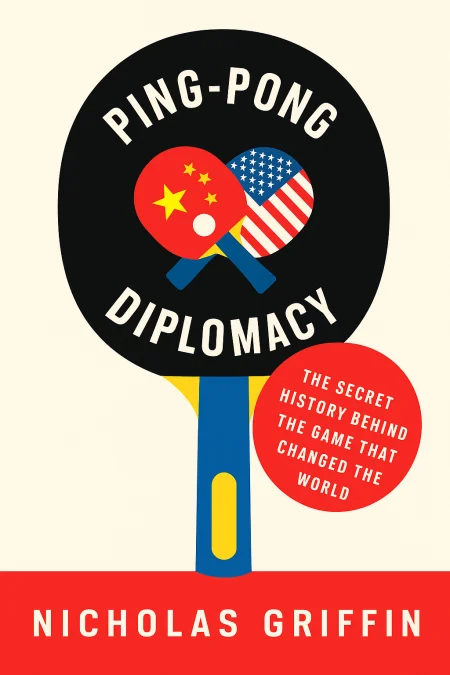
Ping-Pong Diplomacy
The Secret History Behind the Game That Changed the World
Book Edition Details
Summary
In the unlikeliest of alliances, diplomacy unfolds not in grand halls but at the humble ping-pong table. 1971 marked a seismic shift in world politics, orchestrated by the swish of paddles and the bounce of tiny balls. "Ping Pong Diplomacy" unveils how the seemingly innocuous sport of table tennis became a tool of geopolitical strategy, masterminded by Ivor Montagu, a British aristocrat with ties to Soviet espionage. Journey into the heart of Mao Zedong's China, where table tennis served as a mask for tragedy, covering the scars of famine and revolution. Through Griffin's vivid storytelling, meet a cast of eclectic characters—spies, hippies, and generals alike—who reveal how this overlooked sport spun its way into the fabric of international relations, bridging a two-decade chasm between East and West. This narrative isn’t just about sports; it’s about the unexpected paths to peace and the games nations play.
Introduction
In April 1971, a long-haired American hippie accidentally boarded a Chinese team bus in Japan, and within forty-eight hours, this chance encounter had cracked open the bamboo curtain that had separated the United States and Communist China for over two decades. What appeared to be a serendipitous moment was actually the culmination of a fifty-year journey that began with an English aristocrat's radical vision of sport as a weapon for global transformation. This extraordinary tale reveals how the world's smallest ball moved the largest pieces on the international chessboard, exposing the hidden connections between Communist ideology and athletic competition. The narrative spans from the drawing rooms of British nobility to the revolutionary caves of China, from Hollywood studios to the halls of the Kremlin, weaving together espionage, cultural revolution, and the delicate art of diplomacy. It demonstrates how table tennis served simultaneously as propaganda instrument and peace offering, showing that cultural exchanges can achieve what traditional statecraft cannot. For anyone fascinated by the intersection of sports and politics, the hidden mechanisms of Cold War maneuvering, or the surprising ways history pivots on seemingly insignificant human encounters, this story offers profound insights into how personal connections can transcend ideological barriers and reshape the destiny of nations.
The Communist Game: Montagu's Vision and China's Rise (1926-1961)
The story begins in 1920s Cambridge, where Ivor Montagu, son of a wealthy banking baron, discovered both Communism and table tennis with equal passion. This unlikely aristocratic revolutionary would spend the next four decades weaving these twin obsessions into a powerful instrument of international politics. Operating as a secret Soviet agent under the cover of sports administration, Montagu recognized that ping-pong possessed unique qualities that made it perfect for Communist ideology: it required minimal equipment, could be played in cramped spaces, and rewarded intelligence over brute strength. Montagu's masterstroke came in establishing the International Table Tennis Federation in 1926, creating a global network that would eventually span continents and political systems. Unlike other sports dominated by wealthy Western nations, table tennis offered smaller countries and emerging Communist states a genuine chance at international recognition. When the Chinese Communist Party seized power in 1949, they inherited a war-torn nation desperately seeking legitimacy on the world stage, and table tennis became their chosen vehicle for soft diplomacy. The transformation proved remarkable. Within a decade, Chinese players evolved from enthusiastic amateurs to world-beating professionals, culminating in Rong Guotuan's stunning victory at the 1959 World Championships. This triumph carried profound symbolic weight for a nation still reeling from the disasters of the Great Leap Forward. As millions starved in the countryside, the Communist leadership poured resources into their table tennis program, understanding that athletic success could mask political failures and project an image of strength to both domestic and international audiences. The 1961 World Championships in Beijing represented the full flowering of Montagu's vision. Despite the ongoing famine that would claim tens of millions of lives, China constructed a magnificent stadium and hosted teams from around the world, demonstrating that sport could indeed serve as diplomacy by other means. The Chinese team's dominant performance sent a clear message: the People's Republic had arrived as a force capable of excellence that transcended political boundaries.
Cultural Revolution Chaos: Sports Under Political Fire (1966-1970)
The euphoria of sporting success proved tragically short-lived as Mao Zedong unleashed the Cultural Revolution in 1966, turning Chinese society upside down in a convulsion of ideological purification. The table tennis team, once celebrated as national heroes, suddenly found themselves targets of suspicion and persecution. The very international connections that had made them valuable ambassadors now marked them as potential traitors in an atmosphere where any foreign contact could be construed as espionage. The human cost was devastating. Fu Qifang, the brilliant coach who had guided China to world dominance, was driven to suicide by relentless persecution. Rong Guotuan, the nation's first world champion, was found hanging from a tree under circumstances that suggested murder rather than suicide. These deaths represented more than personal tragedies; they symbolized the self-destructive madness of a revolution that devoured its own children while destroying the very achievements it had once celebrated. The surviving players faced a nightmarish existence of struggle sessions, public humiliation, and forced labor. Zhuang Zedong, the three-time world champion, endured beatings and torture while being forced to denounce his former mentors. The entire sports system was dismantled, with athletes sent to remote farms to learn from peasants. The 1967 and 1969 World Championships passed without Chinese participation, marking the first time since 1953 that the nation had withdrawn from international competition. Yet even in this darkest period, the seeds of future diplomatic breakthrough were being planted. Premier Zhou Enlai, walking a dangerous tightrope between revolutionary fervor and pragmatic governance, quietly protected key players and officials, understanding that China's isolation could not continue indefinitely. The table tennis program, though battered and bloodied, survived because Zhou recognized that sport might once again serve as a bridge to the outside world when the political winds inevitably shifted.
Diplomatic Breakthrough: The American Team Opens China (1971-1972)
The miraculous resurrection began in 1971 when Zhou Enlai made the calculated decision to send China's table tennis team to the World Championships in Nagoya, Japan. This marked the beginning of the most audacious diplomatic gambit of the Cold War era. The stage was set when Glenn Cowan, an unlikely American hippie with flowing hair and counterculture attitudes, approached Chinese player Liang Geliang for a practice session, unknowingly triggering a carefully orchestrated sequence of events that would reshape global politics. Zhuang Zedong's decision to present Cowan with a silk-screen portrait on the team bus was far from spontaneous. Armed with gifts specifically chosen for American dignitaries and operating under explicit instructions from Beijing, Zhuang executed a masterpiece of public diplomacy. The photographs of the two young men smiling together flashed around the world, providing the perfect visual metaphor for the possibility of Sino-American friendship. Chairman Mao himself studied these images, recognizing their propaganda value and authorizing the next phase of the operation. The invitation for the American team to visit China represented a diplomatic revolution disguised as a sporting exchange. For the first time since 1949, Americans would walk the streets of Beijing as welcomed guests rather than ideological enemies. The week-long tour was choreographed with exquisite precision, from the carefully controlled crowds at exhibition matches to the climactic meeting with Zhou Enlai in the Great Hall of the People. Every detail served the larger strategic purpose of demonstrating China's readiness to engage with the outside world. The impact was immediate and profound. American public opinion toward China shifted dramatically, with polls showing majority support for Chinese admission to the United Nations for the first time. President Nixon and Henry Kissinger, who had been secretly seeking contact with Beijing through Pakistani intermediaries, suddenly found their diplomatic channels flooded with Chinese responses. Within months, Kissinger was on a secret flight to Beijing, and Nixon was planning his own historic visit, proving that table tennis had achieved what decades of formal diplomacy could not.
Cold War's End: Political Price of Ping-Pong Success
The triumph of ping-pong diplomacy came with unexpected costs for those who had made it possible. Glenn Cowan, thrust into the spotlight as an unlikely ambassador of peace, struggled to cope with sudden fame and the crushing weight of expectations. His mental health deteriorated rapidly after returning from China, leading to a tragic spiral of homelessness, drug abuse, and eventual death on a Venice Beach street corner. The young man who had helped change the world found himself unable to navigate the world he had helped create. Zhuang Zedong's fate proved even more dramatic, illustrating the dangerous intersection of sports and politics in Communist China. His success as a ping-pong diplomat led to rapid political advancement, culminating in his appointment as Minister of Sports. However, his alliance with Jiang Qing and the Gang of Four during the final years of the Cultural Revolution proved disastrous. When Mao died and the political winds shifted, Zhuang found himself imprisoned, spending four years in solitary confinement before being exiled to sweep streets in the same province where he had once sent others for reeducation. The broader consequences of ping-pong diplomacy reshaped the global balance of power. The Sino-American rapprochement fundamentally altered the Cold War's strategic calculus, forcing the Soviet Union into a defensive posture that would ultimately contribute to its collapse. China's integration into the international community, beginning with UN membership and expanding through economic reforms, transformed it from an isolated revolutionary state into a global superpower. The small white ball had indeed, as Zhou Enlai predicted, shaken the entire world. For Ivor Montagu, the architect of political ping-pong, the success of 1971 represented both vindication and irony. His vision of sport as diplomacy had been brilliantly realized, but in service of American rather than Soviet interests. The game he had crafted as a weapon for Communist revolution had become an instrument of capitalist engagement. By the time of his death in 1984, the world he had helped create through table tennis bore little resemblance to the one he had originally envisioned, proving that even the most carefully laid plans can produce utterly unexpected consequences.
Summary
The extraordinary saga of ping-pong diplomacy reveals how cultural exchanges can transcend the most entrenched political divisions, offering profound lessons for our interconnected yet fractured world. At its heart, this story illuminates the fundamental tension between ideological purity and pragmatic engagement, showing how the pursuit of absolute political goals often destroys the very people it claims to serve, while genuine human connections can bridge seemingly unbridgeable divides. The tragic fates of Glenn Cowan and Zhuang Zedong remind us that individuals caught in the machinery of great power politics often pay the highest price for diplomatic breakthroughs they help create. Their sacrifices underscore the importance of protecting human dignity even as we pursue larger strategic objectives. Meanwhile, the success of table tennis as a diplomatic tool demonstrates that soft power approaches, built on shared interests and mutual respect, can achieve what military threats and economic sanctions cannot. For today's leaders facing similar challenges of international engagement, this history offers three crucial insights: first, that cultural exchanges and people-to-people connections remain among the most powerful tools for building trust between adversaries; second, that timing and symbolism matter enormously in diplomacy, requiring patience and careful orchestration; and third, that the most effective diplomatic initiatives often emerge from unexpected quarters rather than traditional channels. In our current era of renewed great power competition, the ping-pong diplomacy model suggests that breakthrough moments may come not from summit meetings or trade negotiations, but from the creative spaces where human curiosity and genuine friendship can flourish despite political barriers.
Related Books
Download PDF & EPUB
To save this Black List summary for later, download the free PDF and EPUB. You can print it out, or read offline at your convenience.
By Nicholas Griffin
