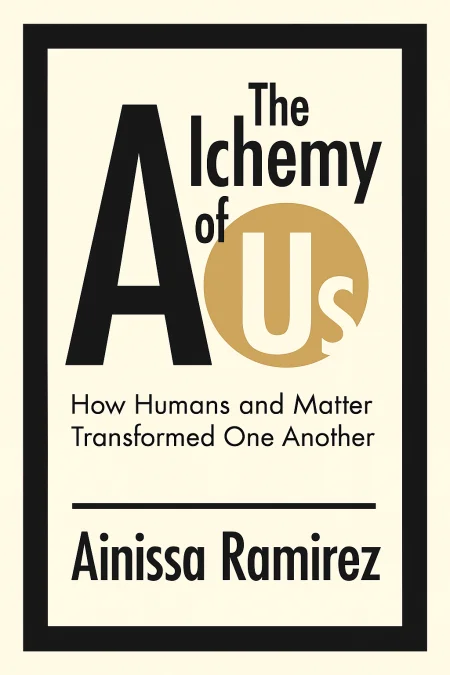
The Alchemy of Us
How Humans and Matter Transformed One Another
Book Edition Details
Summary
Time isn't just ticking; it's rewriting the rhythm of life. In Ainissa Ramirez's "The Alchemy of Us," the pulse of innovation beats through eight pivotal inventions, each a chapter in the saga of human transformation. From the precision of clocks altering our sleep to copper cables weaving a web of communication, Ramirez unveils how these materials molded society and culture. Meet the unsung heroes—women and people of color—who shaped history against the odds, their stories often eclipsed by myths and biases. This narrative offers a kaleidoscope of perspectives, challenging us to see the fingerprints of technology on our collective soul. With a vibrant tapestry of anecdotes, this book isn't just about the past—it's a dialogue with the future, urging us to recognize the universal language of innovation.
Introduction
Every morning when you wake up, you're surrounded by an invisible orchestra of materials that have quietly revolutionized human civilization. The steel springs in your mattress, the glass in your windows, and the copper wires carrying electricity through your walls each represent profound moments when humans discovered how to manipulate matter itself. These materials didn't just change what we could build; they fundamentally altered how we live, work, and connect with one another. The invention of accurate timekeeping didn't just help us arrive on schedule—it completely transformed how we sleep, restructuring our natural rhythms in ways we're only now beginning to understand. Telegraph wires that first carried messages across continents didn't merely speed up communication—they compressed our language, making it more direct and efficient in ways that still influence how we text today. This exploration reveals the hidden stories of revolutionary materials and shows how each one didn't just serve humanity, but actively shaped our culture, our bodies, and our minds in return. You'll discover how steel helped manufacture our modern sleep patterns, how specialized glass unlocked the secrets of the electron, and how simple innovations may be quietly affecting our health in ways their inventors never imagined.
Precision Steel and the Great Sleep Revolution
The story of modern timekeeping begins with a frustrated clockmaker named Benjamin Huntsman, who grew so annoyed with his unreliable timepieces that he revolutionized steelmaking itself. In 18th-century England, Huntsman's clocks kept poor time because their metal springs were inconsistent—some breathed too quickly, others too slowly, like a chest cavity with irregular rhythms. The problem lay in the steel's composition: impurities and uneven mixing made springs that would hiccup or stretch unpredictably. Huntsman's solution was elegantly simple yet revolutionary—he would melt the metal completely, allowing ingredients to blend uniformly while unwanted particles floated to the surface like oil on water. This breakthrough in metallurgy enabled the creation of precision timepieces, but the consequences rippled far beyond clockmaking. As accurate timekeeping spread throughout society, it fundamentally altered one of humanity's most basic behaviors: how we sleep. Before the Industrial Revolution, our ancestors practiced "segmented sleep"—they would sleep for three and a half hours, wake up naturally around midnight for an hour of quiet activities, then return to bed for another three and a half hours. This pattern, documented in literature from ancient texts to Charles Dickens, was the natural human rhythm for over two thousand years. The rise of clock-based living gradually erased this ancient sleep pattern. As society became obsessed with punctuality and efficiency, the leisurely midnight interval began to seem like wasted time. Factory bells dictated when to start and stop work, and family life synchronized around these mechanical rhythms. By the early 20th century, segmented sleep had vanished entirely, replaced by our modern expectation of eight hours of continuous rest. Today, sleep researchers suggest that many of our modern sleep disorders may actually be echoes of our ancestral segmented sleep pattern, our bodies still remembering rhythms that clocks convinced us to abandon.
Glass Chemistry Unlocking Scientific Discovery
The transformation of raw materials into precise scientific instruments represents one of humanity's greatest intellectual leaps, and nowhere is this more evident than in the development of specialized glass. In the late 19th century, German scientist Otto Schott revolutionized glassmaking by systematically exploring how different chemical elements affected glass properties. Using Dmitri Mendeleev's newly published Periodic Table as his guide, Schott treated the elements like ingredients on a restaurant menu, methodically testing combinations to create glasses with specific characteristics. Schott's breakthrough ingredient was boron, derived from common borax detergent. By varying the amount of boron in his glass recipes, he could create materials with dramatically different properties—much like a chef adjusting spice levels to create mild, medium, or hot sauces. Small amounts of boron improved optical clarity for microscopes and telescopes. Large amounts created glass that resisted thermal expansion, perfect for thermometers that needed to return to accurate baseline readings after heating. Medium amounts produced glass that could withstand harsh chemicals, essential for laboratory work. This scientific approach to glassmaking had profound implications beyond the laboratory. When World War I disrupted German glass exports, American companies like Corning were forced to reverse-engineer these formulations. Through systematic experimentation, Corning developed Pyrex glass, which revolutionized home cooking when it was discovered that this laboratory-grade glass allowed radiant heat to penetrate food directly, cooking more evenly than traditional metal pans. Perhaps the most significant discovery enabled by specialized glass was the electron itself. In 1897, physicist J.J. Thomson used carefully crafted glass vacuum tubes to solve the mystery of cathode rays. Working with skilled glassblowers, Thomson created an elaborate glass obstacle course that revealed cathode rays were actually streams of tiny, negatively charged particles—electrons. This discovery, made possible only by glass's unique combination of transparency, electrical insulation, and ability to maintain a vacuum, opened the door to our entire electronic age. Every computer chip, smartphone, and digital device traces its lineage back to Thomson's glass tubes and the fundamental particles they revealed.
Telegraph Wires Compressing Human Language Forever
The story of modern communication begins with a profound personal tragedy that motivated one of history's most important inventions. Samuel Morse, a struggling artist, learned of his wife's death through a letter that arrived days after her burial. The agonizing delay of this news haunted him and drove his obsession with instantaneous communication. When Morse encountered the concept of electrical transmission during a sea voyage in 1832, he immediately envisioned a system that could carry messages at the speed of lightning itself. Morse's telegraph represented more than just faster communication—it fundamentally restructured human language. The constraints of the system, from the pricing structure that charged by the word to the limited capacity of telegraph lines, forced users to compress their thoughts into the most essential elements. Morse himself instructed operators to "condense your language more" and "leave out unnecessary words whenever possible." This technological pressure cooker transformed communication, making it more direct and economical than ever before. The telegraph's influence on language became most apparent in newspaper writing, where reporters competed for limited transmission time. Young Ernest Hemingway, working at the Kansas City Star, learned to write in the telegraphic style that would later make him famous. The newspaper's style guide demanded "short sentences," "vigorous English," and urged writers to "eliminate every superfluous word." What seemed like a literary innovation was actually the telegraph's invisible hand shaping the very structure of modern prose. This compression of language had unexpected cultural consequences. The telegraph enabled the rapid spread of news during major events, creating the first truly national media experiences. Daily bulletins transmitted instantly across the country bonded disparate communities together in shared concern or celebration. However, this same technology that brought people together also began to erode the human elements of communication. The telegraph's emphasis on brevity stripped away emotional nuance, reducing complex feelings to stark, essential facts—a pattern that continues today in our text messages and social media posts, proving that the medium truly shapes the message in ways that outlast the technology itself.
Hidden Costs of Progress and Unintended Consequences
The materials that enabled human progress often carried hidden costs that only became apparent generations later. Photographic film, celebrated as the great democratizer that could capture anyone's likeness regardless of social status, actually embedded cultural biases directly into its chemical formulation. The film was calibrated using reference standards featuring pale skin tones, which meant that the chemistry was optimized to render light skin accurately while struggling to capture the full range of darker skin tones. The consequences of this bias became painfully evident in integrated schools after civil rights advances. African American parents noticed that in class photos, their children appeared as dark silhouettes while white children were clearly visible. The film couldn't simultaneously capture both light and dark skin because its chemistry favored one range over another. This wasn't an oversight—it was the inevitable result of designing technology around a single standard without considering its broader implications. Even more troubling was the use of photographic technology to support oppressive systems. Instant cameras became essential tools for South Africa's apartheid regime, enabling the rapid production of identification photos for documents that controlled the movement of Black South Africans. When employees discovered this connection, their campaign to force corporate withdrawal from South Africa demonstrated how individual actions could challenge technological complicity in injustice. The electric light bulb, celebrated as the invention that banished darkness from human civilization, has created its own set of unintended consequences. Our bodies evolved over millions of years to respond to natural light cycles, using the blue light of daytime skies to regulate our internal clocks. Artificial lighting, especially the blue-rich LED lights now common everywhere, disrupts these ancient rhythms by keeping our bodies in a perpetual daytime mode. This constant exposure to growth-promoting hormones may contribute to increased cancer rates, while light pollution has made the star-filled night sky invisible to most people. Even fireflies are disappearing as artificial lights interfere with their mating signals, reminding us that our technological progress often comes at the expense of the natural world that shaped us, demonstrating that every innovation carries within it the seeds of unforeseen transformation.
Summary
The central revelation of this exploration is that materials and humans exist in a continuous dance of mutual transformation—we shape our tools, and in return, they reshape us in ways both visible and invisible. From the steel springs that altered our sleep patterns to the photographic chemicals that captured cultural biases, every material innovation carries within it the power to restructure society, language, and even our biology. This understanding challenges us to approach future technologies with greater wisdom, asking not just what our innovations can do for us, but how they might change who we are. As we stand on the threshold of new material revolutions—from smart materials that respond to their environment to nanotechnology that operates at the molecular level—we must remember that the most profound impacts often emerge not from a technology's intended purpose, but from its unexpected influence on human culture and consciousness. The question becomes: how might we design tomorrow's materials to enhance rather than diminish our humanity, and what ancient wisdom might we need to preserve as we continue this eternal dance between human creativity and material possibility? Understanding this dynamic relationship between innovation and unintended consequences becomes crucial for navigating our technological future more thoughtfully than our predecessors.
Related Books
Download PDF & EPUB
To save this Black List summary for later, download the free PDF and EPUB. You can print it out, or read offline at your convenience.
By Ainissa Ramirez
