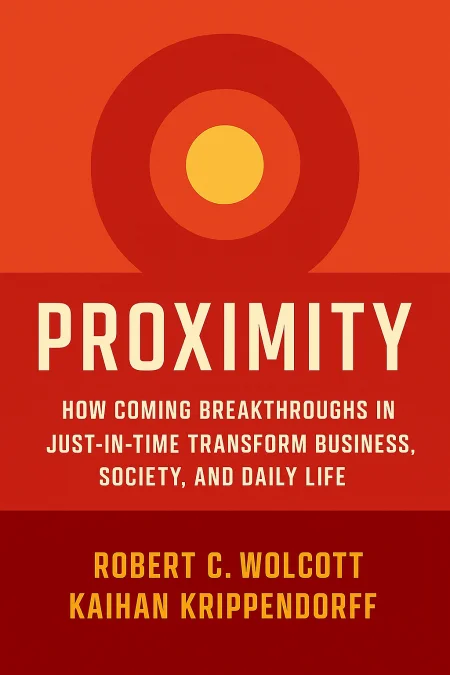
Proximity
Just-In-Time Breakthroughs to Transform Business and Life
byRobert C. Wolcott, Kaihan Krippendorff
Book Edition Details
Summary
In a world teetering on the brink of technological upheaval, the power to conjure desires at the snap of a finger is no longer a fantasy. "Proximity" by Robert C. Wolcott and Kaihan Krippendorff unravels the dawn of an era where digital innovation transforms the ordinary into the extraordinary. This visionary guide delves into the seismic shifts reshaping industries and daily life, as new-age technologies birth a realm of instant gratification with an eco-conscious heart. As the fabric of commerce, policy, and sustainability morphs before our eyes, "Proximity" offers a strategic compass for those daring enough to navigate and thrive in this brave new world. A must-read for visionaries and pioneers, this book is your blueprint for harnessing the winds of change, empowering not just business leaders but everyone eager to understand the vast implications for our shared future.
Introduction
Digital technologies are fundamentally reshaping the relationship between supply and demand, creating unprecedented possibilities for producing and delivering value exactly where and when it is needed. This transformation represents more than mere technological advancement; it constitutes a paradigm shift toward what can be termed "proximity" - the convergence of production and provision toward the precise moment and location of consumer need. The traditional industrial model, built on economies of scale and centralized production, increasingly confronts constraints that digital capabilities can overcome. From 3D printing pharmaceuticals in remote military outposts to vertical farms growing fresh produce in urban centers, evidence accumulates that proximity-based solutions can simultaneously achieve greater customization, reduced waste, enhanced sustainability, and improved customer satisfaction. This convergence challenges fundamental assumptions about trade-offs between efficiency and responsiveness, scale and flexibility, standardization and personalization. The argument presented here extends beyond individual technological applications to propose a comprehensive framework for understanding how proximity principles - moment-of-use production, ecosystem-wide data analytics, true customer centricity, and adaptive learning systems - are creating competitive advantages across industries. The analysis examines both the transformative potential and inherent challenges of this shift, questioning whether organizations and societies possess the wisdom to harness proximity's benefits while mitigating its risks.
The Core Argument: Technology Enables P=0 Production
The central thesis posits that digital technologies enable production and provision to approach what is termed "Proximity = 0" or P=0 - the theoretical point where supply instantaneously matches demand in both space and time. This concept transcends simple efficiency improvements to represent a fundamental reimagining of value creation processes. Traditional manufacturing and service delivery models require extensive prediction of future demand, creating costly inefficiencies through inventory management, waste disposal, and supply chain complexity. The P=0 framework suggests that digital technologies - including artificial intelligence, additive manufacturing, IoT sensors, and advanced analytics - enable businesses to postpone value-added activities until actual demand materializes. This shift from prediction-based to response-based models eliminates much of the guesswork that drives traditional business inefficiencies. The pharmaceutical production example illustrates this principle in action. Rather than manufacturing millions of identical pills months in advance and distributing them globally through complex supply chains, proximity technologies enable on-demand synthesis of specific medications at precise dosages when and where patients need them. Raw materials like hydrogen and carbon remain stable indefinitely, while finished pharmaceuticals expire within years, creating inherent waste in traditional models. This technological capability transforms the fundamental economics of customization. Where personalized production once required prohibitive costs, digital technologies increasingly enable mass customization at scales approaching mass production efficiency. The implications extend far beyond manufacturing to encompass services, experiences, and entirely new categories of value creation that become possible only when supply can respond instantaneously to demand.
Supporting Evidence: Industry Transformations Toward Proximity
Evidence for proximity's transformative potential emerges across diverse industries, each demonstrating how digital technologies overcome traditional constraints between responsiveness and efficiency. The controlled environment agriculture sector exemplifies this transformation, where vertical farms achieve yields 100 to 300 times greater than traditional agriculture while requiring 90 percent less water and 95 percent less fuel for transportation. Healthcare applications reveal proximity's life-saving potential through always-on monitoring systems that detect threats before symptoms appear, coupled with point-of-care pharmaceutical production that eliminates supply chain vulnerabilities. Sweden's deployment of defibrillator-carrying drones represents proximity in action - life-saving interventions delivered within critical time windows that traditional emergency response systems cannot achieve. The energy sector demonstrates proximity through distributed renewable resources that enhance grid resilience while reducing transmission losses. Virtual power plants coordinate thousands of small-scale generators to provide utility-scale capacity without requiring massive centralized facilities, while microgrids ensure continued power availability despite broader system failures. Texas's 2021 power crisis illustrates the vulnerabilities of centralized systems that proximity-based solutions could help prevent. Manufacturing industries showcase proximity through additive manufacturing that produces complex components on-demand without traditional tooling requirements, inventory management, or supply chain coordination. Companies like Allegheny Technologies develop specialized metal powders that enable 3D printing of components previously impossible to manufacture, while Levi Strauss implements laser-finishing systems that customize jeans at the point of sale rather than months in advance during mass production cycles. These examples demonstrate how proximity enables both greater customization and reduced environmental impact through elimination of overproduction and waste.
Conceptual Framework: Four Principles of Proximate Models
Proximity operates through four interconnected principles that distinguish truly proximate business models from incremental improvements to existing systems. Moment-of-use production represents the foundational principle, requiring organizations to design capabilities that can respond to actual rather than predicted demand. This principle extends beyond manufacturing to encompass services and experiences that can be generated in real-time based on specific customer contexts and preferences. Data and analytics across competitive ecosystems form the second principle, recognizing that proximity requires unprecedented visibility and coordination across traditional industry boundaries. Successful proximity models leverage real-time data sharing between suppliers, manufacturers, distributors, and customers to enable rapid response to changing conditions. This ecosystem approach contrasts sharply with traditional models that hoard information as competitive advantage, instead treating shared intelligence as a foundation for collective responsiveness. True customer centricity constitutes the third principle, moving beyond market research and customer feedback to real-time adaptation based on individual customer behaviors and preferences. Proximity models organize around customer demands rather than operational constraints, using technology to overcome traditional trade-offs between personalization and efficiency. This approach requires fundamental shifts in organizational design, performance metrics, and strategic decision-making processes. Real-time learning and adapting systems represent the fourth principle, enabling continuous improvement and evolution based on accumulated experience across all customer interactions. Unlike traditional systems that update periodically based on aggregated data, proximity models learn and adapt continuously, using artificial intelligence and analytics to identify patterns and optimize responses in real-time. This capability enables proximity models to become more effective over time, creating sustainable competitive advantages that compound rather than diminish.
Future Implications: Challenges and Opportunities Ahead
The trajectory toward proximity presents both unprecedented opportunities and significant challenges that will shape the next decades of technological and social development. Space exploration exemplifies proximity's ultimate frontier, where long-duration missions require complete self-sufficiency and the ability to produce whatever might be needed from available resources. These extreme conditions accelerate innovation in proximity technologies that subsequently benefit terrestrial applications. Virtual worlds represent another frontier where proximity approaches its theoretical limits, enabling any experience to be generated on-demand regardless of physical location. As virtual and augmented reality technologies mature, the distinction between physical and digital proximity may dissolve, creating new categories of value creation and human experience. However, this potential raises profound questions about human agency, attention, and the nature of reality itself. The social and economic implications of widespread proximity adoption remain largely unexplored. While proximity models promise greater sustainability through reduced waste and enhanced efficiency, they also enable potentially problematic levels of instant gratification and surveillance. The same technologies that enable personalized medicine and sustainable agriculture could facilitate unprecedented manipulation and control of human behavior. Distributed capabilities inherent in proximity models create distributed risks that traditional centralized systems avoided. Widespread 3D printing capabilities could enable local production of beneficial products while simultaneously making dangerous items more accessible. Always-on health monitoring provides invaluable medical insights while creating new vulnerabilities to cyber attacks and privacy violations. The challenge lies not in avoiding these risks but in developing governance systems and social norms that maximize proximity's benefits while minimizing its potential for harm.
Summary
Proximity represents more than technological advancement; it embodies a fundamental shift toward aligning production and provision with the precise spatial and temporal coordinates of human need. The convergence of artificial intelligence, additive manufacturing, renewable energy, and ubiquitous connectivity creates unprecedented possibilities for eliminating the waste, delay, and inefficiency inherent in prediction-based systems while simultaneously enabling previously impossible levels of customization and responsiveness. The question is not whether proximity will transform industries and societies, but whether humanity possesses the wisdom to harness these capabilities in service of flourishing rather than mere convenience, creating worlds we desire rather than simply satisfying immediate impulses.
Related Books
Download PDF & EPUB
To save this Black List summary for later, download the free PDF and EPUB. You can print it out, or read offline at your convenience.
By Robert C. Wolcott
