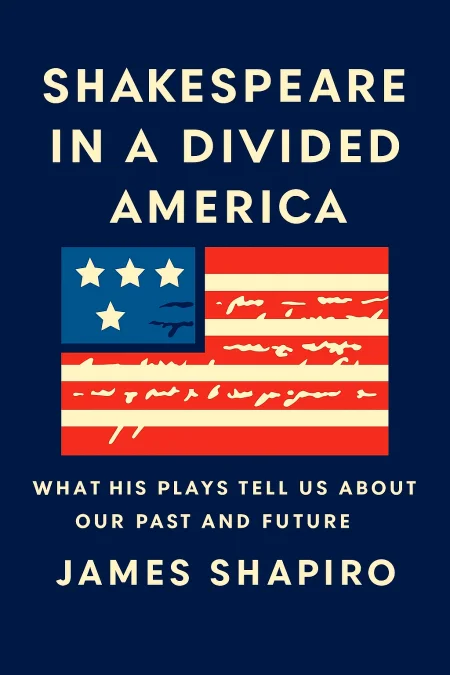
Shakespeare in a Divided America
What His Plays Tell Us About Our Past and Future
Book Edition Details
Summary
In the theater of American history, Shakespeare takes center stage, wielding his quill as both a mirror and magnifying glass for a nation divided. James Shapiro's "Shakespeare in a Divided America" is not just a scholarly pursuit; it’s a vibrant tapestry weaving together past and present through the Bard’s enduring legacy. From the fiery debates of manifest destiny to the charged discussions of race and gender, Shapiro illuminates how Shakespeare’s plays have been invoked—and sometimes weaponized—by figures ranging from presidents to activists. With an astute eye, Shapiro reveals how these centuries-old narratives have been reimagined in America’s cultural wars, echoing through the halls of power and the streets alike. As we traverse from Lincoln’s obsession to contemporary controversies like the 2017 Julius Caesar uproar, this book invites readers to see Shakespeare not as a relic, but as a living dialogue partner in the quest to heal a fractured nation.
Introduction
In the smoky theaters of nineteenth-century New York, audiences didn't just watch Shakespeare—they participated, cheering heroes and hissing villains with a passion that could turn deadly. When British actor William Macready took the stage in 1849, the evening ended not with applause but with military gunfire and dozens of corpses in the streets. This wasn't merely a theatrical riot; it was America wrestling with its own identity through the words of England's greatest playwright. For over four centuries, Americans have turned to Shakespeare not just for entertainment, but as a mirror reflecting their deepest anxieties and aspirations. From John Quincy Adams's disturbing essays about interracial marriage in Othello to John Wilkes Booth's identification with Brutus, from immigrant communities performing in massive pageants to contemporary culture wars over Julius Caesar, Shakespeare's plays have become the stage upon which America's most contentious debates have played out. These stories reveal how a nation has used literature to grapple with questions of race, class, gender, immigration, and power—questions that remain urgently relevant today. This exploration will appeal to anyone curious about how culture shapes politics, how art reflects social tensions, and how the past illuminates our present divisions. Through these forgotten episodes, we discover that America's relationship with Shakespeare tells us less about the playwright himself than about who we are as a people and what we're still fighting to become.
Early Republic Contradictions: Race, Democracy and Othello (1833-1865)
The young American republic faced a fundamental contradiction that would shape its destiny: how could a nation founded on liberty and equality justify the enslavement of millions? This tension found unexpected expression in drawing rooms and theaters where educated Americans debated Shakespeare's Othello, a play that forced uncomfortable questions about race, marriage, and human nature into polite conversation. John Quincy Adams, the former president and leading abolitionist, shocked contemporaries in 1835 by publishing essays condemning Desdemona for her "unnatural passion" in marrying a black man. Adams argued that her elopement with Othello violated natural law, and that her murder was just punishment for this transgression. His stance seemed paradoxical—how could someone fighting to end slavery simultaneously argue that interracial love was abhorrent? The answer reveals the tortured logic of even progressive Americans who could oppose slavery while maintaining white supremacy. Meanwhile, British actress Fanny Kemble arrived in America as a celebrated performer, only to discover through marriage that she had become mistress to hundreds of enslaved people on a Georgia plantation. Her private journals recorded the sexual exploitation she witnessed, challenging the very arguments that men like Adams made about the unnaturalness of racial mixing. The reality was that white masters routinely impregnated enslaved women, while simultaneously criminalizing consensual relationships between races. These debates over Othello weren't academic exercises—they were rehearsals for the coming crisis. As Adams himself predicted, the nation's failure to resolve the contradiction between freedom and bondage would lead inexorably to civil war. The same moral blindness that allowed educated Americans to condemn fictional interracial love while ignoring real racial violence would ultimately tear the country apart, leaving over 700,000 dead in its wake.
Industrial Democracy Crisis: Class Warfare and Theatrical Violence (1845-1916)
As America industrialized and urbanized in the mid-nineteenth century, Shakespeare became a battleground for competing visions of democracy and cultural authority. The transformation was most visible in New York City, where massive immigration and growing wealth inequality created explosive social tensions that would ultimately erupt in the deadly Astor Place riots of 1849. The conflict ostensibly centered on a rivalry between two actors—the refined British tragedian William Macready and the populist American star Edwin Forrest—but it actually reflected much deeper anxieties about class, nationality, and cultural ownership. When working-class New Yorkers stormed the elite Astor Place Opera House to protest Macready's performance, they were asserting their right to participate in cultural conversations previously dominated by the wealthy. The National Guard's decision to fire into the crowd, killing at least twenty-two people, demonstrated how far the establishment would go to maintain cultural control. These battles coincided with America's aggressive territorial expansion and the ideology of Manifest Destiny. Young officers like Ulysses S. Grant performed Shakespeare in military camps during the Mexican-American War, using the plays to explore questions of honor, ambition, and national purpose. The popularity of cross-dressed performances, particularly Charlotte Cushman's acclaimed Romeo, suggested growing anxieties about gender roles in a rapidly changing society. The period's most tragic culmination came with John Wilkes Booth's assassination of Abraham Lincoln in 1865. Booth, an accomplished Shakespearean actor, saw himself as Brutus striking down a tyrant, demonstrating how completely the plays had penetrated American political consciousness. His crime revealed the dangerous potential of cultural appropriation, showing how the same texts that inspired Lincoln's vision of national unity could be twisted to justify political violence and racial hatred.
Modern Social Transformation: Gender Roles and Cultural Negotiation (1948-1998)
The aftermath of World War II created unprecedented opportunities and anxieties for American women, as millions who had entered the workforce during wartime faced pressure to return to traditional domestic roles. This cultural tension found perfect expression in the 1948 Broadway musical Kiss Me, Kate, which used Shakespeare's The Taming of the Shrew to explore the complex negotiations between men and women in postwar America. The musical's genius lay in its double structure, contrasting the patriarchal world of Shakespeare's Renaissance comedy with the more liberated backstage reality of 1940s theater. While the frontstage action celebrated traditional gender hierarchies and male dominance, the backstage plot featured independent career women making their own choices about work, relationships, and sexuality. This duality allowed audiences to have it both ways—enjoying the fantasy of female submission while acknowledging the reality of women's growing autonomy. The show's creators—producer Arnold Saint Subber, writer Bella Spewack, and composer Cole Porter—were all outsiders who understood the performance of social roles. As a gay man, Jewish immigrant, and disabled artist respectively, they brought personal experience of marginalization to their exploration of how Americans navigated competing expectations. Their collaboration produced one of the most enduring American musicals, one that captured the contradictions of a society struggling to define postwar gender relations. By the 1990s, these cultural negotiations had evolved into new forms, as seen in the phenomenal success of Shakespeare in Love. The film's troubled production history, marked by Harvey Weinstein's interference and sexual misconduct, reflected ongoing struggles over women's agency in American culture. The movie's ultimate retreat from more progressive possibilities—including explorations of same-sex desire and female independence—demonstrated the continued power of conservative cultural forces even in supposedly liberal Hollywood.
Contemporary Polarization: Cultural Wars and Interpretive Breakdown (2017-Present)
The 2017 controversy over Julius Caesar in New York's Central Park revealed how completely America's cultural consensus had collapsed, replaced by tribal warfare that made meaningful dialogue nearly impossible. When protesters stormed the stage to disrupt a production they saw as promoting violence against President Trump, they demonstrated how Shakespeare had become another casualty of the nation's political polarization. The incident exposed the sophisticated machinery of modern outrage, as right-wing media outlets transformed a single audience member's complaint into a national controversy within days. Social media amplification allowed a handful of activists to generate thousands of threatening messages, forcing theaters across the country to hire security and cancel performances. The speed and coordination of the campaign revealed how effectively conservative forces had learned to weaponize cultural grievances for political advantage. More troubling was the complete breakdown of shared interpretive frameworks that had previously allowed Americans to debate Shakespeare's meaning while acknowledging his value. Unlike earlier controversies, which centered on competing readings of the plays, the 2017 protests rejected the legitimacy of artistic interpretation itself. The assumption that Shakespeare belonged to all Americans, regardless of political affiliation, had given way to a zero-sum battle for cultural ownership. The controversy also highlighted the changing demographics of American Shakespeare, as diverse casting had quietly transformed the nation's stages over previous decades. While this evolution had proceeded largely without controversy, the Trump era's emphasis on racial and cultural grievance made even artistic diversity seem threatening to some audiences. The result was a cultural cold war that threatened to destroy one of the few remaining sources of shared American identity.
Summary
The four-century journey of Shakespeare in America reveals a nation perpetually struggling to reconcile its founding ideals with the realities of power, prejudice, and social change. From debates over racial mixing in the early republic to contemporary battles over cultural authority, Americans have consistently used Shakespeare's plays to work through their most fundamental disagreements about identity, democracy, and national purpose. The recurring pattern is striking: each generation discovers in Shakespeare exactly what it needs to justify its worldview, whether that involves defending slavery, promoting immigration restrictions, challenging gender roles, or advancing political agendas. This malleability has made Shakespeare simultaneously valuable and dangerous, capable of inspiring both Lincoln's vision of national unity and Booth's justification for assassination. The plays serve as a kind of cultural Rorschach test, revealing more about American anxieties than about Shakespeare's original intentions. Today's cultural polarization represents both a culmination of long-standing tensions and a qualitatively new threat to shared democratic discourse. The breakdown of common interpretive frameworks means that Americans increasingly cannot even agree on what constitutes legitimate cultural conversation, much less find common ground through artistic engagement. Yet the persistence of Shakespeare in American life—from high school classrooms to summer festivals—suggests that the hunger for shared cultural experiences remains strong. The challenge lies in rebuilding the civic institutions and interpretive traditions that allow diverse communities to engage productively with difficult questions about power, justice, and national identity.
Related Books
Download PDF & EPUB
To save this Black List summary for later, download the free PDF and EPUB. You can print it out, or read offline at your convenience.
By James Shapiro
