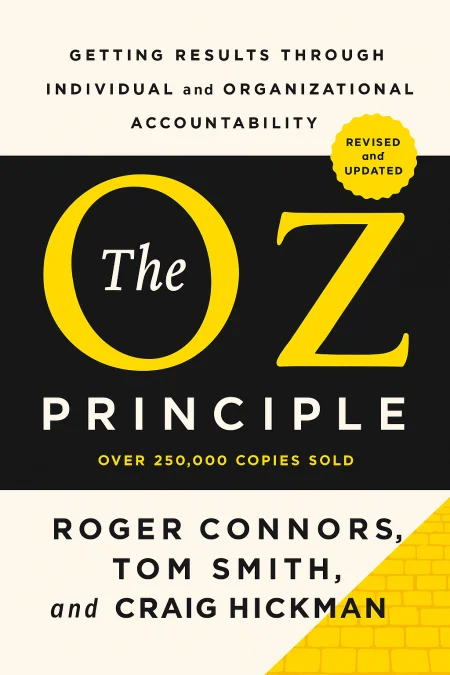
The Oz Principle
Getting Results Through Individual and Organizational Accountability
byRoger Connors, Tom Smith, Craig Hickman
Book Edition Details
Summary
In the whirlwind of the corporate jungle, where the blame game reigns supreme and accountability seems elusive, "The Oz Principle" emerges as a beacon of clarity. Imagine a world where, like Dorothy and her companions, business leaders discover they already possess the tools for success—if only they look inward. This freshly revised edition by Roger Connors, Tom Smith, and Craig Hickman shakes up conventional wisdom with timely tales and updated insights. Casting aside the cloak of victimization, it champions an "Above the Line" mentality, urging professionals to seize responsibility and cultivate leadership through ownership. With its vivid examples and transformative strategies, this book redefines the path to personal and organizational triumph, promising a culture rich in growth and unprecedented results.
Introduction
Every day, millions of people find themselves trapped in cycles of blame, excuses, and powerlessness. They point fingers at circumstances beyond their control, at difficult bosses, at unfair systems, or at bad timing. Yet in organizations around the world, a quiet revolution is taking place. Individuals and teams are discovering that the power to achieve extraordinary results doesn't come from waiting for perfect conditions or magical solutions. It comes from a fundamental shift in perspective—choosing to rise above circumstances and take complete ownership of outcomes. This transformation isn't just about personal responsibility; it's about unlocking the collective potential that exists when everyone moves from victim thinking to accountable action. The journey requires courage to see reality clearly, heart to own your circumstances fully, wisdom to solve problems creatively, and determination to act decisively.
Step Above the Line: See It, Own It, Solve It, Do It
The path to accountability follows four distinct steps that transform how individuals and organizations approach challenges. This journey begins with mustering the courage to acknowledge reality, no matter how uncomfortable that truth might be. Like the Lion in the classic tale, we must face our fears and see situations as they truly are, not as we wish them to be. Consider the experience of Mike Eagle, who found himself struggling as president of a medical instruments company. For months, he blamed external factors for poor performance—claiming his team lacked motivation, that corporate management provided insufficient direction, and that market conditions were unfavorable. His frustration mounted as results continued to disappoint, and he felt increasingly victimized by circumstances beyond his control. The breakthrough came during a conversation with a trusted friend who challenged Mike to examine his own role in the situation. Through honest self-reflection, Mike began to see that he had never fully committed to his new position, maintaining emotional ties to his previous role and keeping potential escape routes open. This recognition was painful but liberating—he finally saw the reality of his circumstances. To implement the "See It" step, start by seeking feedback from trusted colleagues about situations where you feel stuck. Ask yourself what facts you might be avoiding or minimizing. Practice viewing challenges from multiple perspectives, including those of people you might typically blame. Create regular moments for honest self-assessment without the pressure to immediately solve every problem you uncover.
Break Free from the Victim Cycle
The victim cycle represents a dangerous trap that keeps individuals and organizations stuck in patterns of blame, confusion, and inaction. This cycle typically begins with ignoring or denying problems, then progresses through stages of finger-pointing, confusion, and waiting for someone else to solve the issues. Understanding these patterns is crucial for breaking free from their destructive influence. At Strategic Associates, a management consulting firm, the entire organization found itself caught in the victim cycle when facing a severe sales crisis. Rather than taking ownership of the situation, employees blamed management for poor leadership, while management blamed market conditions and employee attitudes. The company president had secretly mortgaged his home to meet payroll, yet the cycle of blame continued to prevent meaningful action. The transformation began when leadership decided to break the pattern by conducting honest interviews with all employees and then sharing the complete truth about the company's financial situation in an all-hands meeting. This radical transparency forced everyone to confront reality and move beyond blame toward collaborative problem-solving. People began asking "What else can we do?" instead of "Who's at fault?" To escape victim thinking, practice recognizing when you're making excuses or blaming others for disappointing outcomes. When you catch yourself in this pattern, pause and ask what role you might have played in creating the current situation. Focus your energy on factors you can influence rather than circumstances beyond your control. Develop the habit of responding to setbacks by immediately asking what actions you can take to improve the situation.
Lead with Accountability and Create Results
Accountable leadership requires more than just personal responsibility—it demands creating environments where others can rise above their circumstances and achieve exceptional results. Effective leaders model accountability while coaching others to move beyond victim thinking toward solution-focused action. David Glass, former CEO of Wal-Mart, exemplified this approach through his relentless focus on results and continuous improvement. Rather than accepting excuses for poor performance, Glass spent most of his time in stores, asking questions and coaching employees to find better ways to serve customers. His leadership style created a culture where everyone felt responsible for the company's success, leading to unprecedented growth and profitability. Glass understood that sustainable results come from empowering others to take ownership of outcomes. He implemented practices like the "Sundown Rule," which required same-day response to requests and problems. This created urgency while demonstrating that accountability starts at the top and cascades throughout the organization. To lead with accountability, begin by modeling the behavior you want to see in others. When problems arise, focus discussions on solutions rather than blame. Ask team members what they can do differently to improve results, and provide coaching rather than criticism when performance falls short. Create regular opportunities for people to report on progress and celebrate both individual and collective achievements.
Transform Your Organization Through Collective Ownership
Creating organizational accountability requires systematic effort to embed ownership thinking into every aspect of company culture. This transformation goes beyond individual behavior change to encompass training, coaching, measurement systems, and reward structures that reinforce accountable actions. Johnson Controls' mid-Atlantic division faced declining market share, customer dissatisfaction, and internal dysfunction as departments worked in silos rather than collaborating effectively. Each function focused on protecting its own interests rather than achieving collective results. The transformation began with comprehensive training that helped everyone understand how victim thinking was undermining performance. The breakthrough came when the organization aligned around three clear objectives: grow 15 percent, become number one in the market, and change the business value proposition. "15, 1, and change" became the mantra that guided every decision and action. Cross-functional teams began working together, sharing information openly, and taking joint ownership of customer outcomes. Within three years, the division doubled its sales, tripled profitability, achieved record customer satisfaction levels, and reduced employee turnover to its lowest point in years. This transformation occurred because everyone learned to ask "What else can we do to get the results we want?" rather than making excuses or blaming other departments. Build organizational accountability by training everyone to recognize victim thinking and understand the four steps to accountability. Establish clear measures and regular reporting that focuses on results rather than activities. Create reward systems that recognize collaborative problem-solving and celebrate people who take initiative to overcome obstacles. Most importantly, ensure that leaders at every level consistently model accountable behavior and coach others to do the same.
Summary
The power to achieve extraordinary results lies not in waiting for perfect conditions or magical solutions, but in choosing to rise above circumstances through complete ownership of outcomes. As the journey reveals, "Accountability is a personal choice to rise above one's circumstances and demonstrate the ownership necessary for achieving desired results." This transformation begins with individual commitment but reaches its full potential when entire organizations embrace collective ownership. The most successful people and companies understand that while they cannot control every circumstance they face, they can always control their response to those circumstances. Start today by asking yourself one simple question: "What else can I do to rise above my current circumstances and achieve the results I truly want?" Then take action, knowing that every step forward builds momentum toward the breakthrough you seek.
Related Books
Download PDF & EPUB
To save this Black List summary for later, download the free PDF and EPUB. You can print it out, or read offline at your convenience.
By Roger Connors
