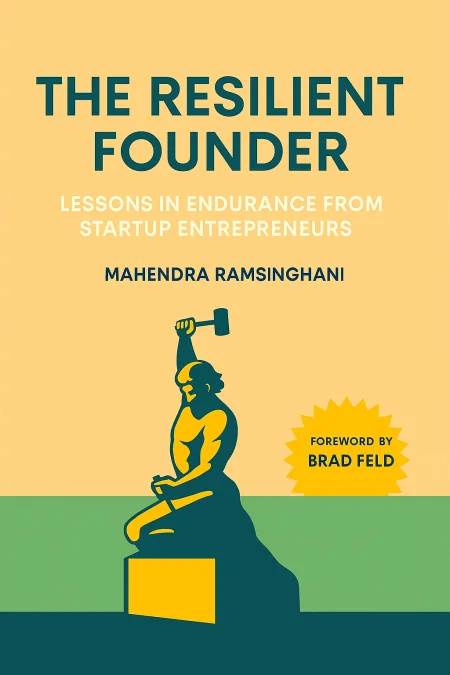
The Resilient Founder
Lessons in Endurance from Startup Entrepreneurs
Book Edition Details
Summary
In the high-stakes arena of entrepreneurship, the true challenge lies not in the external battles but within the depths of the founder's own psyche. Mahendra Ramsinghani's "The Resilient Founder" peels back the layers of the entrepreneurial mind, revealing the turbulent psychological landscape navigated by today’s startup leaders. Drawing on candid insights from over a hundred trailblazers, this book serves as a compass for those wrestling with the relentless pressures of rapid growth, financial expectations, and the emotional roller coaster of leadership. It’s a raw exploration of the loneliness, anxiety, and unseen struggles that haunt even the most successful, offering profound strategies to build resilience from within. Infused with philosophy, poetry, and real-world case studies, Ramsinghani crafts a guide not just for survival, but for thriving in the storm's eye. For founders, CEOs, and visionaries on the brink of burnout, this isn't just a book—it's a lifeline.
Introduction
The entrepreneurial journey presents a paradox that few dare to examine closely. While society celebrates the bold innovators who "think different" and "move fast and break things," it remains largely silent about the psychological toll of this relentless pursuit. The modern startup ecosystem demands cognitive dissonance from its participants—rational individuals attempting fundamentally irrational acts of world-changing disruption, often at tremendous personal cost. This exploration challenges the prevailing narrative that treats mental health struggles as peripheral concerns rather than central features of the entrepreneurial experience. The analysis reveals how founders systematically sacrifice their psychological well-being in service of growth metrics and valuations, creating a culture where burnout becomes a badge of honor and depression lurks beneath every "crushing it" conversation. By examining the intersection of ego development, desire management, and belief systems in high-pressure environments, we uncover the mechanisms through which external market forces penetrate and reshape internal psychological landscapes. The investigation employs a multi-layered approach, drawing from depth psychology, organizational behavior, and first-hand founder testimonies to construct a framework for understanding psychological capital as a measurable and developable resource. Through this lens, readers will traverse the complex terrain where individual psychology meets systemic pressures, discovering how the very traits that enable entrepreneurial success can become vectors for psychological distress when left unexamined and unmanaged.
The Hidden Crisis: Depression and Suicide Among Entrepreneurs
Silicon Valley's mythology of invincible founders masks a darker reality where success and despair often coexist in uncomfortable proximity. Statistical evidence reveals that entrepreneurial environments create perfect conditions for psychological distress—chronic uncertainty, social isolation, and identity fusion with company outcomes form a toxic constellation that traditional mental health frameworks struggle to address. The entrepreneurial personality, characterized by high achievement orientation and vulnerable ego structures, proves particularly susceptible to what researchers term "depression contagion" within startup ecosystems. The phenomenon extends beyond individual pathology to reveal systemic failures in how innovation communities support their most vulnerable members. Case studies demonstrate that founders experiencing suicidal ideation often maintain peak performance facades right up to their breaking points, suggesting that conventional warning signs prove inadequate in entrepreneurial contexts. The research illuminates how the "move fast and break things" mentality inadvertently normalizes psychological breaking points as acceptable casualties of disruption. Most significantly, the analysis exposes how the entrepreneurial community's response to mental health crises often mirrors its approach to technical problems—seeking quick fixes and scalable solutions rather than acknowledging the irreducibly personal nature of psychological distress. The suicide prevention framework proposed here recognizes that entrepreneurial depression operates according to different temporal and social dynamics than clinical depression, requiring specialized intervention strategies. The evidence suggests that addressing this crisis requires fundamental shifts in how startup ecosystems measure success, structure support systems, and conceptualize the relationship between personal well-being and professional achievement. Without these changes, the innovation economy will continue consuming its most creative minds at an unsustainable rate.
Building Psychological Quotient: Understanding the Founder's Mind
Traditional intelligence metrics—IQ and EQ—prove insufficient for capturing the unique psychological demands of entrepreneurial leadership. The concept of Psychological Quotient (PsyQ) emerges as a framework for understanding how founders can develop awareness and mastery of their internal resources under extreme external pressure. This psychological capital encompasses four critical domains: impulse regulation, adaptive capacity, self-perception calibration, and worldview flexibility. The founder's mind operates as a complex system balancing competing forces—what classical psychology identifies as the dynamic tension between id (desires), ego (executive function), and superego (ethical constraints). Unlike conventional business leadership, entrepreneurial success requires maintaining this balance while simultaneously challenging existing market structures and social norms. The research reveals how successful founders develop what might be termed "constructive cognitive dissonance"—the ability to hold contradictory beliefs about market realities without psychological fragmentation. Neurological evidence supports the notion that entrepreneurial cognition differs fundamentally from corporate management thinking. Founder brains show heightened activity in pattern recognition centers while simultaneously suppressing risk-aversion mechanisms that would normally inhibit ambitious ventures. This neurological profile creates both competitive advantages and psychological vulnerabilities that traditional business education fails to address. The PsyQ framework provides diagnostic tools for assessing psychological readiness for entrepreneurial challenges. Unlike personality tests that categorize static traits, PsyQ measures dynamic capabilities—how quickly founders recover from setbacks, adapt worldviews to new information, and maintain identity coherence during rapid scaling phases. These measurements prove predictive of both venture success and founder well-being outcomes, suggesting that psychological capital development should be prioritized alongside technical and market expertise in entrepreneurial preparation programs.
The Therapy Debate: Professional Help vs. Self-Care Strategies
The entrepreneurial community's relationship with psychotherapy reflects broader cultural tensions between self-reliance mythology and professional mental health intervention. Founders often resist therapeutic support due to deeply held beliefs about weakness, control, and the incompatibility of vulnerability with leadership effectiveness. This resistance stems partly from legitimate concerns about confidentiality in tight-knit industry networks and partly from misunderstanding therapy's role in high-performance contexts. Contemporary therapeutic approaches show varying effectiveness with entrepreneurial populations. Traditional psychodynamic methods, focused on childhood origins of current patterns, often frustrate action-oriented founders seeking immediate performance improvements. Cognitive-behavioral interventions prove more compatible with entrepreneurial mindsets but may miss deeper systemic issues related to identity, meaning, and purpose that drive entrepreneurial motivation. The most promising approaches integrate executive coaching methodologies with clinical psychological insights, creating hybrid interventions tailored to founder-specific challenges. The self-care movement offers alternative pathways for psychological maintenance, though with mixed results in high-pressure entrepreneurial environments. Meditation, exercise, and stress-reduction techniques provide valuable tools but can become superficial band-aids when applied without deeper understanding of underlying psychological dynamics. The research suggests that effective self-care for founders requires more sophisticated approaches that account for the interconnected nature of personal psychology and business performance. Evidence indicates that the most resilient founders combine professional therapeutic support with disciplined self-care practices, creating integrated approaches to psychological development. This combination proves particularly effective when therapeutic work focuses on developing internal resources rather than simply addressing symptoms or pathology. The timing of intervention matters critically—founders who engage psychological support during growth phases rather than only during crisis periods show significantly better long-term outcomes for both personal well-being and venture success.
Practical Resilience: Tools and Frameworks for Entrepreneurial Recovery
Recovery from entrepreneurial burnout and depression requires specialized approaches that account for the unique pressures and opportunities within startup environments. The framework presented integrates five evidence-based intervention strategies: organized work diminution, somatic awareness practices, emotional intelligence development, spiritual/meaning-making work, and commitment to personal value alignment. Each strategy addresses different aspects of the psychological restoration process while maintaining compatibility with ongoing business responsibilities. The concept of "organized diminution of work" challenges the prevailing "always-on" culture by introducing structured approaches to energy management and priority setting. Rather than promoting work-life balance—an often meaningless concept for founders—this approach teaches sustainable intensity cycling and strategic attention allocation. Founders learn to identify which activities genuinely require their unique contributions versus those that serve primarily ego or anxiety management functions. Somatic practices prove particularly valuable for founder populations who typically operate from predominantly cognitive orientations. Breathing techniques, movement practices, and sensory awareness exercises help restore the mind-body integration that chronic stress and excessive screen time typically fragment. These interventions show measurable impacts on decision-making quality, emotional regulation, and physical health markers within weeks of consistent implementation. The spiritual dimension of recovery addresses questions of meaning and purpose that often underlie entrepreneurial motivation but become obscured during operational focus periods. This work need not involve traditional religious frameworks but rather explores how personal values align with business activities and how individual purpose connects to broader social contribution. Founders who successfully integrate meaning-making practices into recovery show lower recurrence rates of depressive episodes and higher satisfaction with entrepreneurial lifestyle choices. Long-term resilience depends on developing what researchers term "antifragile" psychological systems—internal resources that grow stronger under stress rather than merely surviving it. This requires moving beyond crisis management toward proactive psychological capital development, treating mental health as a core business competency rather than peripheral concern.
Summary
The entrepreneurial mental health crisis represents more than individual pathology—it reveals fundamental misalignments between human psychological architecture and the demands of contemporary innovation culture. The frameworks and interventions explored here demonstrate that founder well-being and venture success need not exist in zero-sum relationships when approached with adequate sophistication and commitment. The development of Psychological Quotient as a measurable and trainable capacity offers pathways for creating more sustainable approaches to high-impact entrepreneurship. Most critically, this analysis suggests that addressing mental health challenges in entrepreneurial contexts requires moving beyond medical models toward integrated approaches that honor both individual psychological complexity and the legitimate demands of world-changing work. The future of innovation depends not just on brilliant minds but on sustainable systems for nurturing and protecting the psychological resources that drive creative disruption.
Related Books
Download PDF & EPUB
To save this Black List summary for later, download the free PDF and EPUB. You can print it out, or read offline at your convenience.
By Mahendra Ramsinghani
