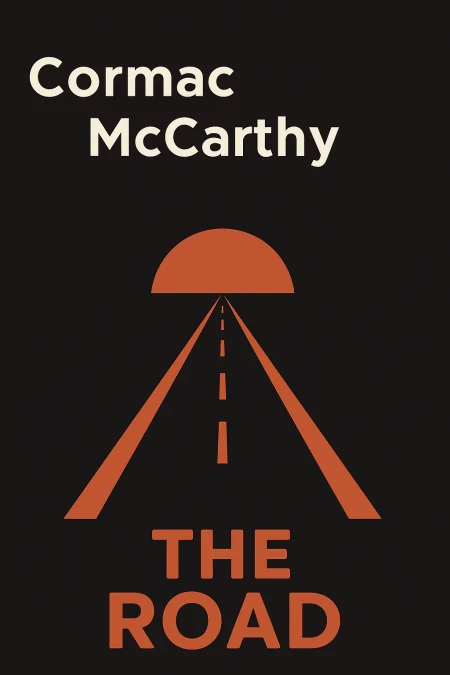
The Road
A Haunting Odyssey Through a Post-Apocalyptic World
Book Edition Details
Summary
In a desolate realm where the very earth seems to whisper of despair, a father and his son trek through the ghostly remnants of what once was America. With each step, they navigate a canvas painted in shades of ash and shadow, their fragile hope flickering like a distant star. As they journey towards an uncertain coast, clutching a scant armory of love and a lone pistol, they confront not just the savage bands that roam the ruins, but the haunting specters of human nature itself. Cormac McCarthy's "The Road" transcends mere dystopian narrative, delivering a haunting exploration of resilience and the enduring bond between parent and child amid the echoes of a world unmade.
Introduction
In the gray dawn of a world stripped bare, where ash falls like snow and silence reigns supreme, two figures emerge from the wasteland—a father and his son, pushing a shopping cart down empty highways toward an uncertain salvation. This haunting vision forces us to confront fundamental questions about human nature when all social structures collapse. What drives us to continue when hope seems extinguished? How do we preserve goodness and humanity when survival demands brutal choices? What does it truly mean to "carry the fire" of civilization? The story reveals profound truths about resilience, moral courage, and the bonds that sustain us through darkness. Through intimate moments of tenderness amid desolation, we discover how love transcends even the most desperate circumstances. This tale speaks to anyone who has faced overwhelming challenges, questioned their moral compass, or wondered about humanity's capacity for both cruelty and compassion. It offers insights into parenting under pressure, finding meaning in meaningless times, and understanding what values are worth preserving when everything else has fallen away.
The Great Collapse: When Civilization Ended in Fire and Ash
The world ended not with fanfare but with fire, leaving behind a landscape where nothing grows and the sun struggles to penetrate the permanent shroud of ash. This catastrophic event, never fully explained, serves as more than mere backdrop—it represents the ultimate stress test of human civilization. In those first terrible moments when the clocks stopped at 1:17, we witness how quickly the foundations of modern life crumble. Cities burn, governments vanish, and the complex web of relationships that once held society together dissolves into chaos. The collapse reveals uncomfortable truths about human nature under extreme pressure. When food becomes scarce and law enforcement disappears, neighbors become threats and strangers become potential meals. The emergence of cannibalistic cults and roving bands of raiders shows how thin the veneer of civilization truly is. Yet this darkness makes the light more precious—those who maintain their humanity despite overwhelming temptation become beacons of hope. What drives some to preserve their moral compass while others abandon it entirely? The catastrophe strips away everything superficial, revealing who people truly are beneath their social masks. Some choose to "carry the fire" of human decency, while others surrender to the beast within. This fundamental choice becomes the defining characteristic of the new world. The great collapse teaches us that civilization is not buildings or technology, but the daily choice to treat others with dignity despite personal cost. When external structures fail, internal moral frameworks become the only barriers between order and chaos, between humanity and savagery.
Surviving the Wasteland: Father and Son Against a Dead World
In the ash-covered years following the collapse, survival becomes both a physical and spiritual battle. The man and boy traverse a landscape where every decision carries life-or-death consequences. Their daily routine of scavenging, hiding, and moving south reveals how quickly human beings can adapt to unimaginable circumstances. Yet adaptation comes at a cost—constant vigilance, perpetual fear, and the gradual erosion of the innocence that once defined childhood. The relationship between father and son becomes the emotional center of their survival story. The man carries the crushing burden of protecting his child while teaching him to navigate a world where kindness can be fatal weakness. He must balance brutal honesty about their circumstances with nurturing the boy's capacity for goodness. Their conversations about being "good guys" versus "bad guys" highlight the difficulty of maintaining moral clarity when survival depends on making hard choices. The boy emerges as the moral compass of their journey, often challenging his father's decisions when they conflict with basic human decency. His innocent questions cut to the heart of ethical dilemmas that have no easy answers. When they encounter the dying man on the road, or when they must reclaim their stolen supplies, the boy's responses reveal an intuitive understanding of right and wrong that adult pragmatism often obscures. Their survival strategy involves more than finding food and shelter—it requires preserving the "fire" of human compassion in a world that punishes such virtues. This internal struggle proves more challenging than the physical hardships they endure, as maintaining humanity requires constant acts of faith in the face of overwhelming evidence of human cruelty.
The Final March: Reaching the Coast and Finding Hope
The journey toward the coast represents more than geographic movement—it becomes a pilgrimage toward the possibility of renewal. As they near their destination, both physical and emotional exhaustion threaten to overwhelm them. The man's declining health adds urgency to their mission while forcing difficult conversations about mortality and legacy. The boy must gradually accept greater responsibility as his father weakens, preparing for the inevitable moment when he will face the world alone. Their arrival at the gray, lifeless ocean delivers a crushing blow to hopes of finding a tropical paradise. The sea stretches endlessly under the same ashen sky, offering no immediate salvation or escape. Yet this apparent defeat becomes a moment of profound acceptance. The boy's simple swim in the freezing water becomes an act of pure joy, a celebration of being alive despite everything. These moments of grace punctuate the narrative, showing how beauty and meaning can emerge even from desolation. The discovery of the boat and its supplies provides temporary reprieve, but also highlights the temporary nature of all worldly solutions. Material resources can extend life, but they cannot address the deeper questions of purpose and meaning that drive the human spirit. The man's growing certainty that he will not survive the journey forces him to focus on what he can pass to his son beyond mere survival skills. When the inevitable moment arrives and the boy must choose whether to trust the strangers who find him, he faces his first independent moral decision. His choice to go with the family who claims to "carry the fire" represents a leap of faith that his father's teaching about goodness and trust was not naive optimism but hard-won wisdom. The boy's willingness to believe in the possibility of good people validates everything his father tried to preserve.
Summary
The central tension driving this narrative lies between hope and despair, between the human capacity for both transcendent goodness and unimaginable cruelty. In a world stripped of all pretense, we discover that love and moral courage are not luxuries but necessities—the very qualities that make survival worthwhile. The story demonstrates that carrying the fire of human decency requires constant choice and sacrifice, but represents the only path toward meaningful existence. The wasteland serves as a mirror for our own world, where moral challenges may be less dramatic but equally demanding. We face daily decisions about whether to prioritize personal advantage or collective welfare, whether to respond to threats with violence or compassion, whether to surrender to cynicism or maintain faith in human goodness. The father's dedication to raising his son with intact moral instincts offers a template for nurturing resilience and ethical clarity in any challenging environment. His example teaches us that the most important inheritance we can leave is not material wealth but the capacity to choose goodness despite personal cost, to extend trust despite betrayal, and to carry forward the best of human nature even when surrounded by the worst.
Related Books
Download PDF & EPUB
To save this Black List summary for later, download the free PDF and EPUB. You can print it out, or read offline at your convenience.
By Cormac McCarthy
